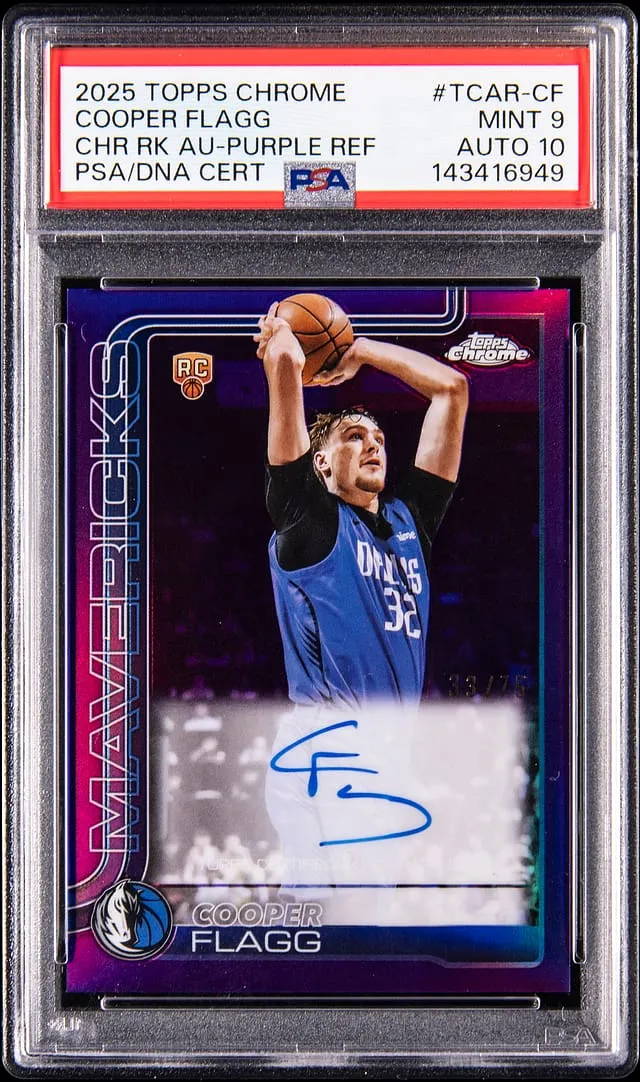
Cooper Flagg Purple Chrome Rookie Auto /75 Sells for $12K
Goldin sold a 2025-26 Topps Chrome Cooper Flagg Purple Rookie Auto /75 PSA 9, auto 10 for $12,200. See what this means for modern basketball collectors.
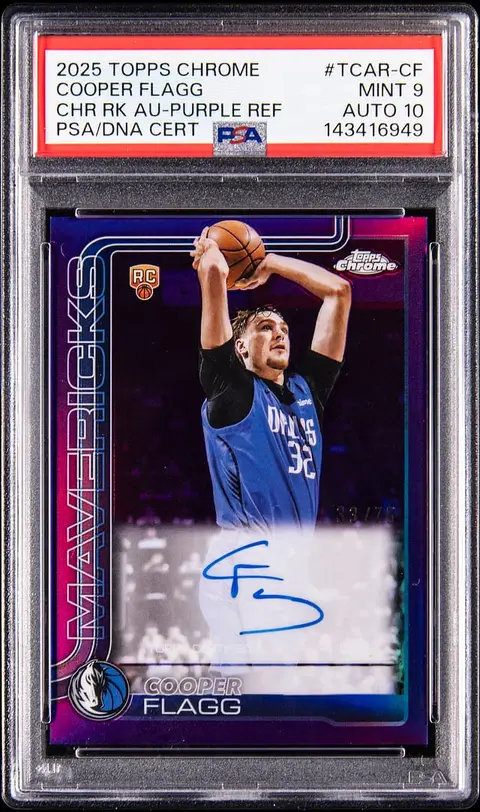
Sold Card
2025-26 Topps Chrome Rookie Autographs Purple Refractor #TCAR-CF Cooper Flagg Signed Rookie Card (#33/75) - PSA MINT 9, PSA/DNA GEM MT 10
Sale Price
Platform
Goldin2025-26 Topps Chrome Cooper Flagg Purple Auto /75 Sells for $12,200
On June 7, 2026, Goldin closed a modern-basketball sale that a lot of prospecting collectors have been watching closely: a 2025-26 Topps Chrome Rookie Autographs Purple Refractor #TCAR-CF Cooper Flagg, serial-numbered 33/75, graded PSA MINT 9 with a PSA/DNA GEM MT 10 autograph. The final price was $12,200.
For an ultra-modern (very recent) basketball rookie, this is an important data point for both Flagg collectors and anyone trying to understand where high-end, non-1-of-1 rookie autos are settling in today’s market.
Card overview: what exactly sold?
Here’s how this card breaks down:
- Player: Cooper Flagg
- Season/Year: 2025-26
- Product: Topps Chrome
- Subset: Rookie Autographs
- Parallel: Purple Refractor
- Card number: #TCAR-CF
- Serial numbering: 33/75 (only 75 copies of this parallel were produced)
- Rookie card: Yes – this is a signed rookie from a core chromium product, treated as a key early card.
- Autograph: On-card (signed directly on the card surface, not on a sticker)
- Grading: PSA MINT 9 for the card, PSA/DNA GEM MT 10 for the autograph
For modern collectors, an on-card rookie autograph from a chromium (Chrome/Prizm/Optic-style) set is a foundational chase. The Purple Refractor sits in the colored parallel ladder as a low-serial, visually distinct version that tends to attract both player collectors and investors in the broader prospecting segment of the hobby.
Why this card matters for Cooper Flagg collectors
Cooper Flagg has been one of the most discussed basketball prospects in recent years. In hobby terms, that usually translates into:
- Strong demand for first-wave, pack-issued rookie autographs, especially from recognizable brands.
- A premium for low-serial parallels like this Purple /75, which strike a balance between true scarcity and being available enough to generate consistent sales data.
This card checks several boxes that experienced collectors look for:
Recognizable brand and format
Topps Chrome is a long-running chromium line and is treated as a flagship-style release when it comes to shiny, pack-pulled rookies. Having Flagg’s on-card rookie autograph in this set gives the card long-term visibility in checklists and player PCs (personal collections).Meaningful serial numbering
At /75, the Purple Refractor is not a super-short print like a /10 or /5, but it is firmly in the “low-numbered” category. That typically supports a tighter supply of high-grade copies and makes clean, graded examples more contested when they hit auction.High-end grading combo
- PSA 9 (MINT): For ultra-modern chromium cards, many collectors aim for PSA 10s, but a strong PSA 9 still carries significant weight, especially when surfaces, edges, and centering are clean.
- PSA/DNA 10 for the auto: This indicates PSA judged the autograph itself to be gem mint—bold, clean, and well placed—with no substantial streaking or fading.
Taken together, it’s a premium version of an early, on-card Cooper Flagg auto from a widely recognized line.
Market context: where does $12,200 sit?
At the time of writing, public data on this specific serial/grade combination is limited, simply because:
- 75 copies exist in total, across all conditions.
- Only a portion of those will be graded, and even fewer will be PSA 9s with a 10 auto.
- Early in a card’s life cycle, many copies sit in collections or unopened wax, so the number of auction appearances is naturally low.
Looking across related sales and comps ("comps" meaning comparable recent sales used to benchmark value):
- Base Rookie Autographs (non-numbered, PSA 9 or raw): These typically sell for a fraction of this Purple /75 price. That reflects the much larger print run, more condition issues, and less collector focus compared to low-numbered color.
- Other colored Refractors of Flagg rookie autos (e.g., /99, /150, or different color tiers): These tend to form a rough pricing ladder where lower serials and more visually desirable colors command higher prices. The Purple /75 usually lands in the upper-middle of that ladder: more scarce and desirable than higher-numbered color, but more attainable than golds, oranges, or 1-of-1s.
- Higher-end parallels (e.g., /25, /10, 1/1): Some of those sales have reached significantly higher levels when they appear at major auction houses, but they are not direct comps—scarcity and perceived prestige are materially different.
Within that context, $12,200 for a PSA 9, auto 10 Purple /75 at a major house like Goldin signals that the market is willing to assign meaningful value to a non-super-short-print Flagg rookie autograph parallel. It sits below the likely range for his very best, ultra-low-number parallels, but well above mass-issue rookie autos.
Because the card and rookie class are still very new, the market is in price discovery mode—figuring out where buyers and sellers are comfortable. One or two sales won’t define a long-term “true value,” but they establish anchor points that future buyers and sellers will refer to when negotiating.
Condition, population, and why PSA 9 matters
When collectors talk about “pop” or “pop report”, they’re referring to the population report: how many copies a grading company has recorded at each grade level.
For a newly released, low-serial card like this, population reports can change quickly as more cards are submitted. However, a few patterns usually hold:
- PSA 10s are relatively scarce, especially on colored refractors with full-bleed or dark-color designs where minor print lines and edge micro-chipping are more visible.
- PSA 9s become the workhorse grade: widely collected, more available than 10s, and often priced in a band that feels more approachable to a broader base of collectors.
A PSA 9 Purple /75 with an auto-grade 10 sits in a sweet spot: clearly premium, but not as cost-barriered as the top of the pyramid.
How this sale fits in the broader modern market
Modern and ultra-modern basketball have gone through a few clear phases over the last decade:
- A run-up in values for star rookies and color parallels.
- A correction that forced collectors to become more selective, focusing on staples: true rookies, on-card autos, low-serial color, and iconic sets.
- A more data-aware environment where buyers regularly reference comps, pop reports, and auction outcomes before bidding.
This Cooper Flagg sale fits the current pattern well:
- It is a numbered, on-card rookie autograph from a mainstream chromium product.
- It sold at a respected auction house (Goldin) with strong visibility.
- The final price of $12,200 reflects that collectors are distinguishing between mass-produced rookie content and genuinely scarce rookie autos with grading and brand support.
Instead of speculation-driven spikes, the market is increasingly anchored by what similar cards of comparably hyped players have done over time. This doesn’t eliminate volatility—especially for a young prospect—but it does mean that each public sale like this contributes to a more informed picture.
What collectors can take away from this result
If you are a Cooper Flagg collector, a modern basketball fan, or a small seller trying to navigate pricing, here are some practical observations:
Tier your expectations by parallel and numbering
Not all rookie autos are created equal. Non-numbered, sticker, or mass-issue autographs tend to live in a very different price band than low-serial color like this Purple /75. When looking at comps, always match:- Player
- Set and subset
- Parallel and serial number
- Grading and autograph grade
Use high-visibility auction results as reference points, not guarantees
A Goldin sale on June 7, 2026 at $12,200 is a strong reference point, but not a promise that the next copy will land at the same number. Timing, seasonality, performance, and supply all matter.Pay attention to grading patterns
If PSA 10s of this card prove to be very scarce, PSA 9s may end up being the main way most collectors access the premium versions. Watching how 9 vs. 10 pricing spreads evolve over time can help you understand where the market is settling.Separate player outlook from card selection
Even if you are confident in a player’s long-term potential, the specific card you choose still matters. A flagship-style, on-card, low-serial rookie auto has historically held collector interest better than fringe inserts or unnumbered parallels.
Final thoughts
The 2025-26 Topps Chrome Rookie Autographs Purple Refractor #TCAR-CF Cooper Flagg, serial-numbered 33/75 and graded PSA MINT 9 with a PSA/DNA GEM MT 10 autograph, closing at $12,200 at Goldin on June 7, 2026, is a meaningful early marker for Flagg’s high-end rookie market.
It reinforces a few themes:
- Collectors continue to prioritize on-card, low-numbered rookie autographs from recognizable chromium sets.
- Even in a more measured market, there is room for strong prices when scarcity, brand, and grading quality line up.
- For emerging stars, each high-profile auction sale becomes part of the reference library that future buyers and sellers will lean on when making decisions.
For figoca users and hobbyists tracking Cooper Flagg or modern basketball more broadly, this sale is worth bookmarking—not as a promise of what comes next, but as a clear snapshot of how the market is currently valuing one of his key early cards.