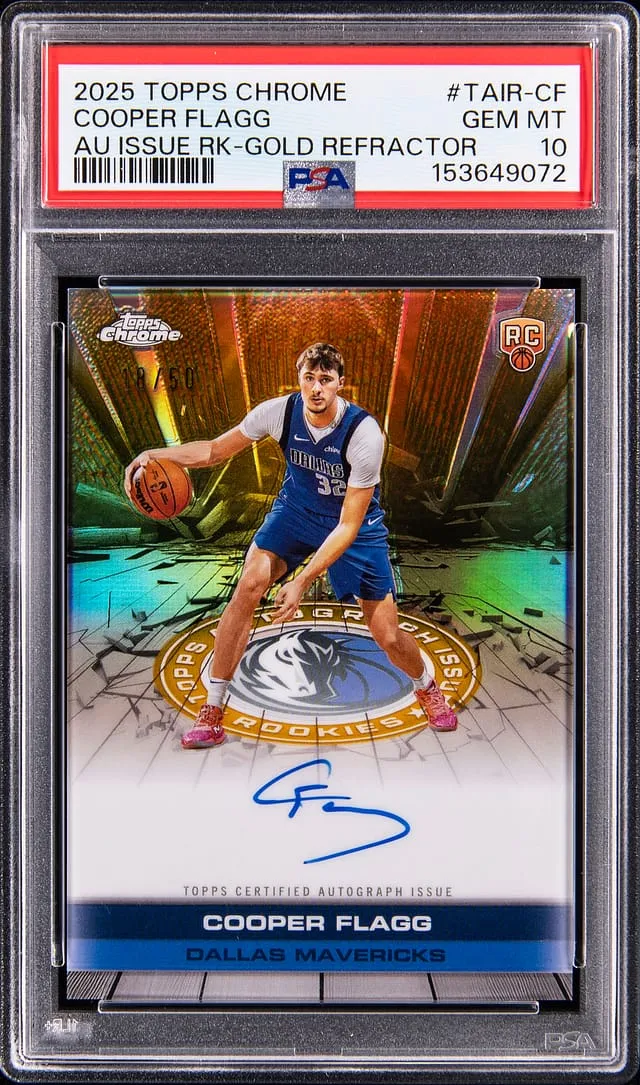
Cooper Flagg Gold Chrome Auto PSA 10 sells for $12K
Deep dive on the $12,444 Goldin sale of a 2025-26 Topps Chrome Cooper Flagg Gold Refractor rookie autograph, serial numbered /50 and graded PSA 10.
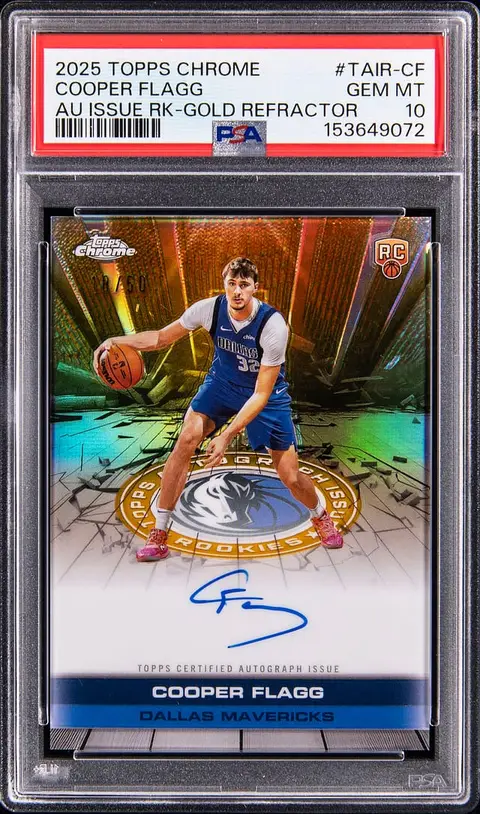
Sold Card
2025-26 Topps Chrome Autograph Issue Rookies Gold Refractor #TAIR-CF Cooper Flagg Signed Rookie Card (#18/50) - PSA GEM MT 10
Sale Price
Platform
Goldin2025-26 Topps Chrome Autograph Issue Rookies Gold Refractor #TAIR-CF Cooper Flagg Signed Rookie Card (#18/50) - PSA GEM MT 10 Sells for $12,444
On April 24, 2026, Goldin sold a key early Cooper Flagg card that many modern basketball collectors are watching closely:
2025-26 Topps Chrome Autograph Issue Rookies Gold Refractor #TAIR-CF Cooper Flagg Signed Rookie Card (#18/50) – PSA GEM MT 10
- Player: Cooper Flagg
- Year: 2025-26
- Set: Topps Chrome Autograph Issue Rookies
- Card number: TAIR-CF
- Parallel: Gold Refractor, serial numbered 18/50
- Autograph: Certified Topps autograph (sticker or on-card, depending on final production), rookie-year issue
- Grading company: PSA
- Grade: GEM MT 10 (PSA’s highest standard numeric grade)
- Auction house: Goldin
- Sale date: 2026-04-24 (UTC)
- Final price: $12,444
While 2025-26 basketball products are still very new, this sale offers an early signal of how the market is valuing Flagg’s top Chrome autograph parallels in gem-mint condition.
Why this Cooper Flagg card matters
Early key issue for a headline prospect
Cooper Flagg is one of the most heavily discussed prospects of the current era, with expectations that place him in the same general conversation as past top overall picks and generational prospects. For modern basketball collectors, his first mainstream, licensed, pack-pulled autograph rookies are likely to define his long-term card market.
This card checks several boxes that hobbyists typically look for in a modern centerpiece:
- Rookie-year autograph: It is part of the Autograph Issue Rookies subset in Topps Chrome, clearly positioned as a rookie autograph line.
- Recognizable chromium brand: Topps Chrome is one of the most familiar names in sports cards, especially for those coming from baseball and soccer into basketball.
- Gold Refractor parallel: Gold out of 50 has become a widely accepted “benchmark” color in modern refractor-based sets. It’s low-serial, visible, and easy for collectors to understand.
- PSA GEM MT 10 grade: In ultra-modern cards, a PSA 10 is often treated as the default target grade for long-term holding and premium pricing.
Put simply, this is the kind of card that often ends up on player-focused “PC” (personal collection) lists or as a target for long-term Flagg believers once the market matures.
Understanding the card’s attributes
Gold Refractor /50
A Gold Refractor is a colored, shiny parallel of the base autograph card. In this case it is serial numbered 18/50, meaning only 50 copies of this specific Gold Refractor version were produced.
In modern basketball:
- Gold (often /50) is widely viewed as a core color parallel, not as rare as /10 or 1/1, but significantly more limited than base or unnumbered refractors.
- Collectors frequently use gold pricing to gauge where /25, /10, and 1/1 versions might land.
PSA GEM MT 10
PSA’s GEM MT 10 is its highest standard numeric grade. For ultra-modern chromium cards, collectors typically expect a relatively high percentage of PSA 10s, but they still command a clear premium over PSA 9 and raw (ungraded) copies.
When you see a price quoted for a top-tier modern parallel, it is usually the PSA 10 that sets the headline.
Market context and price comparisons
The Goldin result of $12,444 for this PSA 10 Gold Refractor sits in a market that is still forming around 2025-26 Flagg cards. Because we are very early in the release cycle, detailed long-term data is still limited. Instead of definitive conclusions, it is more useful to think in terms of early indicators.
Here is how to frame this sale:
1. Ultra-modern rookie auto, premium color
In the ultra-modern era (roughly 2018 onward), collectors have converged on a hierarchy for chromium rookies:
- Flagship or near-flagship brand (here, Topps Chrome).
- Autograph version.
- Shorter-printed color parallels (gold, orange, red, etc.).
- PSA 10 or an equivalent high grade.
This card lands in a premium but not absolute top tier lane: it is not a 1/1 or /10, but it is a key color parallel from a recognizable line, and the sale confirms that the market is already willing to pay five-figure prices for Flagg’s better Chrome autographs.
2. Relationship to other Flagg autographs and parallels
Because product releases and grading are staggered, recent sales data across marketplaces may show:
- A mix of ungraded and PSA 9/10 copies of less-scarce parallels (base autographs, standard refractors, possibly /199 or /149 color).
- Early movement on lower serial-numbered Flagg autographs (for example, /25 or /10) in various brands.
In that developing environment, a PSA 10 Gold /50 closing at $12,444 suggests:
- The market is assigning meaningful value to numbered Chrome Flagg autos, not just chasing one-off 1/1s.
- There is already a clear separation between Gold /50 and more common, unnumbered or higher-numbered versions.
Exact comp numbers will continue to shift quickly as more copies are pulled, graded, and sold, so this result is best read as an early benchmark rather than a long-term anchor.
3. Not a record, but an early highlight
At this stage, record prices for Flagg are more likely to come from:
- 1/1 super-premium issues.
- The very first or most publicized early sales.
- Future flagship rookie cards from whichever brand ultimately becomes his main licensed home once he is established in the league.
This specific sale does not need to be an all-time record to matter. Its significance is that a numbered Chrome rookie autograph in PSA 10 has already found a five-figure buyer via a major auction house.
Why collectors care about this sale
1. Signaling early demand
When an auction house like Goldin sells a card like this at $12,444 on April 24, 2026, it provides a public datapoint. Collectors often refer to these as “comps”, short for “comparables” – recent, similar sales used to understand current market ranges.
While this single auction does not define value, it shows:
- There is serious, real-money interest in Flagg’s premium rookie autographs.
- Buyers are willing to differentiate by color and grade, not just by player name.
2. A reference point for small sellers and flippers
For smaller sellers and hobbyists who open boxes or participate in breaks:
- If you hit a Cooper Flagg Chrome autograph (especially numbered), this sale offers a reference point when considering grading or deciding how to price.
- For those holding raw or PSA 9 copies, the gap to a PSA 10 Gold /50 signals how strongly the market rewards top condition plus strong color.
Again, this is not a guarantee that any single card will reach similar numbers; it simply shows how the market has treated one of the better examples to surface early.
3. A snapshot of ultra-modern behavior
This transaction also reflects broader ultra-modern patterns:
- Prospect-driven pricing: High expectations for a player can translate into strong prices well before long-term on-court results are known.
- Parallel hierarchy: Collectors clearly distinguish between standard autographs and scarcer, visually distinct parallels.
- Grading premium: A PSA 10 is increasingly treated as the default target for high-end modern cards, and buyers pay accordingly.
How to think about a card like this in your own collecting
This is not financial advice, but there are a few practical takeaways for collectors and small sellers:
1. Understand the ladder: base, color, and numbering
Topps Chrome and similar sets usually create a ladder of scarcity:
- Base rookie autograph (most common).
- Unnumbered refractors or mild color.
- Numbered color parallels like Gold /50.
- Lower serial-numbered colors (/25, /10) and 1/1s.
Knowing where your card falls on that ladder helps you interpret comps and not over- or under-estimate value.
2. Learn how condition translates into price
In ultra-modern cards, small surface flaws, print lines, or soft corners can create a large price gap between PSA 9 and PSA 10.
If you pull or buy a card like this raw:
- Look closely at centering, edges, and surface before submitting to grading.
- Consider the cost and turnaround time of grading relative to recent PSA 10 vs. raw sale gaps.
3. Use comps as a guide, not a promise
Public sales like this Goldin auction create a trail of comps. They are data points, not guarantees.
- Market interest can shift with player performance, injuries, team changes, and broader hobby sentiment.
- Supply can increase as more copies are graded and listed, especially in the months following a product’s release.
A single strong result is useful, but it is most informative when viewed alongside multiple other sales over time.
Final thoughts
The sale of the 2025-26 Topps Chrome Autograph Issue Rookies Gold Refractor #TAIR-CF Cooper Flagg Signed Rookie Card (#18/50) – PSA GEM MT 10 for $12,444 at Goldin on April 24, 2026 is a noteworthy early marker for Flagg’s high-end rookie autograph market.
It confirms that:
- Collectors are already treating Cooper Flagg’s premium, low-serial Chrome autographs as serious centerpieces.
- Color, numbering, and a top PSA grade all combine to create a meaningful premium in ultra-modern basketball.
- Even while the broader checklist and future performance story are still taking shape, the hobby is willing to assign significant value to his earliest top-tier issues.
For newcomers and returning collectors, watching cards like this can help you learn how modern prospects are valued – and how brand, parallel, and grade all interact in today’s basketball card market.