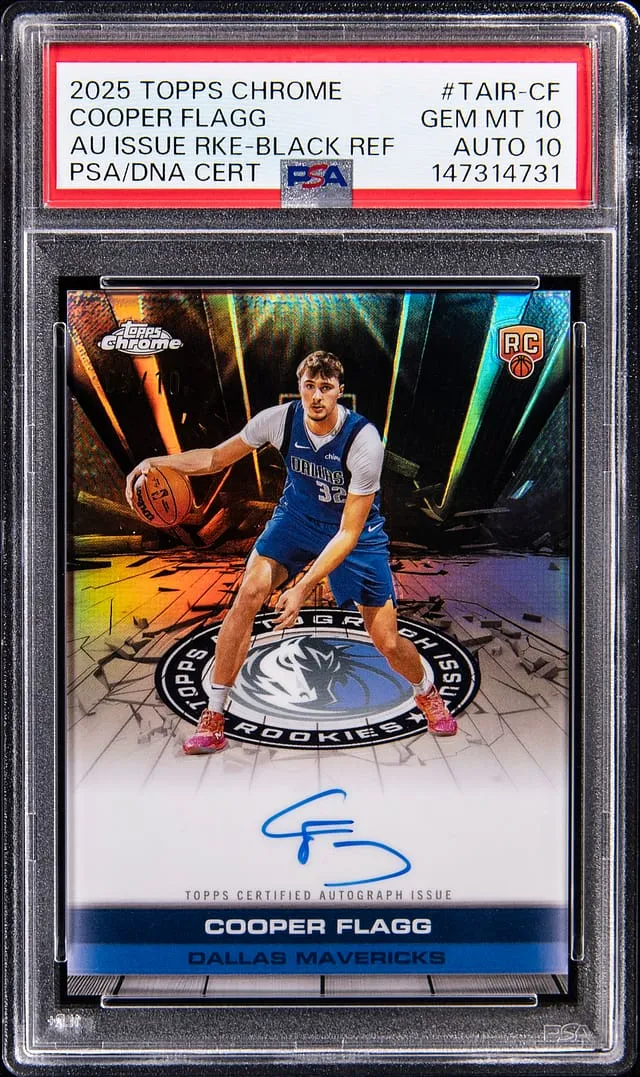
Cooper Flagg Black Refractor Auto /10 Sells for $21K
Goldin sells a 2025-26 Topps Chrome Cooper Flagg Black Refractor Auto /10 PSA 10 for $21,960. A key early marker for his ultra-modern market.
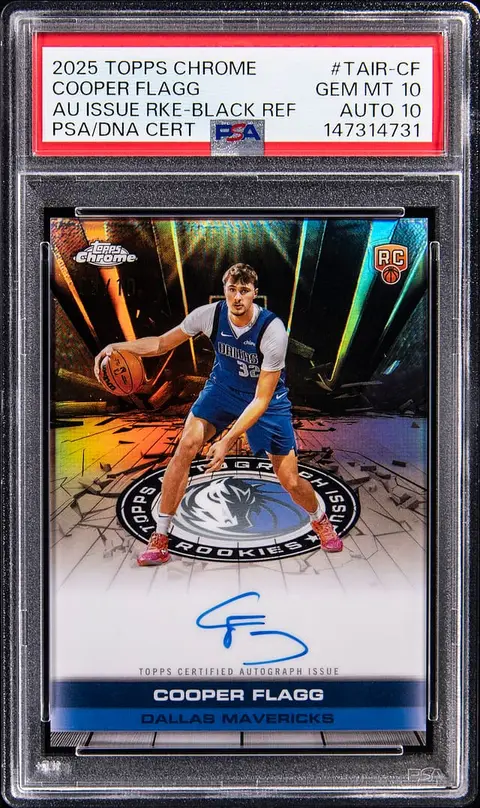
Sold Card
2025-26 Topps Chrome Autograph Issue Rookie Black Refractor #TAIR-CF Cooper Flagg Signed Rookie Card (#03/10) - PSA GEM MT 10, PSA/DNA GEM MT 10
Sale Price
Platform
Goldin2025-26 Topps Chrome Cooper Flagg Black Refractor Auto /10 Sells for $21,960
On April 24, 2026, Goldin closed a notable ultra-modern basketball sale: a 2025-26 Topps Chrome Autograph Issue Rookie Black Refractor #TAIR-CF Cooper Flagg Signed Rookie Card, serial numbered 03/10, graded PSA GEM MT 10 with a PSA/DNA GEM MT 10 autograph, realized $21,960.
For a player this early in his career, this type of result is an important data point for collectors who are trying to understand how the hobby is valuing elite prospect ink in the current market.
Card overview and key details
Let’s start with the basics of the card itself:
- Player: Cooper Flagg
- Season / Product: 2025-26 Topps Chrome Autograph Issue
- Card: Rookie Autograph, Black Refractor parallel
- Card number: #TAIR-CF
- Serial numbering: #03/10 (only ten copies produced)
- Rookie status: Signed rookie card / key early-issue auto
- Grading:
- Card: PSA GEM MT 10
- Autograph: PSA/DNA GEM MT 10
This is a low-serial-number, on-card autograph refractor from a major chromium (shiny, chrome-style) release. In modern basketball, that combination—rookie, chrome brand, serial numbered, and a perfect PSA 10 with a 10 auto—typically places a card toward the top of a player’s non-1/1 hierarchy.
Why the Black Refractor matters
In Topps Chrome, Black Refractors are an established, premium color parallel. They are harder to pull than base refractors and most mid-tier colors, and low print runs (here, only 10 copies) make them a target for collectors who want a scarce but still recognizable version of an important card.
Layered on top of that, this card is a signed rookie issue—the kind of card many player collectors consider a “core” piece rather than a side parallel.
Grading: PSA 10 / PSA/DNA 10 and why it matters
PSA is one of the hobby’s leading grading companies. A PSA GEM MT 10 grade indicates that, under standard collecting criteria, the card is essentially pack-fresh: sharp corners, strong centering, clean surfaces, and no visible printing defects.
Additionally, the autograph has a separate PSA/DNA GEM MT 10 grade. PSA/DNA is PSA’s autograph authentication arm. A 10 grade there signals a bold, clean signature with no visible skipping, smudging, or fading.
In low-serial cards like this, any copy is rare by definition, but a 10/10 combination usually sits at or near the top of the market:
- It reduces concerns about condition or autograph quality.
- It appeals to registry and set collectors who specifically chase PSA 10 examples.
- It often becomes the benchmark for “top comp” (short for comparable sale—a way to reference recent, similar transactions when evaluating a card).
Market context: where this $21,960 sale fits
This particular copy sold for $21,960 at Goldin on April 24, 2026.
When looking at a result like this, collectors usually compare it against:
- Other copies of the same card (same parallel, same numbering range) in different grades.
- Similar parallels of the same player (e.g., Gold Refractor autos, base refractor autos, lower-numbered colors).
- Key early-issue autographs of comparable prospects in recent years.
Across major marketplaces and auction houses, early Cooper Flagg Chrome and Chrome-style autographs have shown a familiar pattern for a highly anticipated modern prospect:
- Lower-numbered color refractors (like /10 and /5) tend to lead the way on price.
- Non-serial or higher-print parallels sit well below them, even in strong grades.
- Perfect 10/10 copies serve as reference points, with lower grades usually trading at a noticeable discount.
Within that landscape, a Black Refractor /10, graded PSA 10 with a 10 autograph, landing at just under $22,000 places this card solidly in the upper tier of Cooper Flagg’s early hobby market. It is being treated more like a true centerpiece card than an experiment or a flyer.
Because Flagg is still at an early stage of his career, there is not yet a long history of transactions for this exact card in this exact grade. Instead, auction results across close parallels and other top color autos help set a rough band for expectations. In that band, this sale fits in as a strong, data-backed number rather than a clear outlier.
Why collectors care about this card
1. Early, premium autograph of a headline prospect
Ultra-modern basketball often centers around the first chromium autographs of big-name prospects. Cooper Flagg has carried significant attention from the prep and pre-draft stages, and collectors have been quick to target his first major pack-issued, on-card signatures.
This specific card checks several boxes:
- Recognizable, long-running brand (Topps Chrome).
- Clearly labeled autograph issue, not a later insert.
- Rookie year context, giving it added long-term interest if his career develops.
2. Low supply by design
With just 10 copies produced, the Black Refractor /10 is a true short print. Even before grading, you’re dealing with a very limited population. Once you factor in:
- Not all 10 will be pulled quickly.
- Not all will be submitted to PSA.
- Not all will achieve a 10/10 grade.
The number of copies that can realistically compete with this one in the high-end market narrows further.
This scarcity matters most to collectors who like to own “the” card for a player—something they won’t see frequently at shows or online.
3. Ultra-modern era dynamics
This is firmly an ultra-modern card—recent issue, chromium, serial numbered, and grade-dependent. In this era:
- Values are strongly influenced by player narrative and hobby attention.
- Condition sensitivity and color/serial numbering often matter more than raw age.
- The best color autos can act as anchors for a player’s overall market.
Collectors returning from earlier eras sometimes compare these to 1990s refractors or early Exquisite autographs: different products and print runs, but similar in that they represent premium, early-career pieces.
What this sale might signal for the Cooper Flagg market
Without making predictions, we can note a few grounded takeaways from this Goldin sale:
- High-end bidders are engaged. A near-$22,000 realized price for a non-1/1 card indicates there is meaningful, organized demand at the top of Flagg’s market right now.
- Color and grade are being rewarded. The combination of Black Refractor /10 and PSA 10/10 grading clearly matters; less scarce or lower-grade pieces have been trading at noticeably lower levels.
- Auction houses remain the venue for top-tier copies. While some strong cards move via private deals, the most visible benchmark results for this kind of piece continue to come from major houses like Goldin.
How collectors interpret those points will vary. Some will see this as confirmation that Flagg’s key rookies have entered a serious price tier. Others may take it as a careful reference point when comparing to his other autographs or to prospects from recent classes.
Takeaways for different types of collectors
If you’re new or returning to the hobby
- This card is an example of a “chase card”: a rare, high-end version of a rookie that advanced collectors pursue.
- Terms to know:
- Parallel: A version of a card with different colors or finishes, often serial numbered.
- Refractor: A shiny, reflective parallel in Chrome-style sets.
- Comp: A recent, similar sale used to gauge price expectations.
- You don’t need cards at this price level to enjoy the hobby. But watching these sales can help you understand how rarity, brand, and grading interact.
If you actively buy, sell, or trade
- This sale offers a clear comp for a top-tier Cooper Flagg autograph:
- Known auction house (Goldin).
- Documented date (April 24, 2026).
- Precisely defined card and grade.
- When evaluating other Flagg pieces, you can work down from this benchmark while adjusting for:
- Color and serial numbering (e.g., /99, /50, /25 vs. /10).
- Grading differences (PSA 9, BGS, raw/ungraded).
- Whether the autograph is graded and how.
If you focus on long-term PCs (personal collections)
- A card like this is the type of piece many player collectors build around.
- Even if it’s out of budget, understanding where it sits in the player’s “card ladder” can help you choose alternatives that fit your lane—such as lower-numbered but non-Black colors, or higher-serial Chrome autos in strong grades.
Final thoughts
The sale of the 2025-26 Topps Chrome Autograph Issue Rookie Black Refractor #TAIR-CF Cooper Flagg Signed Rookie Card (#03/10), graded PSA GEM MT 10 with a PSA/DNA GEM MT 10 autograph, for $21,960 at Goldin on April 24, 2026, is a clear marker for how the market is currently valuing high-end Cooper Flagg ink.
For collectors, it serves as:
- A reference point for pricing conversations.
- An example of how scarcity, brand, and grading combine in ultra-modern basketball.
- A reminder that, even in a crowded modern market, truly limited, well-graded rookie autographs can distinguish themselves.
As more of Flagg’s key cards surface and additional sales data accumulates, this transaction will likely be one of the early results that future collectors look back on when tracing the evolution of his market.