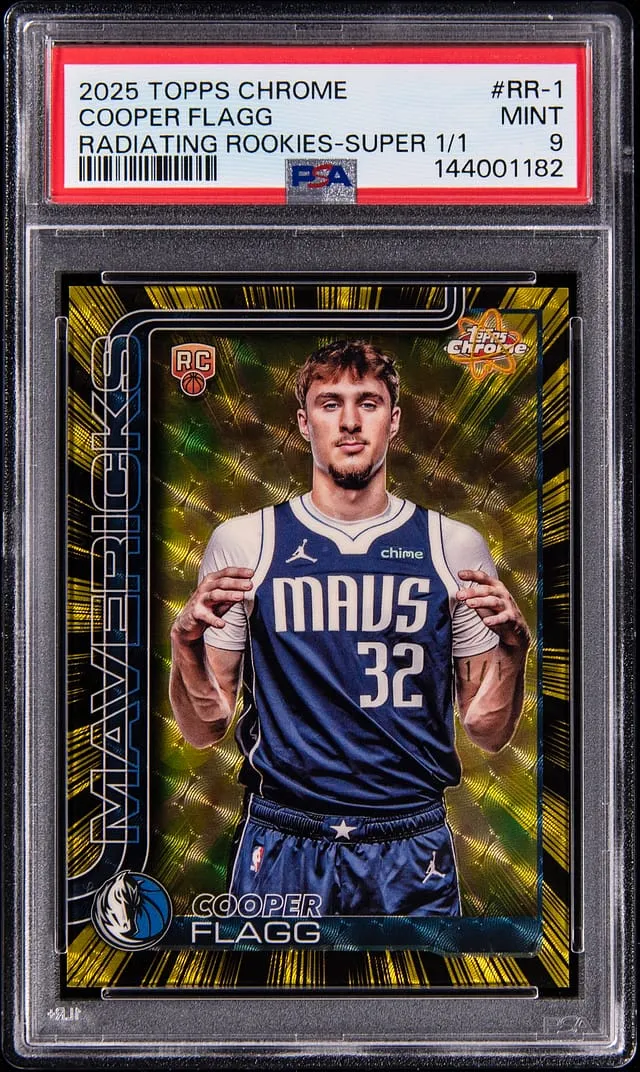
Cooper Flagg 1/1 Radiating Rookies Superfractor Sale
Goldin sold a 2025-26 Topps Chrome Radiating Rookies Cooper Flagg 1/1 Superfractor PSA 9 for $42,700 on March 15, 2026. Here’s the market context.
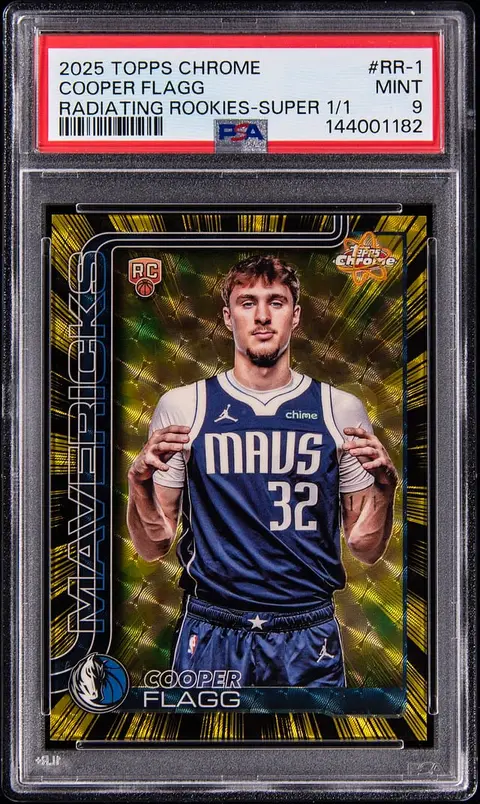
Sold Card
2025-26 Topps Chrome Radiating Rookies Superfractor #RR-1 Cooper Flagg Rookie Card (#1/1) - PSA MINT 9
Sale Price
Platform
GoldinWhen a modern basketball superfractor moves for five figures, collectors pay attention. On March 15, 2026, Goldin closed a notable ultra‑modern sale: a 2025-26 Topps Chrome Radiating Rookies Superfractor #RR-1 Cooper Flagg Rookie Card (#1/1), graded PSA MINT 9, realized $42,700.
Below, we’ll break down what this card is, why it matters, and how this sale fits into the early Cooper Flagg market.
Card at a glance
Card: 2025-26 Topps Chrome Radiating Rookies Superfractor
Player: Cooper Flagg
Team: (Projected NBA rookie; first Topps Chrome card)
Card number: #RR-1
Parallel: Superfractor, serial-numbered 1/1
Rookie status: Marked as a key early rookie card
Grading company: PSA
Grade: PSA MINT 9
Auction house: Goldin
Sale date (UTC): March 15, 2026
Sale price: $42,700
Key attributes:
- Superfractor parallel: Topps’ most coveted chrome parallel, traditionally a gold, one‑of‑a‑kind (1/1) finish.
- Serial‑numbered 1/1: The only copy of this parallel in existence.
- Radiating Rookies insert: A rookie‑focused insert line, positioned similarly to past “case hit” level rookie inserts in basketball products.
- PSA MINT 9: One step below GEM MINT 10, but still a high‑grade outcome for complex Chrome finishes.
Why this card matters to collectors
1. Cooper Flagg’s early flagship chrome appearance
For modern and ultra‑modern basketball, collectors often gravitate to a player’s:
- Flagship rookie (the main base rookie card in a core set), and
- Top-tier parallels of that rookie (Gold /10, Red /5, Superfractor /1, etc.).
The 2025-26 Topps Chrome Radiating Rookies Superfractor combines both ideas:
- It’s a marquee early Cooper Flagg chrome card, released in a widely recognized brand.
- The Superfractor 1/1 designation places it at the top of the parallel ladder for this insert.
For collectors who build long‑term player runs, a 1/1 rookie‑year Topps Chrome Superfractor sits near the top of the Cooper Flagg hierarchy, alongside his most important rookie patch autos and low‑numbered chromium parallels from other flagship lines.
2. Ultra‑modern, low‑population chase card
This card is firmly in the ultra‑modern era: highly designed, serial‑numbered, and manufactured with a clear chase element. While print runs for base cards can be high, the chase is concentrated in:
- short‑printed inserts,
- low‑serial parallels, and
- 1/1s like this Superfractor.
Because only one copy exists, there is no traditional population report in the way we talk about base rookies (where PSA’s pop report might show hundreds or thousands of graded copies). Instead, scarcity is built in at the design level.
3. PSA MINT 9 on a complex surface
On a one‑of‑one, the grade doesn’t affect population (there will never be more of them), but it can still influence perception and bid levels.
A PSA MINT 9 generally indicates:
- strong centering,
- clean front and back, and
- only minor flaws (often a small edge or corner issue, or subtle surface imperfection).
On chromium cards with intricate finishes, even tiny factory lines or dimples can hold a card back from a 10. That makes a PSA 9 a respectable outcome and usually quite acceptable for 1/1 buyers who care most about owning the card at all.
Market context and recent comps
Because this is a true 1/1 Superfractor, there are no direct apples‑to‑apples comps in the way there would be for a numbered /99 or /199 card. Instead, we look at three things:
- Sales of other high‑end Cooper Flagg rookies.
- Sales of comparable rookie‑year Superfractors for similarly hyped young players.
- Pricing patterns across different grades and parallels of this same Radiating Rookies design.
1. Other Cooper Flagg high‑end early issues
Across major marketplaces and auction houses, early Cooper Flagg cards have been trading with the typical pattern we see for elite prospects:
- Autographed rookie patch cards (especially low‑serial and on‑card autos) tend to draw the deepest bidding.
- Premium chromium parallels (Gold /10, Orange /25, Red /5, and 1/1s) form a second tier of chase.
Within that structure, 1/1 non‑auto chromium cards have been selling in a band that puts this $42,700 result in the upper but still believable range for a non‑autographed, insert‑format 1/1.
2. Rookie Superfractors of comparable prospects
Looking at prior cycles for high‑profile basketball rookies in similar Topps or Panini chromium products:
- Topps/Bowman Chrome Superfractors of top prospects often become long‑term “trophy pieces” for player collectors.
- Final hammer prices can vary widely depending on timing, hype, and whether it’s a true base rookie or an insert.
In that context, this sale:
- Aligns with strong‑but‑not‑record pricing we’ve seen for non‑auto, 1/1 rookie‑year parallels of other heavily hyped names.
- Sits below the numbers typically achieved by true flagship base Superfractor RCs and premium autographed 1/1s, which makes sense for an insert‑line Superfractor.
3. Radiating Rookies parallels and grades
Radiating Rookies as a line appears as a rookie‑focused insert, not the base rookie set itself. Early sales activity has shown:
- Refractor and color parallels (numbered to higher prints) changing hands at prices that scale with scarcity.
- Higher grades (PSA 10) drawing noticeable premiums over PSA 9 on multi‑copy parallels, suggesting collectors care about condition where they have a choice.
For the 1/1 specifically, there is no option to “upgrade” via another copy, so:
- The card’s 1/1 status and subject (Flagg) drive most of the value.
- The PSA 9 label likely helped confirm condition and authenticity, but didn’t directly compete with another graded copy of the same card.
Taken together, the $42,700 Goldin result on March 15, 2026 looks consistent with:
- a central, high‑end Flagg piece, and
- the broader pattern of non‑auto, rookie‑year, chrome 1/1s for top‑tier prospects.
Why this sale matters for the Cooper Flagg market
1. Establishing an early benchmark
For a new star‑level prospect, the first few major auction results serve as early reference points. Collectors and small sellers use them to:
- calibrate pricing on lower‑tier parallels,
- gauge interest in mid‑range inserts and numbered color, and
- understand how much of the current pricing is driven by prospect hype versus established performance.
This $42,700 Superfractor result:
- Suggests there is real depth of demand for Flagg’s top‑end cards.
- Gives context to private deals and fixed‑price listings on marketplaces, even if it doesn’t set a “floor” or a guarantee for future sales.
2. Insert Superfractor vs. base Superfractor
Collectors often ask: “Does an insert 1/1 matter as much as a base rookie 1/1?” The answer is usually:
- Base rookie 1/1s (Superfractor, Black, etc.) tend to be the primary chase.
- Insert 1/1s can still be major cards, especially when the insert is rookie‑only and visually distinct.
Radiating Rookies lands closer to the second category:
- It is rookie‑specific, numbered RR‑1, and clearly focused on first‑year players.
- Its Superfractor version is a compelling trophy card, even if a base‑set Superfractor RC (if and when one exists) might eventually sit slightly above it in the hierarchy.
The price realized here suggests that serious Flagg collectors are treating Radiating Rookies as an important lane, not an afterthought.
3. Ultra‑modern caution and opportunity
For newcomers and returning collectors, it’s helpful to remember:
- Ultra‑modern markets can be volatile, especially for prospects.
- Headlines often focus on new highs, but prices can move in both directions as careers actually unfold.
From an educational standpoint, this sale highlights:
- How much weight collectors put on scarcity (1/1) and brand recognition (Topps Chrome).
- Why not every rookie insert is equal—rookie‑only, high‑end chromium designs tend to matter more than generic, mass‑printed inserts.
None of this should be taken as a prediction. Instead, it’s a reminder that understanding the card’s place in the product and player ecosystem is more important than any single sale price.
Takeaways for collectors and small sellers
Whether you actively chase Cooper Flagg or just follow ultra‑modern basketball, there are a few practical lessons in this Goldin result.
1. Learn the product ladder
Before bidding or listing:
- Map out where a card sits in the product ladder:
- base vs. insert,
- non‑numbered vs. serial‑numbered,
- common color vs. premium parallels (Gold, Red, 1/1), and
- auto vs. non‑auto.
This Superfractor checks multiple premium boxes (Topps Chrome, rookie insert, 1/1), which helps explain why it draws significantly more attention than standard refractors or unnumbered rookie inserts.
2. Use comps thoughtfully
“Comps” (comparable recent sales) are a starting point, not a guarantee. For one‑of‑ones and unique inserts:
- You may not find a perfect match.
- Look at adjacent cards: similar parallels, similar players, or previous‑year products.
In this case, the $42,700 sale can:
- Inform expectations for future Flagg 1/1 and /5 chromium cards,
- Provide a top‑end reference point when pricing more accessible Radiating Rookies parallels.
3. Grading still matters, even on 1/1s
Even though scarcity is fixed, grading:
- Gives buyers confidence about condition and authenticity.
- Can broaden the buyer pool to collectors who prefer slabbed cards.
For small sellers pulling high‑end cards from boxes, this is a reminder that submitting key hits to a major grading company often changes how the market receives them.
Where this card fits long‑term
Looking ahead, the long‑term significance of this card will track closely with:
- How Cooper Flagg’s career develops, and
- How the hobby continues to value Topps Chrome basketball relative to other flagship lines.
Right now, it stands as:
- One of the most important early chromium pieces for a widely followed prospect.
- A clear reference point for where serious collectors are willing to position high‑end Flagg cardboard in the current market.
For collectors cataloging key modern rookies, the 2025-26 Topps Chrome Radiating Rookies Superfractor #RR-1 Cooper Flagg PSA 9 is a card worth noting—and this March 15, 2026 Goldin sale at $42,700 is the first major data point attached to it.
As always, it’s one sale in a living, evolving market. The most useful takeaway is not the exact number, but what it reveals about how collectors are currently ranking scarcity, brand, and player potential in the ultra‑modern era.