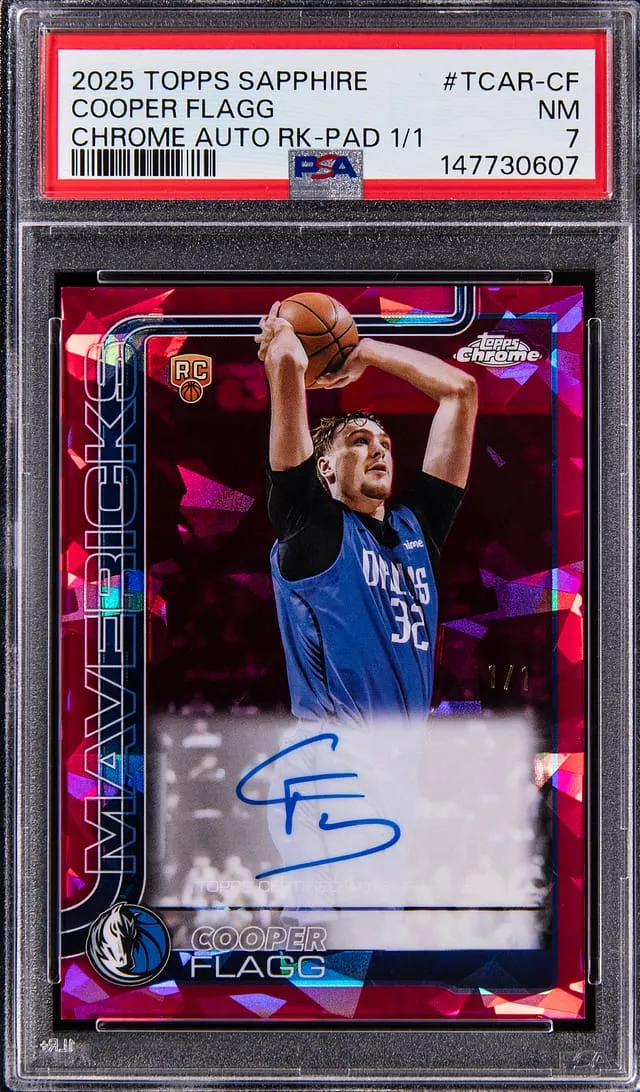
Cooper Flagg 1/1 Padparadscha Auto Sells for $366K
Breaking down the $366,000 Goldin sale of the 2025-26 Cooper Flagg Topps Chrome Sapphire Padparadscha 1/1 rookie auto, graded PSA 7.
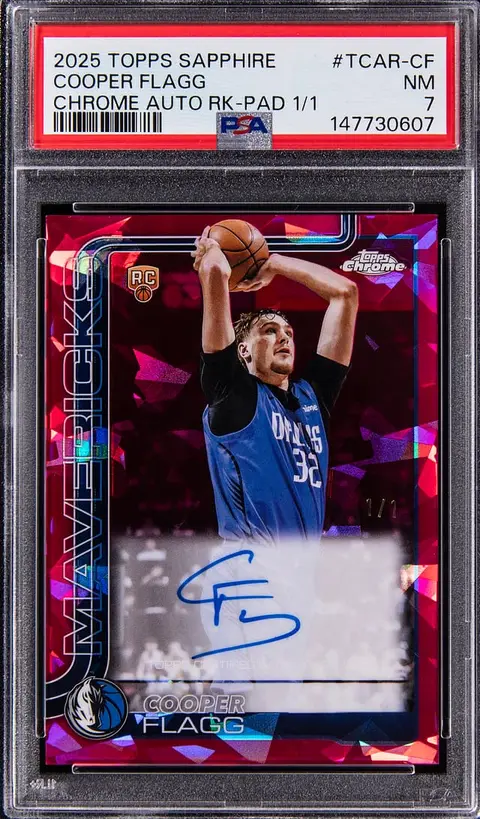
Sold Card
2025-26 Topps Chrome Sapphire Edition Chrome Autographs Rookies Padparadscha #TCAR-CF Cooper Flagg Signed Rookie Card (#1/1) - PSA NM 7
Sale Price
Platform
GoldinWhen a modern basketball card sells for six figures, it usually says more about collector confidence than short‑term hype. That’s exactly what we saw with the recent sale of a Cooper Flagg 1/1 autograph from Topps Chrome Sapphire.
On March 8, 2026 (UTC), Goldin closed a sale for a 2025-26 Topps Chrome Sapphire Edition Chrome Autographs Rookies Padparadscha #TCAR-CF Cooper Flagg Signed Rookie Card, serial-numbered 1/1 and graded PSA NM 7. The final price was $366,000.
Below, we’ll break down what this card is, why it matters, and how this sale fits into the broader modern basketball card market.
The card at a glance
Let’s start by identifying the card clearly:
- Player: Cooper Flagg
- Year: 2025-26
- Set: Topps Chrome Sapphire Edition
- Subset: Chrome Autographs Rookies
- Parallel: Padparadscha (a high-end, ultra-short print sapphire parallel)
- Card number: #TCAR-CF
- Serial numbering: 1/1 (one-of-one; only copy produced)
- Autograph: Certified Cooper Flagg signature (Chrome Autographs Rookies line)
- Rookie status: This is a key early-issue Cooper Flagg rookie autograph within the Chrome Sapphire line.
- Grading company: PSA (Professional Sports Authenticator)
- Grade: NM 7 (Near Mint)
Several things stand out immediately:
- 1/1 Padparadscha parallel – Padparadscha in Topps Chrome Sapphire is positioned at the very top of the parallel ladder. For many modern sets, a Padparadscha is effectively the artistic, ultra-short print “crown jewel” parallel. In this case, it’s also a one-of-one.
- On-card rookie autograph – The Chrome Autographs Rookies subset is built around signed rookie cards. For player-focused collectors, an early on-card (or pack-certified) rookie autograph often becomes a foundational piece of a player’s card portfolio.
- Modern, ultra-modern issue – 2025-26 places this firmly in the ultra-modern era, where scarcity is manufactured through short prints, serial numbering, and parallel tiers instead of simple age-based supply.
Grading context: PSA NM 7 for a six‑figure card
This particular copy received a PSA 7 (Near Mint). For context, PSA’s scale runs from 1 (Poor) to 10 (Gem Mint). In the ultra-modern space, most six‑figure cards we see publicly marketed will often be in the PSA 9–10 range, or their equivalents from BGS or SGC.
A PSA 7 indicates noticeable flaws (such as corner wear, surface issues, or centering) that keep it from high grade status. However, there are two important counterweights here:
- True 1/1 status – With a one-of-one, there is no higher-grade duplicate to compete with. Collectors who want this card have exactly one option, regardless of grade.
- Autograph and subject matter – For certain grail-level pieces (early LeBron, Jordan, or ultra-rare prospect cards), collectors sometimes prioritize card type and rarity over numeric grade, especially for the top parallel in the run.
So while a PSA 7 might limit value on a more common parallel, the 1/1 Padparadscha Cooper Flagg auto still commands premium attention.
Market context and price positioning
The Goldin sale closed at $366,000. To understand that number, it helps to look at related market data, even if exact comparables (“comps”) are scarce.
A comp is a “comparable sale” — a recent, verifiable sale of the same card or a closely similar version, used for rough price context.
For a 1/1 Padparadscha Cooper Flagg auto, true comps are naturally limited:
- Exact card, other copies: There are no other copies. By definition, a one-of-one has no direct duplicate. That means no true historical sales of this precise card.
- Same player, different parallels: We can look at sales of Cooper Flagg Chrome autographs in more common parallels (like refractors, base autos, lower-tier color) to understand the general demand curve. Those tend to sit in significantly lower price brackets, as expected, because they don’t share the 1/1 status or Padparadscha tier.
- Similar players, similar cards: In recent years, top‑end 1/1 rookie autos of high‑profile prospects in premium Chrome or Chrome-adjacent products have reached into the six‑figure range when hobby sentiment is strong. These include elite basketball rookies whose names quickly became central to the ultra-modern conversation.
Within that framework, $366,000 sits in the upper band of modern prospect-based card pricing, but it is not an outlier in the context of what the market has seen for top-tier, 1/1, on-card autos of highly anticipated talents.
Because this is a unique card and the ultra-modern market evolves quickly, it’s more accurate to view the Goldin result as a reference point for Cooper Flagg’s high-end market rather than a firm benchmark. Future sales of other flagship Flagg 1/1s (Logoman autos, superfractors, or equivalent top parallels) will likely be compared to this number.
Why collectors care about this card
Even without leaning on speculation, we can outline several reasons this particular piece matters:
1. Key early Cooper Flagg rookie autograph
Among modern collectors, a player’s early certified autographs in recognizable, premium chromium products often become long-term reference points. For Cooper Flagg, Topps Chrome Sapphire Edition’s Chrome Autographs Rookies line checks several boxes:
- Recognizable brand: Topps Chrome and its Sapphire offshoot are established in the hobby. Sapphire has developed a reputation for premium, limited parallels and a strong visual identity.
- Rookie-focused subset: Being explicitly labeled within a rookie autograph subset positions this card as a central piece of Flagg’s early trading card story.
2. Padparadscha as a top-tier parallel
In modern Topps Chrome and Chrome-adjacent products, padparadscha parallels are usually:
- Very low print (often 1/1 in specific configurations)
- Recognized among collectors as a “chase” tier — the type of card that becomes a set highlight in breaks and auctions
For collectors who rank parallels, the hierarchy often places padparadscha near or at the peak, alongside superfractors or black 1/1s depending on the specific product.
3. Ultra-modern scarcity model
This card also illustrates how ultra-modern scarcity works:
- Instead of relying on age or natural attrition to create rarity, manufacturers build scarcity through serial numbering, short prints, and color tiers.
- A 1/1 padparadscha auto like this is deliberately designed as a pinnacle card within the checklist.
Collectors who are comfortable with the ultra-modern model often gravitate to these engineered grails, especially when tied to high-upside, highly followed players.
How the PSA grade plays into collector decisions
While a PSA 7 is lower than typical for many six‑figure ultra-modern cards, the impact is moderated by the card’s uniqueness and niche:
- No grade competition for this exact card: With only one copy in existence, there is no PSA 9 or PSA 10 version for a collector to target instead.
- Player and parallel focus: For some collectors, the calculus is: “Do I want the Cooper Flagg 1/1 Sapphire Padparadscha auto or not?” rather than “Which grade should I choose?”
Over time, collectors may still differentiate heavily between high-grade, more numerous parallels (like /99, /50, /25 autos) and unique, lower-grade 1/1s. But for cornerstone pieces, the card’s identity often outweighs grade minutiae.
What this sale signals to the hobby
Several broad takeaways for hobbyists, small sellers, and returning collectors:
High-end modern demand is still there
A $366,000 result in March 2026 for an ultra-modern rookie auto confirms that there is still deep collector and investor interest at the top of the market for carefully selected pieces.Player narrative drives attention
Major auction houses like Goldin tend to feature cards of players with strong hobby narratives — whether that’s established superstardom or significant projected upside. Cooper Flagg fits into that pattern as a heavily followed modern basketball name.Rookie autos and true 1/1s remain focal points
When collectors talk about “cornerstone” modern cards, they frequently mean:- True rookie-year issues
- Certified autographs
- Flagship or premium brand
- 1/1 or extremely low-serial parallels
This Flagg Padparadscha auto checks all four boxes.
Comps are a guide, not a rulebook
With a unique card, pricing is more about the overlap of:- How much this specific card means to a particular bidder, and
- How the broader market feels about the player and category at that moment.
That’s why it’s more informative to discuss “price context” than to treat any 1/1 result as a hard reference for everything else.
Takeaways for different types of collectors
New and returning collectors
If you’re just getting back into the hobby, this sale highlights a few principles:
- Learn the parallel ladder: Understanding where Padparadscha, superfractors, golds, and other colors sit in each set goes a long way in reading auction results.
- Focus on structure, not just headline numbers: Rather than thinking “$366,000 is wild,” ask why a card is positioned as a grail — rookie status, brand, autograph, serial number, and player.
Active hobbyists and small sellers
For more experienced collectors and sellers, this sale serves as a modern benchmark for:
- High-end Cooper Flagg demand: It offers a reference point when evaluating other Flagg autographs and low-numbered parallels across different products.
- How much weight a brand and parallel can carry: Sapphire plus Padparadscha plus rookie autograph is a powerful combination in current market language.
This doesn’t mean that more common parallels will track this sale proportionally, but it does suggest that the hobby is assigning real significance to Cooper Flagg’s top-of-the-ladder rookie autos.
Final thoughts
The 2025-26 Topps Chrome Sapphire Edition Chrome Autographs Rookies Padparadscha #TCAR-CF Cooper Flagg Signed Rookie Card (1/1), graded PSA NM 7, selling for $366,000 at Goldin on March 8, 2026 (UTC) is a meaningful data point for the ultra-modern basketball market.
It encapsulates several trends in today’s hobby:
- Engineered scarcity through premium 1/1 parallels
- The continuing importance of rookie autographs in defining a player’s card narrative
- The willingness of collectors to prioritize uniqueness and card identity over perfect numerical grades in certain cases
For collectors who track the evolution of the modern basketball landscape, this result will likely be referenced whenever Cooper Flagg’s top-tier rookie cards are discussed in the years ahead.