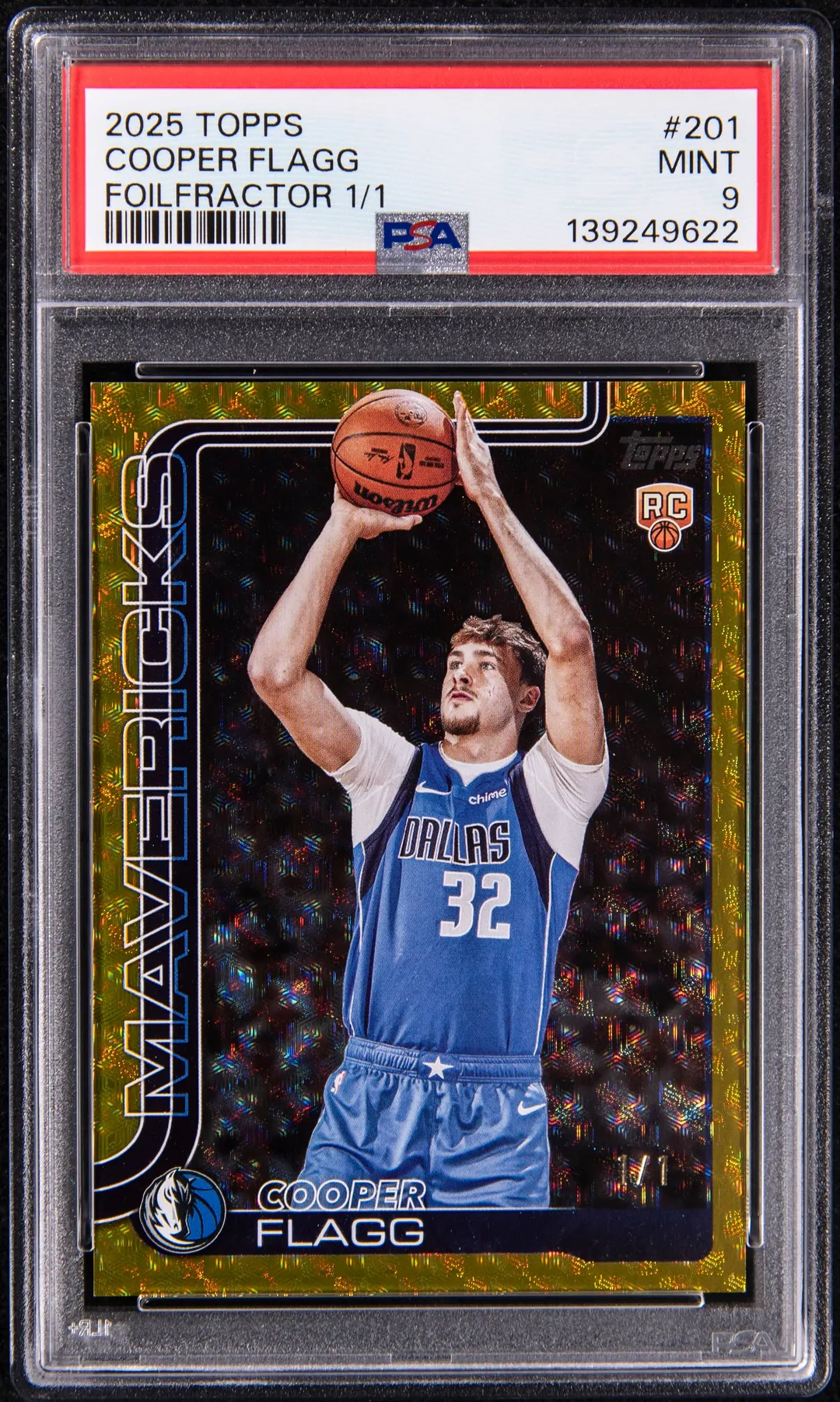
Cooper Flagg 1/1 FoilFractor PSA 9 sells for $158K
A look at Goldin’s $158,639 sale of the 2025-26 Topps FoilFractor 1/1 Cooper Flagg rookie in PSA 9 and what it means for ultra-modern hoops cards.
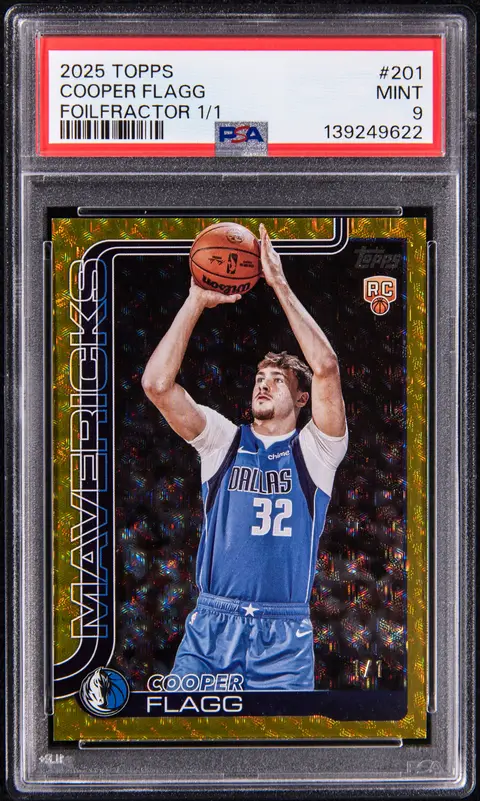
Sold Card
2025-26 Topps FoilFractor #201 Cooper Flagg Rookie Card (#1/1) - PSA MINT 9
Sale Price
Platform
Goldin2025-26 Topps FoilFractor Cooper Flagg Rookie Sells for $158,639
On January 4, 2026, Goldin closed a notable ultra-modern basketball sale: a 2025-26 Topps FoilFractor #201 Cooper Flagg Rookie Card, serial-numbered 1/1 and graded PSA MINT 9, sold for $158,639.
For a prospect who has yet to log an NBA minute, that is a meaningful data point for both Cooper Flagg’s hobby profile and the growing role of non-NBA licensed products in the basketball market.
Card at a glance
- Player: Cooper Flagg
- Card: 2025-26 Topps FoilFractor #201
- Status: Rookie card (pre-NBA, early key card)
- Parallel: FoilFractor, serial-numbered 1/1 (one-of-one)
- Grading company: PSA
- Grade: PSA 9 (MINT)
- Auction house: Goldin
- Sale date: January 4, 2026 (UTC)
- Sale price: $158,639
This FoilFractor is effectively the top-end chase card for Flagg in this Topps release: it’s a one-of-one parallel, it carries the “rookie” designation for a hugely anticipated prospect, and it received a strong mint grade from PSA.
Why this card matters to collectors
Early, premium Cooper Flagg piece
Cooper Flagg has been one of the most closely watched basketball prospects in recent memory. For many collectors, this card represents:
- An early flagship-style rookie: Even though it is not an NBA-licensed card, this Topps issue is functioning as a first major release for Flagg in pack-issued form.
- The top parallel of the base card: In modern Topps/Chrome-style products, the 1/1 parallel (like a Superfractor in chrome sets or FoilFractor here) is typically the ceiling version of the main rookie card.
- True scarcity: One-of-one means exactly that—there is only one copy of this exact FoilFractor. Grading it PSA 9 removes some condition uncertainty and locks in its state for long-term collecting.
Because this is a rookie-era, 1/1, PSA-graded card, it sits at the intersection of three things modern collectors care about: key player, true scarcity, and third-party authentication.
Ultra-modern era dynamics
This card belongs firmly in the ultra-modern era (roughly mid-2010s to present), which has a few defining traits:
- Heavy use of parallels: Multiple color and texture variations of the same card, often numbered to very low print runs.
- Serial numbering: Stamped numbers like 1/1, 1/25, or /99 that tell you exactly how many exist.
- Grading as standard: Most high-end cards move through PSA, BGS, or other graders before reaching auction.
In that context, a one-of-one rookie parallel for a headline prospect is positioned naturally as a high-end, centerpiece piece in a collection.
Market context and comps
When collectors talk about “comps”, they mean comparable recent sales: similar cards that help frame what a new sale might reasonably bring. For a true 1/1 like this, there are no direct duplicates, so we look at:
- Other Cooper Flagg 1/1 or low-serial parallels from the same or similar products.
- High-end parallels of other top prospects at similar stages of their careers.
At the time of this sale, public marketplaces and auction records show that:
- Other Cooper Flagg cards from mass-market products (non-1/1, higher print runs) have generally been trading at significantly lower levels, as expected—this FoilFractor sits at the very top of his card hierarchy from this release.
- Premium, low-numbered parallels (for example /10, /25, or /50 versions of Flagg’s early cards) have been changing hands for a fraction of this 1/1 result, again consistent with typical pricing tiers across modern basketball.
Because 1/1s rarely surface and often trade privately, it’s hard to label this $158,639 result as definitively high or low versus an exact comp. What we can say from the available data:
- This is among the stronger public prices for a pre-NBA Cooper Flagg card so far.
- The result is directionally consistent with how the hobby has treated one-of-one parallels of elite, heavily hyped prospects in recent years—positioning this as a top-end, showcase item rather than an outlier bargain.
The role of PSA 9 in the result
PSA uses a 1–10 grading scale. A PSA 9 (MINT) generally allows for very minor flaws (slight print or surface marks, a small touch of white on a corner, or off-centering within tight tolerances) but still presents as a clean, high-end copy.
For a one-of-one, there is no population to compare—this is the only graded example of this exact card by definition. Even so:
- A PSA 9 gives buyers confidence that the card is free of major condition issues.
- It narrows the condition debate, which can matter at higher dollar levels where small defects cause big disagreements.
In other words, while you cannot have a competing PSA 10 of this exact 1/1, the mint grade likely helped the card attract broader bidding than if it were ungraded or showed visible wear.
How this fits into Cooper Flagg’s broader market
At this stage, Cooper Flagg’s market is driven more by expectation and scarcity than by NBA stat lines. That has a few implications:
Early key issues are being defined right now. As more products release, the hobby will gradually decide which cards are considered core Flagg rookies and which are side pieces. This FoilFractor 1/1 from a recognized Topps release is likely to stay near the top of that conversation simply because of its combination of timing (early), parallel level (1/1), and grade (PSA 9).
Non-NBA licensed cards can still matter. Recent years have shown that top prospects can develop notable markets in college, high school, or mixed-license products when the design, brand, and scarcity line up. This sale suggests that a portion of the collector base is comfortable assigning real weight to this card in Cooper Flagg’s overall portfolio.
Hype cycles are real. Prospect-driven cards often move with news—tournament performances, awards, draft positioning, and early pro results. While we cannot say precisely which headline influenced which bid, this sale sits within an environment of heightened attention around Flagg.
What this sale tells collectors and small sellers
For collectors who are new or returning to the hobby, the numbers around this card can feel abstract. Here are a few practical takeaways:
Not every Cooper Flagg card is a six-figure card. This FoilFractor is a perfect storm of attributes: one-of-one, early issue, high grade, and sold on a major auction platform (Goldin) with a strong marketing reach. Base or higher-serial cards from the same player and year exist in much larger quantities and trade in a very different price range.
Scarcity and context matter. When looking at your own cards, check:
- Is it a parallel? Which one?
- Is it serial-numbered? Out of how many?
- Is it graded? By whom and at what grade?
Cards that share more of these attributes with this FoilFractor will usually sit closer to the high end of any player’s market.
Auction venues shape visibility. High-end cards sold through major houses like Goldin tend to set the public benchmarks that collectors and dealers reference later. When you look up comps for your own cards, pay attention not just to price, but to where the card sold and how it was presented.
Final thoughts
The January 4, 2026 sale of the 2025-26 Topps FoilFractor #201 Cooper Flagg Rookie Card (#1/1) in PSA MINT 9 at Goldin for $158,639 gives us a clear snapshot of where the hobby currently places top-tier, ultra-scarce, early Flagg pieces.
It doesn’t guarantee where future prices will go, and it doesn’t define the value of every other Flagg card. But as a marker, it helps collectors calibrate expectations: for a key prospect in the ultra-modern era, a one-of-one, PSA-graded flagship-style rookie can command serious attention and serious bids.
For anyone tracking Cooper Flagg or trying to understand how high-end modern basketball cards are being valued, this sale is a reference point worth bookmarking.