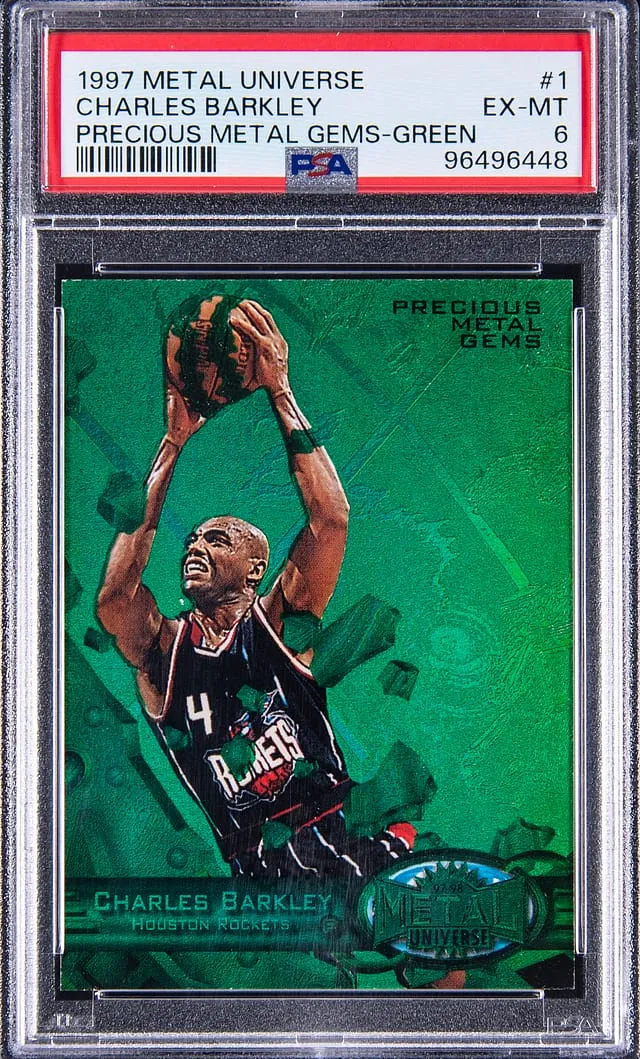
Charles Barkley 1997-98 PMG Green PSA 6 sells
Breakdown of the $79,384 Goldin sale of the 1997-98 SkyBox Metal Universe PMG Green #1 Charles Barkley PSA 6.
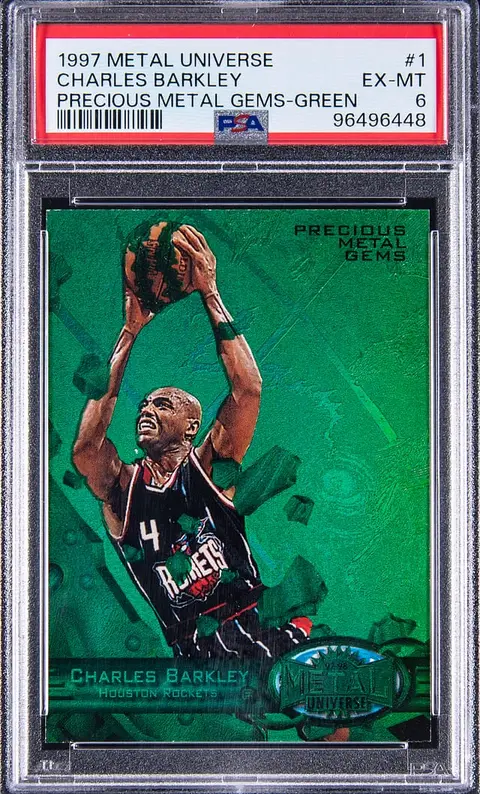
Sold Card
1997-98 SkyBox Metal Universe Precious Metal Gems (PMG) Green #1 Charles Barkley (#009/100) - PSA EX-MT 6
Sale Price
Platform
Goldin1997-98 SkyBox Metal Universe Precious Metal Gems (PMG) Green #1 Charles Barkley (#009/100) – PSA EX-MT 6 sold at Goldin on March 8, 2026 for $79,384. For high-end 90s basketball collectors, this is a meaningful data point in a market that continues to treat PMG Green as one of the true “blue-chip” inserts of the era.
Card overview
Let’s start by laying out exactly what this card is:
- Player: Charles Barkley
- Team: Houston Rockets (featured with Rockets on the 1997-98 Metal Universe #1)
- Year: 1997-98
- Set: SkyBox Metal Universe
- Parallel: Precious Metal Gems (PMG) Green
- Card number: #1
- Serial number: #009/100 (with the first 10 copies traditionally treated as Green)
- Grading company: PSA
- Grade: EX-MT 6
- Type: Not a rookie, but a key 90s insert issue from Barkley’s late-career period
The 1997-98 SkyBox Metal Universe Precious Metal Gems run is one of the hobby’s most famous parallel sets. For basketball, PMG Green parallels are widely viewed as a cornerstone of 90s insert collecting due to their low print run, distinctive design, and the set’s influence on later high-end parallels.
How the PMG Green numbering works
The original Precious Metal Gems parallel for 1997-98 Metal Universe is serial-numbered to 100 for each card, but the breakdown is important:
- Typically, the first 10 copies (01–10) are considered PMG Green
- The remaining 90 copies (11–100) are PMG Red
This Barkley is #009/100, which places it in the Green portion of the print run.
Why this card matters to collectors
1. PMG Green as a cornerstone 90s insert
Among 1990s inserts, PMG Green sits near the top of the hierarchy:
- Ultra-low supply: Effectively 10 copies per player
- Condition sensitivity: Chipping, edge wear, and surface issues are common due to the foil-heavy design
- Design influence: The look and scarcity profile helped shape how modern high-end parallels are conceived
Collecting PMG Green has become a focused niche inside high-end 90s basketball, often crossing over with player collectors, set builders, and investors who treat PMGs as long-term “store of quality” pieces.
2. Charles Barkley’s hobby position
Charles Barkley isn’t Michael Jordan or Kobe Bryant in terms of market ceiling, but he sits in that next group of highly respected Hall of Famers:
- Hall of Famer, MVP, Dream Team member, and one of the defining personalities of the 80s–90s NBA
- A long-running, visible presence on Inside the NBA, keeping him culturally relevant
- Limited true “premium” 90s chase cards compared to some peers, which concentrates demand into cornerstone issues like PMGs
For Barkley specifically, PMG Green is one of the clear top non-rookie cards in his catalog.
3. Era and scarcity
The 1997-98 Metal Universe PMGs sit in the late-90s insert/parallel boom era, not in the mass-printed “junk wax” period of the late 80s–early 90s. Production was still modest relative to modern releases, and the PMG Greens are meaningfully rare even before grading.
On top of raw scarcity, condition is a major factor. Surface and edge issues mean that mid-grade copies (PSA 5–6, BGS 6–7) are common landing spots even for cards pulled fresh and stored carefully.
Grading context: PSA EX-MT 6
This copy is graded PSA 6 (EX-MT), which typically allows for:
- Noticeable corner and edge wear
- Minor to moderate surface issues
- Still presentable eye appeal, but clearly not near-mint
For 90s PMG Green, the grading scale behaves a bit differently in terms of desirability:
- Any authenticated Green is significant, especially for key players
- High grades (PSA 8–9) can be extremely scarce and command a substantial premium
- Mid grades like PSA 5–6 often become the most realistic entry point for collectors who want the card itself rather than chasing top-of-pop registry pieces
Market context and price positioning
This Barkley PMG Green #1 /100 in PSA 6 sold for $79,384 at Goldin on March 8, 2026 (UTC).
A few contextual notes, based on broader PMG and Barkley market data up through early 2026:
- PMG Green as a segment: For top-tier names (Jordan, Kobe), PMG Greens in mid to high grade have achieved six-figure and even seven-figure results in past headline auctions. That sets the upper bar for the parallel, but not for every player.
- Non-Jordan Hall of Famers: For stars like Barkley, prices are lower but still anchored by the same scarcity logic: 10 Greens, heavy condition sensitivity, very few graded copies.
- Grade-relative pricing: Higher grades draw significant premiums. As a PSA 6, this card sits in a middle range where competition from player collectors, set builders, and 90s specialists still drives bidding, but the price gap versus an 8 or 9 can be large.
Publicly archived sales for this exact card (Barkley PMG Green #1) are limited; these rarely change hands, and many are locked away in long-term collections. Where comparable Barkley PMG Greens have appeared in the past, they’ve generally:
- Sold at strong multiples of Barkley’s base and lower-tier inserts
- Tracked broader PMG sentiment more than short-term player news
Within that framework, $79,384 for a PSA 6 sits in what you would expect for a true PMG Green star-level Hall of Famer in mid-grade: meaningful, but not surprising given the supply and the profile of the set.
Because confirmed, up-to-the-minute, like-for-like Barkley PMG Green sales are sparse, it’s more accurate to treat this as part of a thin but consistent high-end PMG market rather than a dramatic outlier or a clear record-breaker.
How this sale fits into broader PMG and 90s insert trends
1. Continued depth for non-Jordan PMGs
This result reinforces something serious collectors have seen for a while: demand for PMG Green runs deeper than just Jordan. High-end collectors have been quietly building out player runs and Hall-of-Fame checklists:
- PMG Green sales for second-tier hobby stars have remained relatively firm when they do surface
- Long gaps between auctions make each sale useful as a fresh “marker” for that particular player
This Barkley sale gives collectors a new mid-grade comp to reference when assessing:
- Private deals
- Cross-grades and regrades
- Insurance values for existing holdings
2. 90s insert stability
Even as modern ultra-modern products produce new SSPs (super-short prints), color parallels, and case hits each year, 1990s “pillars” like PMG, Jambalaya, and Essential Credentials tend to:
- Trade infrequently
- Maintain a core following of specialized collectors
PMG Green sits at the top of that pile, so a ~$80K sale for a Barkley PSA 6 fits the pattern: relatively few data points, but each one validating that the core 90s insert market remains structurally tight on supply.
3. Impact of player news
Barkley’s ongoing presence on TV and in NBA media keeps him relevant, but there has been no single news event (like a Hall of Fame induction or a jersey retirement) right around this sale that would explain a sudden spike. Instead, this looks more like steady, collector-driven demand meeting a genuinely scarce card.
What this sale can mean for different types of collectors
For newcomers
If you’re newer to the hobby and just hearing about PMG Green:
- Think of PMG Green as one of the most important premium parallels of the 1990s
- Cards like this Barkley are more like art pieces or long-held collectibles than short-term flips
- Mid-grade slabs (PSA 5–6) are common for this set and not a red flag by themselves
For returning collectors from the 90s
If you opened Metal Universe back in the day, this sale underscores how far high-end 90s inserts have come:
- What was once seen as a tough, flashy parallel has become a centerpiece card for serious collectors
- The gap between PMG and most other 90s inserts has widened dramatically
This Barkley sale is a reminder that if you have raw 90s inserts sitting in boxes, it can be worth:
- Checking for premium parallels
- Researching population reports (known graded copies) and past sales
For active hobbyists and small sellers
For people already buying and selling regularly, this sale is useful in three ways:
- Comp reference: It gives a fresh, public comp (a recent comparable sale) for a mid-grade PMG Green of a Hall of Famer outside the absolute top tier.
- Grade anchoring: It reinforces the value gap between authentic/low-grade and mid-grade PMGs, and between mid-grade and top-pop examples.
- Market read: It supports the view that 90s cornerstone inserts behave differently from most modern short prints—less volume, more scarcity-driven, and heavily influenced by set reputation rather than momentary buzz.
None of this should be taken as financial advice or as a guarantee of what future prices will do. The main takeaway is about structure: PMG Greens remain tightly held, and when they surface in public auctions like this Goldin sale, the realized prices tend to reflect both the scarcity of the card and the maturity of the 90s insert collector base.
Key takeaways
- The 1997-98 SkyBox Metal Universe PMG Green #1 Charles Barkley (#009/100) in PSA EX-MT 6 sold for $79,384 at Goldin on March 8, 2026 (UTC).
- PMG Green is one of the most important 90s basketball parallels, with roughly 10 Green copies per player, heavily condition-sensitive.
- For Barkley, this is a top-tier non-rookie card, sitting near the pinnacle of his 1990s catalog.
- The sale fits the pattern of strong, scarcity-driven demand for high-end 90s inserts, particularly PMG Greens, even outside the absolute top names.
For collectors watching the 90s insert market, this Barkley result is another data point confirming that PMG Green remains one of the defining chase cards of the era—rarely seen, closely watched, and strongly contested whenever a copy does hit the auction block.