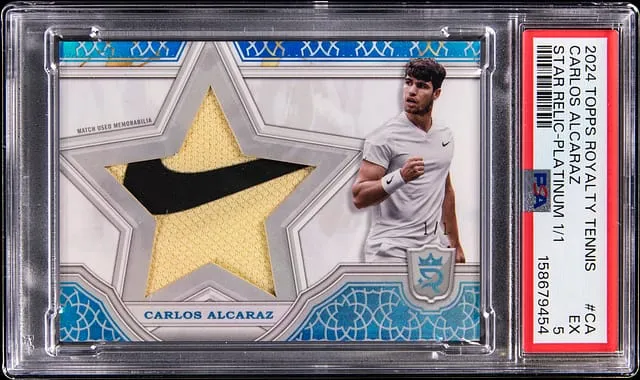
Carlos Alcaraz 1/1 Royalty Patch Sells for $12.2K
Goldin sells a 2024 Topps Royalty 1/1 Carlos Alcaraz Australian Open match-used patch (PSA 5) for $12,200. A key data point for modern tennis cards.
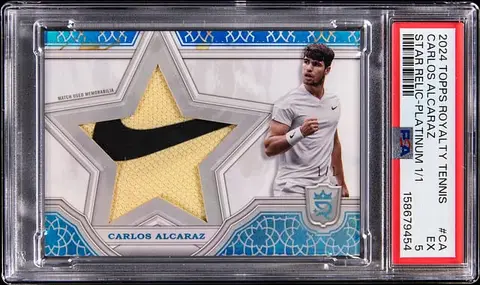
Sold Card
2024 Topps Royalty Collection Tennis Star Relic Platinum #SRR-CA Carlos Alcaraz '24 Australian Open Match-Used Patch Card (#1/1) - PSA EX 5
Sale Price
Platform
Goldin2024 Topps Royalty Collection Tennis Star Relic Platinum #SRR-CA Carlos Alcaraz '24 Australian Open Match-Used Patch Card (#1/1) - PSA EX 5 Sells for $12,200
On June 7, 2026, Goldin closed the sale of a modern tennis grail: a 2024 Topps Royalty Collection Tennis Star Relic Platinum #SRR-CA Carlos Alcaraz featuring a match-used patch from the 2024 Australian Open. Serial-numbered 1/1 and graded PSA EX 5, the card realized $12,200.
For a young player whose market is still developing in the trading card world, this is an important data point. Below, we break down what this card is, why it matters, and how the price fits into the broader Alcaraz and tennis card landscape.
Card overview: what exactly sold?
Card details
- Player: Carlos Alcaraz
- Event: 2024 Australian Open (match-used patch)
- Year: 2024
- Set: Topps Royalty Collection (tennis subset)
- Insert / subset: Tennis Star Relic
- Card number: #SRR-CA
- Parallel: Platinum
- Serial numbering: 1/1 (one-of-one)
- Attributes: Match-used patch relic
- Rookie status: Not a rookie card, but an early, high-end, event-specific relic
- Grading company: PSA (Professional Sports Authenticator)
- Grade: EX 5 (Excellent)
Topps Royalty is part of the newer generation of multi-sport and tennis-focused releases that try to place current stars in a premium, modern design. The Platinum parallel here is the key: in modern trading cards, one-of-one (1/1) parallels represent the absolute ceiling of scarcity within a given release.
This card combines three things that typically matter to collectors:
- Ultra-scarcity – a true 1/1 parallel.
- Event-specific memorabilia – a match-used patch tied to the 2024 Australian Open.
- A rising star – Carlos Alcaraz is already a multiple major champion and widely viewed as a long-term cornerstone of men’s tennis.
Understanding the grade: PSA EX 5
PSA’s 1–10 scale classifies EX 5 (Excellent) as a mid-grade card. That usually implies:
- Noticeable corner or edge wear, or
- Visible surface flaws (scratches, indentations, print lines), or
- Centering issues that are more than minor.
For modern cards, collectors often prioritize high grades (PSA 9 or 10). However, for one-of-one relics, the grade frequently takes a back seat to:
- The fact that it is the only copy in existence, and
- The eye appeal of the patch (number of colors, stitching, logo pieces).
Relics, especially thicker patch cards, are prone to soft corners and surface issues straight out of the pack. As a result, many collectors of ultra-rare relics focus more on the patch and the player than on chasing a perfect grade.
Market context and price positioning
- Sale price: $12,200 (converted from 1,220,000 cents)
- Auction house: Goldin
- Sale date (UTC): 2026-06-07
When looking at a card like this, we usually compare it with:
- Other Alcaraz 1/1s (especially premium brands or key events), and
- High-end tennis relics and autos of active stars.
Across major marketplaces and auction archives, detailed public sales data for this exact card is naturally thin – it is a 1/1. Instead, the most useful reference points are:
Other modern Alcaraz 1/1s:
In 2023–2025, Alcaraz one-of-one cards from premium sets (including autos, patches, and parallel 1/1s) have generally shown a wide range of realized prices, depending on brand strength, autograph presence, patch quality, and timing relative to his Grand Slam performances.High-end tennis modern market:
The broader tennis card category is still relatively small compared to basketball or football, but it has been steadily gaining depth since the early 2020s. Key cards of Federer, Nadal, and Djokovic set the upper tier, with young stars like Alcaraz and Sinner forming the next wave. Within that context, a five-figure sale for an early high-end Alcaraz relic from a recognizable manufacturer like Topps fits into the emerging “high-end modern tennis” tier.
Because this is the only copy of this specific Platinum 1/1, it’s not realistic to label the $12,200 result as definitively “high” or “low” in a precise, statistical sense. Instead:
- The result signals solid demand for event-linked, ultra-rare Alcaraz memorabilia.
- The card is not autographed, and the grade is mid-tier, so the value here is clearly anchored in the 1/1 scarcity plus the Australian Open connection, rather than condition or ink.
Why this card matters to collectors
1. Early premium Alcaraz relic with clear event tie-in
This card is tied to the 2024 Australian Open, one of the four Grand Slam tournaments. While not a rookie card, it falls into the category of early-career, event-specific premium issues that many collectors track as a player’s story develops.
For context, tennis doesn’t have the same long-established rookie card traditions as baseball or basketball. Instead, collectors often focus on:
- First on-card autographs,
- First premium relics, and
- Early cards tied to specific majors or breakout seasons.
Within that framework, a match-used patch from a 2024 Slam event carries narrative weight for long-term collectors who like to anchor their collections to specific moments and tournaments.
2. Modern / ultra modern era dynamics
The 2024 Topps Royalty Collection sits firmly in the ultra modern era (roughly mid‑2010s onward). This period is characterized by:
- Heavy use of serial numbering and parallels,
- More relics and patches,
- A high share of cards going straight from pack to grading.
In ultra modern cards, rarity is often engineered by design through parallels like this Platinum 1/1. That can compress population—there is literally just one copy—while spreading collector demand across multiple parallel tiers.
For a player like Alcaraz, whose prime years are likely still ahead, ultra modern collectors are often trying to identify:
- The most iconic set(s) for the player.
- Which cards will be viewed as cornerstone issues if he continues to add majors and historic achievements.
This Royalty Collection 1/1 may not end up as his single most famous card, but it clearly sits in the high-end narrative lane: early-career, Slam-linked, ultra-low print.
3. Patch quality and eye appeal
While exact patch visuals vary, collectors of premium relics usually pay close attention to:
- Number of colors (two-, three-, or more-color patches),
- Presence of logos, stripes, or unique stitching, and
- How well the patch is framed in the window.
Even when a card has a mid-grade technical assessment like PSA 5, strong eye appeal can make it a centerpiece in a player collection. That’s especially true when there is no alternative copy for this parallel.
How this Goldin sale fits into the broader tennis market
The tennis card market has gradually been maturing:
- Legends (Federer, Nadal, Djokovic) have established a recognized top tier of modern tennis cards, including rookies, autos, and key patches.
- Next‑gen stars (Alcaraz, Sinner, Rune, etc.) are carving out their own premium lanes, but price discovery is ongoing as their careers evolve.
In that environment, this $12,200 Goldin sale on June 7, 2026, can be read as:
- A vote of confidence in Alcaraz’s long-term relevance from at least two serious bidders (the winning buyer and underbidder).
- A benchmark data point for future Alcaraz 1/1 relics and event‑linked cards.
- Evidence that ultra-rare, non‑auto relics can hold meaningful value alongside autographs, especially when attached to key tournaments.
For small sellers and new entrants, this doesn’t mean every Alcaraz card will approach these levels. Instead, it highlights how rarity, event tie‑in, and player status can combine to push a specific card into a much higher tier than base or common parallels.
What collectors can take away
If you’re watching Alcaraz and tennis cards more broadly, here are a few practical takeaways:
Context matters more than a single auction.
One data point at Goldin is helpful but should be read alongside other sales, including lower‑tier parallels, autos, and earlier issues.1/1s are their own ecosystem.
A one‑of‑one does not have a simple “market price.” Each sale is partly about the individual buyer’s goals and budget. Comps (recent comparable sales) can guide expectations, but exact equivalence is rare.Event-linked cards carry narrative weight.
Patches tied to specific majors or historic runs often resonate more with collectors than generic relics. For long‑term collections, that narrative component can be as important as the logo on the slab.Grade is important, but not everything.
For modern base or chromium parallels, PSA 9 vs PSA 10 can drive big spreads. For a 1/1 relic, the existence of the card, the patch quality, and the story can sometimes matter more than whether it’s a 5, 7, or 9.
Final thoughts
The 2024 Topps Royalty Collection Tennis Star Relic Platinum #SRR-CA Carlos Alcaraz 2024 Australian Open match‑used patch 1/1, graded PSA EX 5, closing at $12,200 with Goldin on June 7, 2026, is a useful reference point for anyone tracking modern tennis.
It underscores how early, event-specific, ultra-rare Alcaraz cards are being treated by the market and shows that there is real, measurable demand for high‑end tennis memorabilia in trading card form.
For collectors, the lesson is less about chasing any single sale and more about understanding how scarcity, story, and timing intersect. Whether you’re building a focused Carlos Alcaraz player collection or just watching the space, this sale is a data point worth bookmarking.