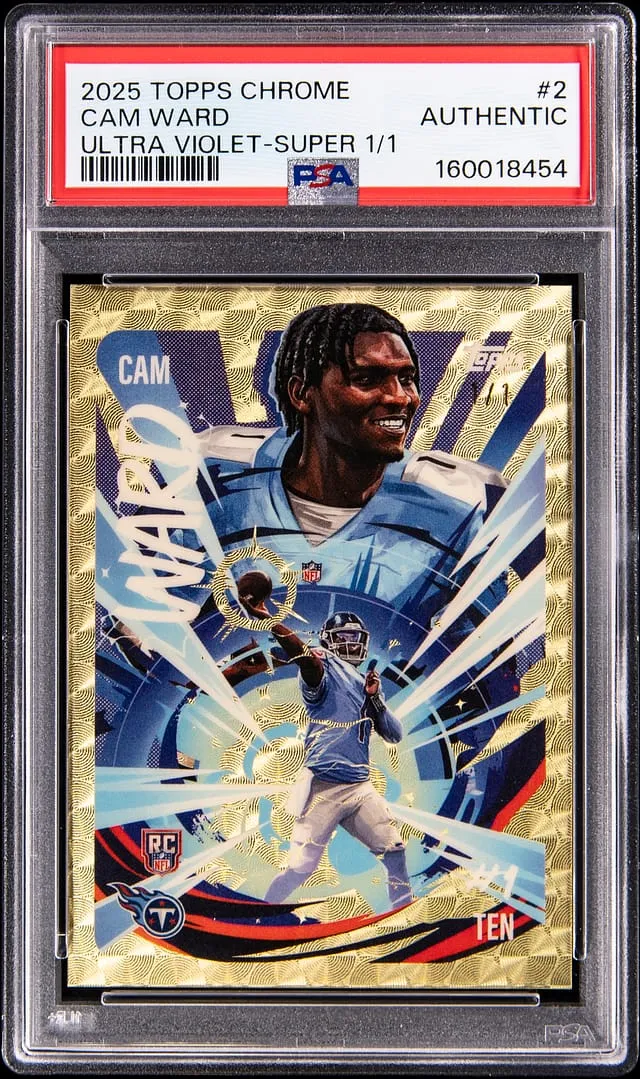
Cam Ward 2025 Ultra Violet SuperFractor 1/1 Sold
Breakdown of the $15,860 Goldin sale of the 2025 Topps Chrome Ultra Violet SuperFractor 1/1 Cam Ward rookie, PSA Authentic.
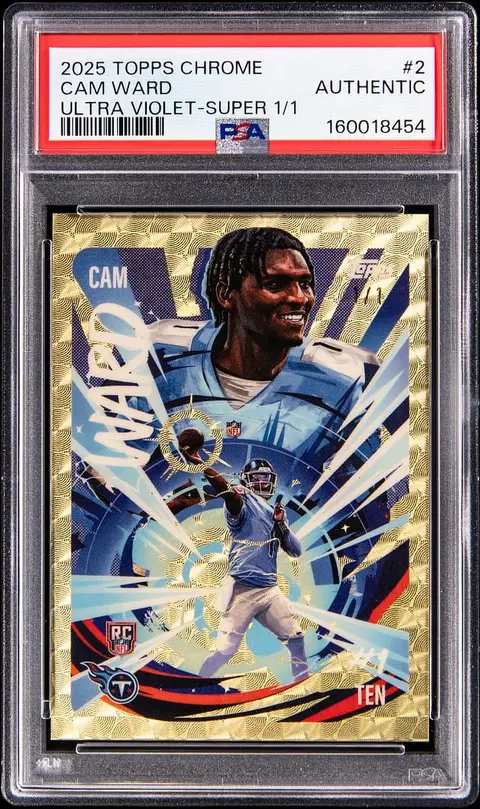
Sold Card
2025 Topps Chrome Ultra Violet SuperFractor #UV-2 Cam Ward Rookie Card (#1/1) - Jersey Number - PSA Authentic
Sale Price
Platform
Goldin2025 Topps Chrome Ultra Violet SuperFractor #UV-2 Cam Ward Rookie Card (#1/1) – Market Notes on a $15,860 Sale
On June 7, 2026, Goldin closed a notable ultra‑modern football sale: a 2025 Topps Chrome Ultra Violet SuperFractor #UV-2 Cam Ward Rookie Card, serial‑numbered 1/1, PSA Authentic, ending at $15,860.
For a quarterback who is still early in his narrative, this result is less about a single auction and more about how the hobby is starting to value top‑end, non‑auto, 1/1 rookie chromium cards from new‑era sets.
Because this product year and parallel are extremely recent, there is limited public sales history. What we can do is set some context around the card, the player, and how this kind of sale typically fits into the broader football market.
Card basics: What exactly sold?
From the auction description and slab info, here’s the breakdown:
- Player: Cam Ward (quarterback)
- Year: 2025
- Set: Topps Chrome
- Subset / Parallel Line: Ultra Violet
- Parallel: SuperFractor (the signature 1/1 chrome finish)
- Card number: #UV-2
- Serial numbering: 1/1, and also matching Ward’s jersey number (jersey‑number 1/1)
- Rookie status: Labeled and treated as a rookie card
- Grading company: PSA
- Grade: PSA Authentic (card is authenticated as genuine; no numeric condition grade is assigned)
A few quick definitions for newer collectors:
- SuperFractor: Topps’ flagship 1/1 parallel in chrome products, with a gold spiral pattern. In modern chromium sets, the SuperFractor is often the top non‑autograph parallel for a given player.
- 1/1: Short for “one of one” – the only copy produced of that exact parallel.
- Jersey‑number 1/1: When the serial number or labeling of the card matches the player’s uniform number. On a true 1/1 like this, “jersey‑numbered” is more about hobby perception than a printed serial, but many collectors still treat it as an extra layer of desirability.
- PSA Authentic: PSA confirms the card is genuine but does not assign a 1–10 condition grade. This is often used when the owner prioritizes authentication over condition, or when the card may be altered, heavily handled, or simply submitted this way on purpose.
Why this card matters to collectors
Even without a season’s worth of NFL stats behind him yet, several factors make this a meaningful piece for Ward collectors and modern football hobbyists:
Top‑end rookie parallel in a chromium flagship line
Topps Chrome has long been a cornerstone chromium brand in baseball, and Topps’ return to football chrome–style products has been closely watched. Within that structure, a SuperFractor remains the top parallel tier for non‑auto cards.True 1/1 rookie of a quarterback
Quarterbacks drive a large share of modern football card demand. A rookie‑year 1/1 SuperFractor is typically considered one of a player’s premium non‑patch, non‑auto rookies.Jersey‑number angle
Jersey‑numbered copies tend to appeal to player‑focused collectors—people who chase a specific athlete more than a specific set. On serial‑numbered cards it is straightforward (e.g., 3/10 for a player who wears #3). On 1/1s, the “jersey‑number” label is more subjective, but it still matters to some segments of the market and can be a conversation point in an auction listing.Ultra‑modern scarcity vs. print‑run reality
We are firmly in the ultra‑modern era (roughly 2018–present), where total product print runs are high, but the most desirable parallels remain extremely scarce. A 1/1 SuperFractor is rare by definition, even if the broader product sees substantial volume.
In short, for collectors who focus on top‑end parallels of skill‑position rookies, this card sits near the top of Ward’s non‑auto rookie card hierarchy.
Market context and comps
Because this specific card is a 1/1 and very newly released, there is, by definition, no direct comp: it is the only copy. However, we can look at adjacent areas to frame the $15,860 price realized at Goldin:
Same player, different parallels
As of early June 2026, publicly reported sales for Cam Ward’s high‑end rookies (on various platforms) show:- Lower‑tier serial‑numbered refractors (for example /99, /75, /50) trading well below this sale, often in the low to mid‑three‑figure range depending on parallel and grade.
- Non‑1/1 color parallels (e.g., Gold /50, Orange /25) occasionally approaching or crossing into four figures when graded highly and sold through major marketplaces.
None of those reach the tier of a SuperFractor 1/1, but they are helpful to understand the slope of demand: each step down in rarity tends to drop off sharply in price.
Other Ward 1/1s across products
Early 1/1s from other Ward issues—such as printing plates or non‑Chrome low‑end plates—have generally sold below this level. That gap makes sense: brand prestige and visual appeal (like the SuperFractor finish) often carry a premium over more utilitarian 1/1s such as plates.Analogues: other modern QB 1/1 chromium rookies
For other quarterbacks from recent years, non‑auto chrome‑style 1/1 rookie parallels (SuperFractors or equivalents) commonly:- Command a large premium over /5 and /10 parallels.
- React strongly to on‑field performance swings, awards, and playoff runs.
While exact dollar amounts vary widely by player and season, the pattern is consistent: the top‑end 1/1 rookie parallel often becomes a focal point for serious player collectors and sometimes for investors.
Grade impact: PSA Authentic vs numeric grade
Most ultra‑modern 1/1 chase cards are submitted for a numeric grade (PSA 8–10, BGS 8.5–10, etc.). A PSA Authentic label can influence value in either direction depending on buyer and context:- Some collectors care primarily about authenticity and rarity; they see little difference, especially if the card visually presents well.
- Others strongly prefer a numeric grade, viewing it as a form of condition certification and liquidity tool.
Because 1/1s cannot be directly cross‑comped, it’s harder to quantify the effect here. It is reasonable to assume that a high numeric grade (e.g., PSA 9 or 10) might have drawn different bidding dynamics, but we do not have a clean comparison point.
With those caveats in mind, the $15,860 sale price looks consistent with how the hobby tends to value top chromium 1/1 rookie parallels of promising quarterbacks in the early stages of their careers, especially when sold by a major auction house like Goldin.
How this sale fits into broader hobby trends
Several ongoing themes in the football card market intersect in this auction result:
Continued focus on ultra‑scarce parallels over base rookies
While raw base rookies and lower‑tier parallels remain important entry points for new collectors, serious budget tends to flow toward:- True 1/1s
- Very low‑serial color (e.g., /5, /10)
- Premium patches and on‑card autographs
This sale is in line with that pattern: a high price for the top 1/1 parallel, while more common versions trade at a fraction of the cost.
Brand and finish still matter
Even with a range of new products, chromium brands (Topps Chrome, Prizm, Optic, etc.) continue to act as benchmarks. Within that environment, a visually distinct finish like the SuperFractor spiral is understood and recognized by a wide range of collectors.Early narrative pricing for young quarterbacks
Ultra‑modern pricing for QB rookies often bakes in a degree of “what could happen later” rather than strictly rewarding past performance. That does not mean buyers expect specific outcomes—it just reflects that there is added attention and volatility in this category.For hobbyists, this means that:
- Prices for high‑end QB rookies can move significantly around draft days, preseason hype, standout games, awards, or injuries.
- Not every sale marks a new baseline; sometimes it reflects a specific moment of optimism or a bidding matchup between a small number of determined collectors.
Authentication first for unique cards
Opting for a PSA Authentic label rather than chasing a numeric grade reinforces a trend we see with certain grail‑type items: owners and buyers want certainty that the card is real and unaltered. Condition still matters, but for some collectors, the uniqueness of a 1/1 overrides the necessity of a 10‑point scale.
Points for collectors, buyers, and small sellers
If you are watching this sector of the market—or thinking about how to approach similar cards—here are a few practical takeaways:
For player collectors
- This specific card is now quietly “placed” in a collection somewhere, and 1/1s often stay off the market for long stretches once they land.
- If you chase Ward, your next‑best options, in terms of scarcity, may be:
- Other 1/1s from different brands or insert lines
- /5 or /10 color parallels
- High‑grade autos or patches from respected products
For set and parallel collectors
- Ultra Violet SuperFractors appear positioned as a chase tier within 2025 Topps Chrome football. Completing rainbows that include a 1/1 is rarely realistic, but securing lower‑serial colors can still be satisfying.
- Tracking these early 1/1 results helps establish a rough hierarchy between Chrome parallels.
For small sellers
When you list a card, clear labeling matters. Including:
- Set, year, and brand
- Parallel name (e.g., “Ultra Violet SuperFractor”)
- Serial numbering and whether it is a rookie card
- Grading company and grade or “Authentic” status
If you hold scarce parallels of young quarterbacks, following major auction house results (Goldin, PWCC, Heritage, etc.) is useful context for setting expectations, even though your card will likely transact at a smaller scale.
For newer collectors
- When people refer to “comps”, they mean comparable recent sales used as a rough price guide. For a unique 1/1, there is no perfect comp; you look instead at parallel structures, other sets, and similar players.
- Pop report (population report) is a grading company’s count of how many copies of a card they have graded at each grade. For 1/1s, pop reports are less relevant for scarcity (the print run is already 1) and more about how often the card has changed hands or been resubmitted.
What this sale does—and does not—tell us
The $15,860 result for the 2025 Topps Chrome Ultra Violet SuperFractor #UV-2 Cam Ward Rookie Card (1/1, PSA Authentic) at Goldin on June 7, 2026, offers a few grounded takeaways:
- It confirms that there is meaningful demand for Ward’s top‑end rookie parallels, especially in recognizable chromium brands.
- It fits within a broader pattern where unique, visually distinctive QB rookie 1/1s command a heavy premium over lower‑serial parallels.
- It highlights how rarity, brand, and player position can matter as much—or more—than a numeric grade, at least for certain buyers.
What it does not offer is a guaranteed template for future pricing. Ultra‑modern football is highly event‑driven: individual sales can spike or soften as player narratives evolve.
For now, this card stands as one of the key Ward pieces to change hands publicly, and a useful reference point for anyone tracking the top end of his market or the early trajectory of 2025 Topps Chrome Ultra Violet parallels.
As always, these observations are about hobby context, not predictions. Prices will move over time as performance, supply, and collector interest change—and that’s part of what keeps the chase interesting for collectors at every level.