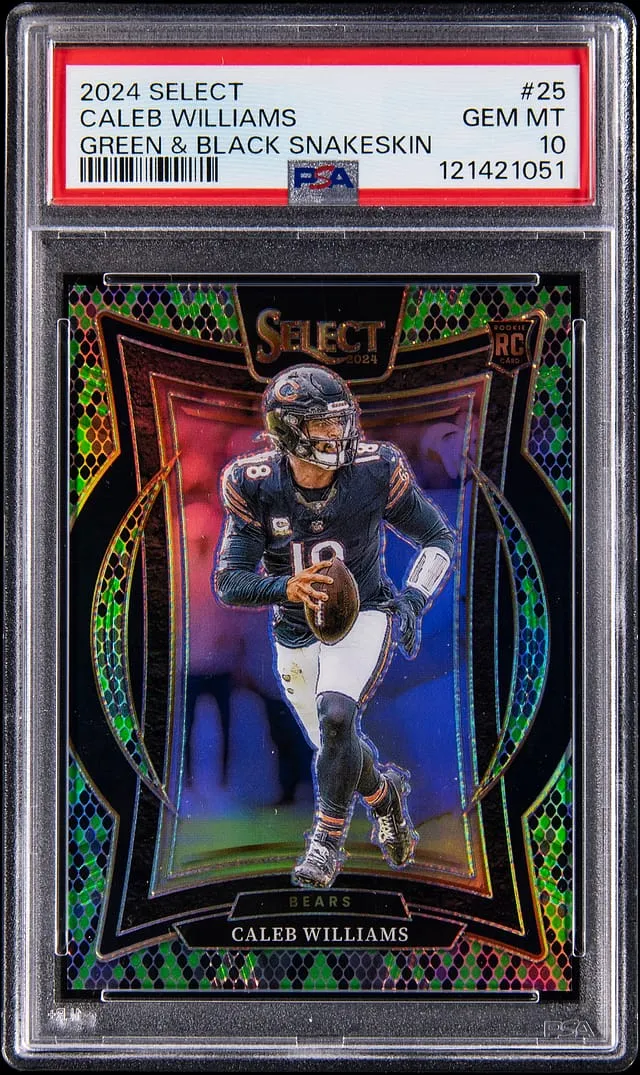
Caleb Williams 2024 Select Snakeskin PSA 10 sells
A PSA 10 Pop 1 2024 Select Green & Black Snakeskin Caleb Williams rookie /2 sold for $31,720 at Goldin on June 7, 2026. Here’s the price context.
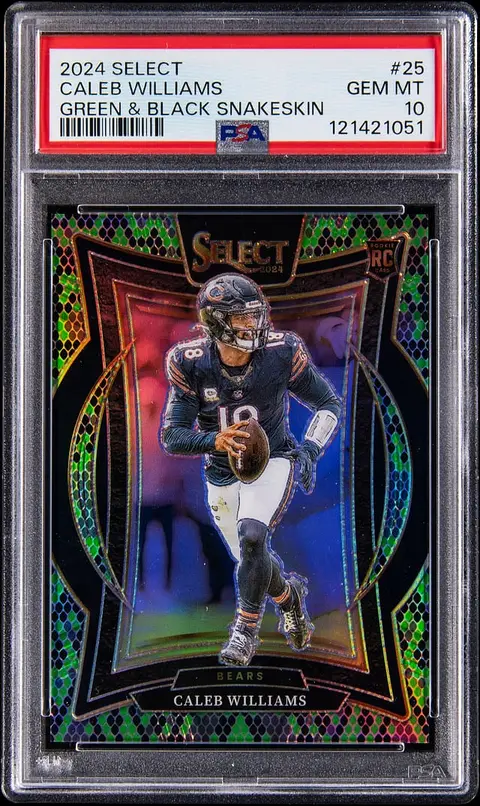
Sold Card
2024 Panini Select Green & Black Snakeskin Prizm #25 Caleb Williams Rookie Card (#2/2) - PSA GEM MT 10 - Pop 1
Sale Price
Platform
GoldinA Green & Black Snakeskin Caleb Williams Rookie Sets the Bar at Goldin
On June 7, 2026, Goldin closed a notable ultra‑modern football sale: a 2024 Panini Select Green & Black Snakeskin Prizm #25 Caleb Williams Rookie Card, serial‑numbered 2/2, graded PSA GEM MT 10 (Pop 1), sold for $31,720.
For a market that has spent several years trying to sort out what truly scarce, truly important parallels look like in football, this card offers a useful case study.
Card overview: what exactly sold?
Let’s break down the card itself before we talk about price:
- Player: Caleb Williams (QB)
- Team (on card): Chicago Bears uniform and branding in 2024 Select
- Year: 2024
- Product: Panini Select Football
- Card number: #25
- Parallel: Green & Black Snakeskin Prizm
- Serial numbering: 2/2 (only two copies produced)
- Rookie card: Yes – this is one of Williams’ key licensed rookie issues
- Grading company: PSA (Professional Sports Authenticator)
- Grade: GEM MT 10
- Population: Pop 1 at PSA in this grade at the time of the sale
“Prizm” in this context refers to Panini’s chrome‑style, reflective finish and parallels. The Green & Black Snakeskin pattern is a very low‑print, visually distinctive parallel in 2024 Select, and the 2/2 serial stamp confirms that only two copies of this specific version exist.
Why this card matters to collectors
Several factors combine to make this an important piece for player collectors and modern football specialists:
Premium rookie from a major chromium set
- Select is one of Panini’s core chromium‑style football brands, alongside Prizm and Optic. It sits in the “mid‑high” tier of modern products with multiple tiers (Concourse, Premier, Field Level, etc.) and a deep parallel ladder.
- While not the only important Williams rookie, a rare Select parallel is typically on the want‑list for serious player collectors.
Extremely low print run (2/2)
- Serial‑numbered cards show the exact quantity printed. A 2/2 means there are only two of this parallel in existence.
- At this level, you’re in true scarcity territory; you are not just competing with other collectors for a "low‑number" card – you’re competing for one of two total copies.
PSA 10 with Pop 1
- “Pop report” (population report) is the grading company’s tally of how many copies of a specific card exist in each grade.
- Pop 1 at PSA means only one example has received a GEM MT 10 so far. Even if the other 2/2 copy is eventually graded, it may or may not match this grade.
- For buyers who care about owning the best‑graded example available, Pop 1 status is a real differentiator.
Ultra‑modern quarterback with outsized attention
- Caleb Williams enters the league with substantial on‑field expectations and hobby visibility.
- Modern and ultra‑modern (roughly late‑2010s onward) cards are heavily driven by current player performance, hype cycles, and media exposure. Quarterbacks, in particular, tend to anchor a product’s singles market.
Putting the $31,720 sale in context
Price alone doesn’t say much without context. Let’s frame this sale relative to what we can observe in the market.
- Comps and close cousins
When collectors talk about “comps,” they mean comparable recent sales – ideally the same card in the same grade, or the closest possible variant. For a 2/2 PSA 10 Pop 1 parallel, exact comps are usually sparse. That means we look to neighboring parallels and other premium Williams rookies from the same general tier.
Across recent public sales and major marketplaces for Caleb Williams’ early football cards (Prizm, Select, Optic, Contenders, and high‑end brands):
- Non‑1/1, non‑autographed color parallels in PSA 10 have been landing well below this mark, as you’d expect for higher‑print or less scarce versions.
- 1/1s and ultra‑low serials (out of 5 or 10) in flagship or near‑flagship products have achieved strong five‑figure prices at auction, especially in top grades or with on‑card autographs.
Within that broader environment, a rare non‑auto 2/2 Select parallel at $31,720 sits in a familiar pocket: high‑end but not record‑shattering relative to the very top of the Williams market (such as superfractors, 1/1 shields, or premium on‑card autographs). It reflects the reality that:
- This is not his absolute “best possible” card, but
- It is comfortably in the tier of scarce, premium rookies that serious collectors chase.
- How does Select typically stack up?
In football, the informal product hierarchy for rookies is still forming and can be subjective, but generally:
- Prizm base and key parallels are often treated as the core “flagship” chromium rookies.
- Select is valued for its multi‑level structure and strong parallel checklist, with certain color/print levels commanding serious attention.
- Contenders (especially Rookie Ticket autos) and National Treasures/Flawless (patch autos and 1/1s) tend to live in the top‑end, autograph‑driven segment.
A low‑serial Select rookie parallel like this one usually finds its buyers among:
- Player collectors trying to build a “rainbow” (one of every parallel of a particular card).
- Investors and collectors who want a scarce, visually strong piece that’s not fully dependent on ink or patches.
- Typical, high, or low?
Because there are only two copies of this exact card and one has now sold as a PSA 10 Pop 1, calling any price “typical” is tricky. The more meaningful takeaway is that this result:
- Aligns with how other premium Caleb Williams rookies have been behaving in public auctions.
- Confirms that highly graded, low‑serial, non‑auto parallels in established brands can sustain solid five‑figure interest.
Without a trail of prior public sales of the exact card, it’s more accurate to see this as an early benchmark rather than as part of a long, stable price history.
What this sale suggests about the Caleb Williams market
- Depth beyond autos and 1/1s
The fact that a non‑autographed 2/2 parallel commands $31,720 signals that demand is not limited to patch autos or logoman‑style grails. Collectors are:
- Differentiating between common color and true low‑print color.
- Paying up for genuine scarcity even without ink, especially in PSA 10.
- Emphasis on grading and condition
In ultra‑modern football, raw (ungraded) copies of high‑end parallels can be pricey, but the biggest premiums tend to appear at PSA 10 (and occasionally BGS 10 / SGC 10) for:
- True low‑print parallels (out of 25 or less, and especially single‑digits like 2/2).
- Distinctive designs such as snakeskin, tiger stripe, or other visually unique patterns.
The Pop 1 designation here is important. When there are only two total copies and only one is a PSA 10, the intersection of print scarcity and grade scarcity is unusually tight. That can influence both how aggressively a buyer bids and how long a seller is willing to wait.
- The risk‑reward profile of ultra‑modern QBs
Quarterback cards are often more volatile than position players because:
- Media narratives around QBs shift quickly.
- Team success and individual performance can move in opposite directions.
Modern collectors who buy at this level are typically aware of that volatility. Instead of chasing guarantees, they’re:
- Placing a long‑term bet on the player’s trajectory.
- Choosing cards that will remain desirable as objects – rare, visually appealing, and graded – even if short‑term sentiment fluctuates.
What this means for collectors and small sellers
If you’re a newer or returning collector, this sale can feel distant, but it still offers useful lessons.
- Learn how rarity is actually defined
On ultra‑modern cards, rarity is not just about how often you see a card for sale. It’s about:
- Serial numbering (e.g., 2/2 vs /199).
- Parallel type (case hits, short prints, color patterns).
- Grading population (Pop 1, Pop 2, etc.).
In this case, you have all three working together:
- Very low serial number (2/2).
- Distinctive Green & Black Snakeskin parallel.
- PSA 10 Pop 1.
- Comps require nuance at the very high end
For common rookies, you can pull up dozens of recent sales and get a clear price lane. For cards like this, comps will be sparse, and you’ll often:
- Compare across nearby parallels and similar brands.
- Adjust expectations for print run and grade.
Looking at this Goldin sale alongside other Williams rookies can help you understand the relative tiers in his market, even if no two cards are truly identical.
- Not every parallel is created equal
Select has a long parallel ladder. Some are:
- Higher‑print color (often numbered /199, /149, etc.).
- Shorter‑print or pattern‑based parallels (like snakeskin, tiger stripe, zebra).
While both can look great in a binder, the market typically assigns more weight to the truly scarce, distinctive patterns – especially when they’re numbered as low as 2/2.
- Use high‑end sales as a map, not a target
Most collectors and small sellers aren’t operating at the $30,000‑plus level, and that’s fine. Instead, you can:
- Use high‑end results as a reference to understand which types of cards drive the most interest.
- Apply those insights at your own price point – for example, preferring low‑numbered parallels or strong grading outcomes for the players you care about.
Key takeaways from the Goldin sale
- Card: 2024 Panini Select Green & Black Snakeskin Prizm #25 Caleb Williams Rookie Card (#2/2).
- Grade: PSA GEM MT 10, Pop 1.
- Auction house: Goldin.
- Sale date: June 7, 2026 (UTC).
- Sale price: $31,720.
For serious Caleb Williams collectors, this is a defining type of piece: not necessarily the absolute top of the pyramid, but firmly in the tier of true chase cards. For the broader football market, it’s another data point showing that:
- Ultra‑low serial, visually unique parallels in established brands can support strong demand.
- Condition and population data (PSA 10, Pop 1) continue to matter, even in a hobby segment already saturated with parallels.
As more 2024 Select Williams cards surface and more copies get graded, this sale will likely serve as an early marker in the price history of one of his scarcest non‑auto rookies. Whether you’re tracking comps for your own cards or simply mapping the evolving Caleb Williams market, it’s a result worth bookmarking.
figoca will keep tracking these high‑end results and their ripple effects on more accessible cards, so you can situate your own collection – and your own decisions – within the wider hobby landscape.