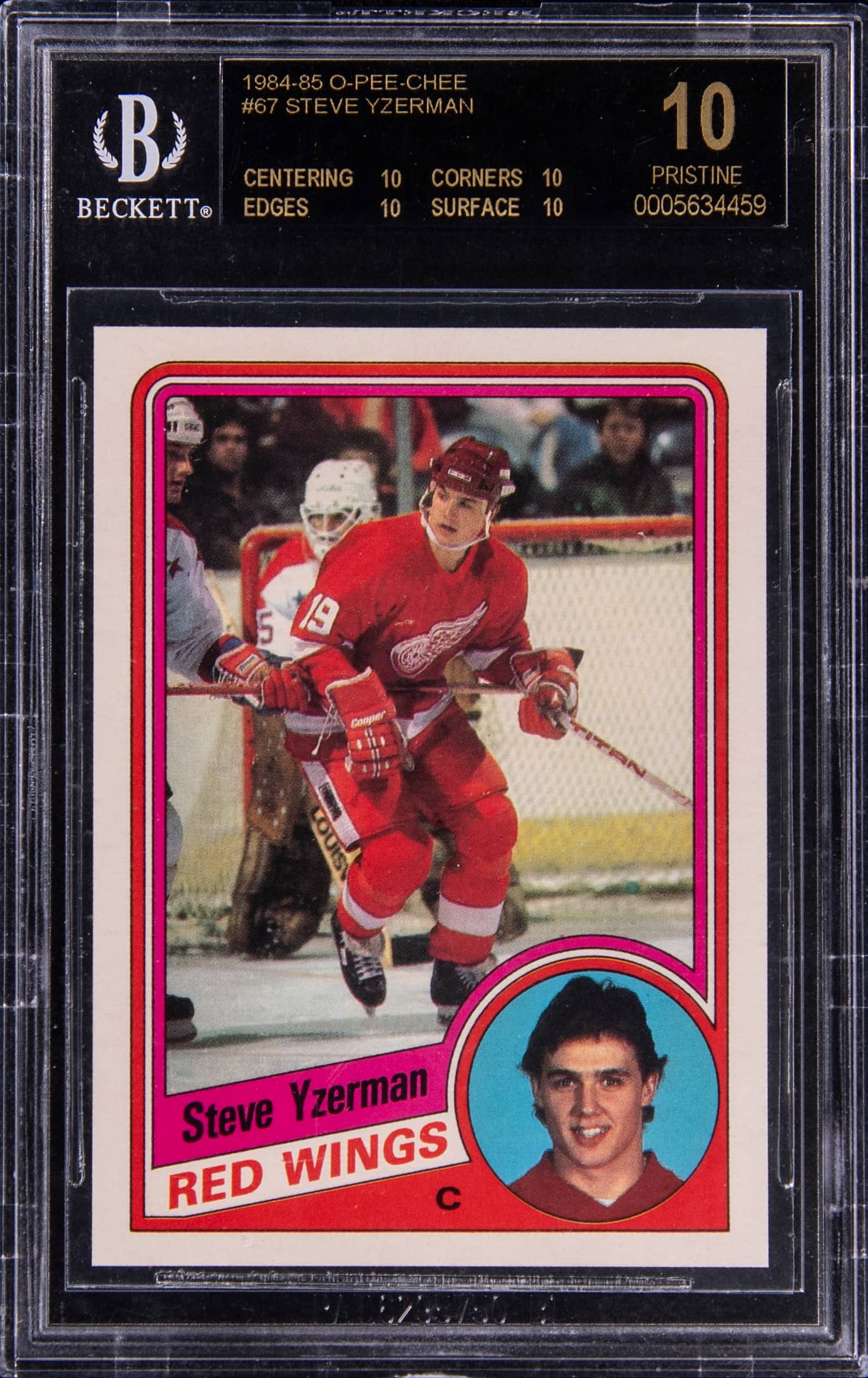
BGS Black Label 1984 OPC Yzerman RC Sells for $19k
Breakdown of a 1984-85 O-Pee-Chee #67 Steve Yzerman BGS Black Label 10 rookie card sale for $19,520 at Goldin on February 8, 2026.
Sold Card
1984-85 O-Pee-Chee #67 Steve Yzerman Rookie Card - BGS PRISTINE/Black Label 10 - Pop 2
Sale Price
Platform
Goldin1984-85 O-Pee-Chee #67 Steve Yzerman Rookie Card - BGS Black Label 10 Sells for $19,520
On February 8, 2026, Goldin sold a 1984-85 O-Pee-Chee #67 Steve Yzerman rookie card graded BGS PRISTINE/Black Label 10 for $19,520. For one of the most important hockey rookies of the 1980s, in one of the toughest possible grades, this is a meaningful data point for high-end vintage hockey.
In this breakdown, we’ll walk through what this card is, why the Black Label matters, and how this sale fits into the broader Steve Yzerman and 1980s hockey market.
The card: Steve Yzerman’s flagship OPC rookie
Card details
- Player: Steve Yzerman
- Team: Detroit Red Wings
- Year: 1984-85
- Set: O-Pee-Chee (OPC)
- Card number: #67
- Type: Rookie card (RC), flagship base card
- Grading company: Beckett Grading Services (BGS)
- Grade: PRISTINE 10, Black Label (all four subgrades 10)
This is Steve Yzerman’s key rookie card in the Canadian O-Pee-Chee release. For 1980s hockey, OPC is generally treated as the premier version versus the Topps counterpart, mainly because of:
- Shorter print runs relative to Topps
- Stronger connection to the hockey market in Canada
- More condition sensitivity due to OPC production quality
What a BGS Black Label 10 means
BGS uses subgrades for centering, corners, edges, and surface. A standard BGS 10 Pristine often has three 10 subgrades and one 9.5. A BGS Black Label 10 means:
- All four subgrades are 10
- The label on the slab is black instead of gold
- It represents the strictest possible standard within the BGS system
For a mid-1980s OPC card, which often suffers from off-centering, rough edges, print defects, and chipping, a Black Label 10 is extremely difficult to achieve. The listing notes a population of 2 in this grade, which lines up with the idea that perfect copies of this card are essentially outliers.
Market context: how does $19,520 fit in?
The Goldin result of $19,520 (February 8, 2026, Goldin) sits at the intersection of three forces:
- High demand for iconic Hall of Fame rookies
- Limited supply of true gem or pristine copies from 1980s OPC
- A niche but serious premium for Black Label 10s
Related sales and pricing tiers
While exact, up-to-the-day comps (recent comparable sales of the same card) for a BGS Black Label 10 Yzerman OPC rookie are sparse due to the population of just 2 copies, we can still frame this price using nearby benchmarks hobbyists often track:
- PSA 10: Gem Mint Yzerman OPC rookies have historically been strong performers, reflecting both player importance and set difficulty. Clean PSA 10s have commanded meaningful four-figure and sometimes low five-figure prices depending on timing, market sentiment, and specific auction exposure.
- BGS 9.5: True gem copies (with strong subgrades) tend to sit in a similar band to PSA 10s or a bit below/above depending on centering and eye appeal.
- Raw and lower grades: Centered, clean raw copies and PSA/BGS 8–9 range cards typically serve as the “accessible” entry point for collectors who want the card without chasing the very top of the population.
Black Label 10s tend to exist in their own lane. Across the hobby, they often trade at a significant premium to PSA 10s and standard BGS 10s, especially for:
- True rookie cards of inner-circle Hall of Famers
- Condition-sensitive 1970s–1980s sets
- Low-pop or pop-1/pop-2 situations
Within that context, $19,520 for a Pop 2 Black Label Yzerman feels consistent with the idea that collectors pay a separate tier for the absolute top of the grading scale. With only two known examples at this level, regular, predictable comps are not realistic. Each sale is more of a one-off event that helps set the narrative for the card’s ceiling in perfect condition.
Why this card matters to collectors
Yzerman’s legacy
Steve Yzerman is widely considered one of the most important players of the modern NHL era:
- Long-time captain of the Detroit Red Wings
- Three-time Stanley Cup champion as a player
- Hall of Famer and later a highly respected executive
For many collectors, Yzerman sits in that tier just below the absolute Mount Rushmore names (Gretzky, Lemieux, Orr), but solidly in the "must-have" category for any serious 1980s hockey run.
The 1984-85 OPC set and era
The 1984-85 O-Pee-Chee release lives in what many call the early vintage/late classic era of hockey.
Key themes for this era:
- Condition sensitivity: OPC printing and cutting were not modern-precise. Off-centering, rough cuts, chipping, and print flaws are common.
- Lower survival rates in high grade: Cards were often played with, stacked, and handled without sleeves or top loaders.
- Growing nostalgia: Collectors who watched Yzerman in his playing prime are now in peak collecting years and often chase the best possible examples of the cards they remember.
Because of these factors, top-grade vintage and 1980s hockey often behaves differently from modern ultra-high-end inserts and patches. Scarcity is less about serial numbering and more about how few copies survived in elite condition.
Grade scarcity and pop report context
A “pop report” (population report) is the grading company’s count of how many copies of a card exist at each grade level.
For this card:
- Lower and mid grades (PSA/BGS 6–8) are relatively common due to the card’s age and popularity.
- High-end grades (PSA 9, BGS 9.5, PSA 10) are much fewer, reflecting how tough it is to find well-centered, clean copies.
- BGS Black Label 10: Pop 2, which puts this sale at the extreme tip of the pyramid.
When a card sits at Pop 2, every sale becomes an important marker. There is no deep history of dozens of Black Label transactions to build an exact price curve. Instead, each appearance at auction helps define what the market is willing to pay for the very best example.
Factors that may support demand
A few hobby and collector dynamics help explain why a Pop 2 Black Label Yzerman is meaningful:
Hall of Fame anchor
Yzerman’s Hall of Fame status and continued visibility as an executive give his rookie card long-term relevance. Collectors tend to gravitate toward established, low-risk legends when they step up to higher price points.OPC vs. Topps preference
While Topps versions have their place, the OPC version of key 1980s rookies is generally treated as the preferred copy in the hockey community, especially among Canadian collectors and hobbyists who grew up opening OPC packs.Growing focus on top-pop cards
Across sports, more collectors are targeting “top-pop” cards (the highest graded examples) as centerpiece items. This is especially true when the pop count is tiny, like 1–3 copies.Condition challenges of mid-80s OPC
The difficulty of achieving even a gem-mint grade in this era makes a Black Label feel qualitatively different, not just one step above a gem.
What this sale might signal to collectors
This Goldin sale doesn’t set a new all-time record for hockey cards, but it does add an important data point for:
- High-end 1980s OPC rookies
- Black Label vintage and semi-vintage cards
- The premium paid for the very best available example of a key Hall of Famer’s rookie
For active collectors and small sellers, here are a few practical takeaways:
- If you own raw or mid-grade Yzerman OPC rookies, this sale won’t instantly transform their value, but it reinforces the card’s status as a core 1980s hockey piece.
- For high-grade copies (PSA 9, PSA 10, BGS 9.5), this result helps frame a wider gap between “true elite” and “top of the bell curve” condition.
- For set builders and player collectors, it underlines how much grading and condition can separate two copies of the “same” card.
This is not a guarantee of future prices, just another data point to understand current demand at the very top of the Yzerman market.
How this fits into the broader hobby
We’re seeing a consistent pattern across sports where:
- Inner-circle or near-inner-circle legends
- In respected, vintage or 1980s sets
- In the very highest available grades
…can command outsized attention when they surface at major auction houses such as Goldin.
This February 8, 2026 sale is another example. The card itself is not rare in absolute terms—thousands of Yzerman rookies exist—but a BGS PRISTINE/Black Label 10, Pop 2 version is a different story.
For collectors who focus on condition, provenance, and long-term hobby history, this Yzerman Black Label sale will likely be a reference point the next time an elite copy surfaces.
Key details at a glance
- Card: 1984-85 O-Pee-Chee #67 Steve Yzerman Rookie Card
- Grade: BGS PRISTINE 10, Black Label (all 10 subgrades), Pop 2
- Auction house: Goldin
- Sale date: February 8, 2026 (UTC)
- Sale price: $19,520
For anyone tracking high-end 1980s hockey, this is a sale worth bookmarking. It captures where the market currently values one of the cleanest known examples of Steve Yzerman’s most important trading card.