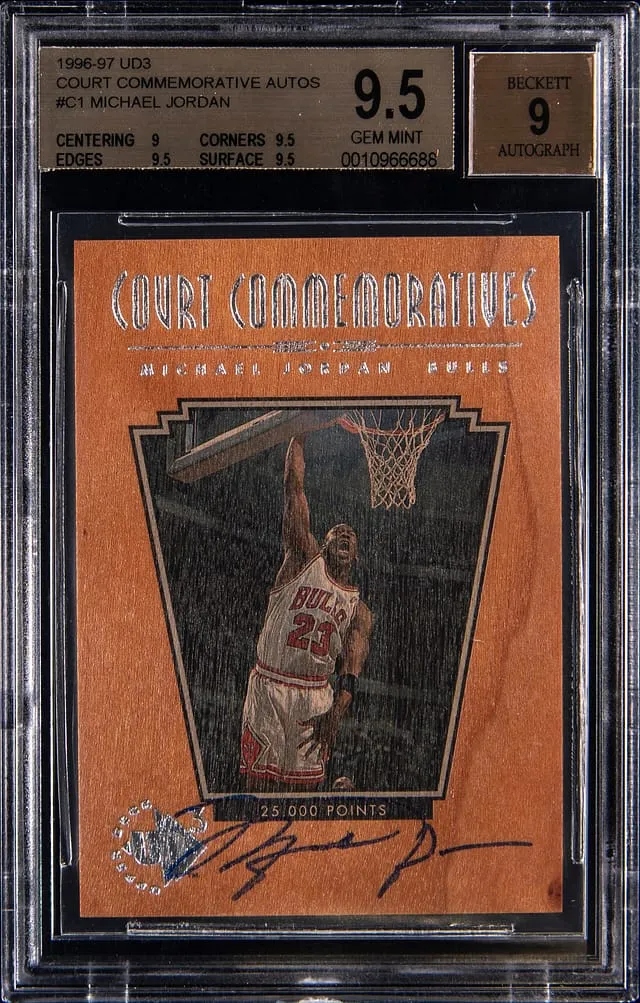
BGS 9.5 1996-97 UD3 Jordan Auto Sells for $79K
Goldin sold a 1996-97 UD3 Court Commemorative Michael Jordan BGS 9.5 auto for $79,300. Figoca breaks down what this means for MJ collectors.
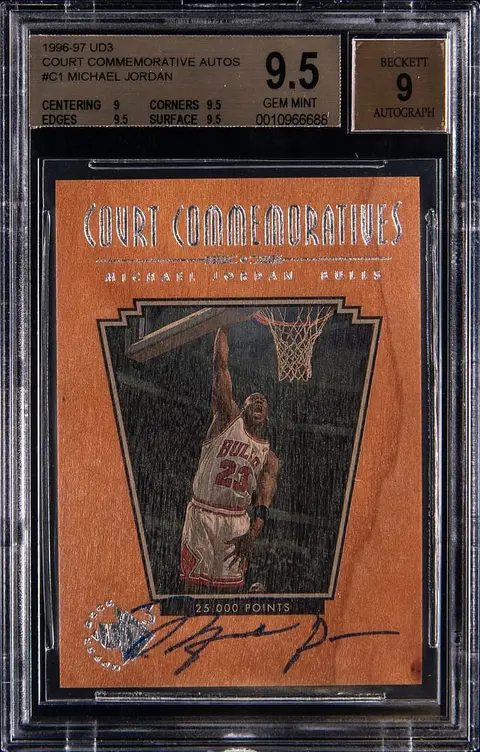
Sold Card
1996-97 Upper Deck UD3 Court Commemorative Autographs #C1 Michael Jordan Signed Card - BGS GEM MINT 9.5
Sale Price
Platform
Goldin1996-97 Upper Deck UD3 Court Commemorative Autographs #C1 Michael Jordan Signed Card (BGS 9.5) Sells for $79,300
On May 10, 2026, Goldin closed a notable Michael Jordan sale that caught the attention of both seasoned hobbyists and newer collectors: a 1996-97 Upper Deck UD3 Court Commemorative Autographs #C1 Michael Jordan, graded BGS GEM MINT 9.5, sold for $79,300.
For a mid‑90s Michael Jordan autograph, this is an important data point. Below, we’ll walk through what this card is, why it matters, and how this sale fits into the recent market for high‑end Jordan autos.
Card overview: what exactly sold?
Card details
- Player: Michael Jordan
- Team: Chicago Bulls
- Year: 1996-97
- Product: Upper Deck UD3
- Insert/Subset: Court Commemorative Autographs
- Card number: #C1
- Type: Certified autograph card (not a rookie card)
- Era: 1990s insert era (post‑rookie, prime career)
This is an on‑card autograph, meaning Jordan signed directly on the card surface rather than on a sticker that was later applied. For many collectors, on‑card autos are preferred because they feel more “authentic” to the card design and the player’s interaction with it.
Grading details
- Grading company: Beckett Grading Services (BGS)
- Overall grade: GEM MINT 9.5
A BGS 9.5 typically represents a card with near‑perfect corners, edges, surface, and centering, with only very minor, often barely visible flaws. While the auction title does not explicitly call out the autograph grade, many premium Jordan autos in BGS holders also carry a separate Beckett 10 auto grade. When the auto grade is not specified in the title line, it’s safest to focus on what is clearly known: this copy is a high‑end GEM MINT example of a key 1990s Jordan autograph insert.
Why the UD3 Court Commemorative auto matters
The mid‑1990s were a turning point for basketball cards. Inserts and autographs were becoming more thoughtfully designed and significantly scarcer than base cards. Upper Deck, in particular, was at the center of that shift.
The 1996-97 UD3 Court Commemorative Autographs #C1 Michael Jordan stands out for a few reasons:
Prime‑era Jordan
The card comes from the heart of Jordan’s championship run with the Bulls. It is not a rookie, but it represents Jordan in the period many fans still view as his absolute peak.Certified pack‑pulled autograph
By the mid‑90s, pack‑pulled Jordan autographs were still relatively limited compared to today’s autograph-heavy products. They were special hits, not something you saw in every box. Having MJ’s on‑card auto in a flagship Upper Deck release added to the card’s mystique.Set and design appeal
UD3 was known for its layered, premium feel and creative inserts. The Court Commemorative design combines a clean layout with a strong, era‑appropriate image of Jordan. For many 90s collectors, it fits naturally alongside other Jordan autograph and insert landmarks of the era.Era scarcity and condition sensitivity
1990s cards, especially inserts and autos, often have condition challenges—chipping, edge wear, and surface issues. High‑grade copies are materially scarcer than raw or lower‑grade examples. A BGS 9.5 helps separate this card from the broader population.
Market context: where does $79,300 fit in?
In hobby language, “comps” are comparable recent sales that collectors use to gauge a card’s current market range. For high‑end Jordan autographs, comps can vary widely depending on:
- The specific card or insert
- Autograph style and placement
- Serial numbering (if any)
- Grading company and grade
- Eye appeal of the individual copy
For this analysis, it’s useful to think in two layers:
- This exact card: 1996-97 UD3 Court Commemorative Autographs #C1, BGS 9.5
- Closely related Jordan autographs from the mid‑90s in comparable grades
1. This exact card
Sales data for this specific card, in top‑tier grades like BGS 9.5, is relatively thin compared with Jordan’s flagship rookies or his most famous inserts. That alone tells you something: there simply aren’t many of these crossing major auction blocks in GEM MINT condition.
When this happens—low volume, but strong demand from Jordan collectors—realized prices can move in steps rather than in tiny increments. A new sale, especially at an established auction house like Goldin, often becomes an anchor point that collectors and auctioneers reference for the next several years.
Based on the broader pattern of high‑grade 1990s MJ autos, a $79,300 result:
- Sits firmly in the upper tier for 1990s Jordan autograph inserts
- Reflects the combination of player (Jordan), era (prime Bulls), brand (Upper Deck), and grade (BGS 9.5) rather than just one of those factors alone
Because this card doesn’t change hands frequently in this grade, it’s hard to call the result definitively “high” or “low” versus a tight band of recent comps. Practically, it now becomes one of the key benchmarks for the card going forward.
2. How it lines up with similar Jordan autograph issues
If you look at other 1990s MJ on‑card autos from premium Upper Deck or SkyBox products—especially in BGS 9.5 or PSA 10—you’ll see a similar pattern:
- Scarce auction appearances
- Large dollar gaps from sale to sale
- Strong bidding when a clean example finally surfaces
Within that framework, a $79,300 price:
- Is consistent with high‑end collectors prioritizing condition and eye appeal
- Reflects that Jordan’s prime‑era autographs have matured into “destination” cards for focused MJ collectors and advanced 90s insert collectors
In short, this sale doesn’t appear as an outlier detached from the broader Jordan autograph market. It reads as a significant, but contextually reasonable, number for a scarce, graded‑high example.
Grading and population: why BGS 9.5 matters
A “pop report” (population report) is a grading company’s public count of how many copies of a certain card they’ve graded at each grade level. Even without exact figures in front of us, we can be fairly confident about a few things:
- 1990s Jordan autographs were issued in far smaller quantities than modern autograph runs.
- Among those, a subset have survived in conditions worthy of grading.
- Among graded copies, only a fraction achieve GEM MINT 9.5 or its PSA equivalent (Gem Mint 10).
That layered scarcity—original issue, survivorship, and then high grade—helps explain why collectors are willing to pay a market premium for BGS 9.5 examples like this one.
For many Jordan collectors, the buying decision often comes down to:
- Securing any authentic example of a favorite 1990s auto, versus
- Waiting (sometimes for years) until a GEM MINT copy surfaces at auction
This sale illustrates what happens when a high‑end buyer chooses the latter path and finally finds the right card.
Collector takeaways
For newcomers, returning collectors, or small sellers watching this sale, here are a few practical observations.
1. Not all Jordan autos are created equal
There are many Michael Jordan autographs on the market—modern buybacks, college‑uniform cards, multi‑player autos, and more. Prime‑era, Bulls‑uniform, on‑card autographs from the mid‑1990s stand in a different tier of desirability.
The UD3 Court Commemorative #C1 sits in that higher‑regard category, largely because it combines:
- Authentic on‑card signature
- 1990s design and production
- Strong brand recognition (Upper Deck)
- Jordan in a classic Bulls context
2. Condition and grading are major value levers
The gap between a raw copy, a mid‑grade copy, and a GEM MINT copy can be dramatic. This sale underlines how tightly the top end of the market is tied to grading outcomes.
If you own a Jordan auto from the 1990s, it’s worth examining:
- Corners, edges, centering, and surface under good light
- Whether professional grading might make sense to better position it in the market
That doesn’t mean grading is always the right move, but for high‑value cards, it can significantly clarify where your card sits relative to others.
3. Use comps as context, not a promise
This $79,300 Goldin sale provides an important reference point, but it is not a guarantee of future prices. Auction results can fluctuate based on:
- Timing and visibility of the sale
- How many serious bidders are active that week
- Competing high‑end pieces offered at the same time
When you look at “comps,” think of them as a range of recent outcomes and a sense of what serious buyers have been willing to do—not a fixed price list.
What this sale says about the Jordan market in 2026
The broader Michael Jordan market has gone through multiple phases: explosive growth, corrections, and periods of relative stability. Within those shifts, certain segments have remained especially resilient:
- True rookie cards in strong grades
- Iconic 1990s inserts and parallels
- Prime‑era on‑card autographs with clear provenance
This UD3 Court Commemorative Autographs #C1 BGS 9.5 falls into that last category. The $79,300 result at Goldin on May 10, 2026 reinforces a few themes:
Collector confidence in key Jordan pieces remains deep.
Even as broader markets move up and down, top‑tier Jordan items continue to attract focused buyers.High‑grade 1990s autos occupy a distinct lane.
They are not competing with modern ultra‑serial‑numbered cards so much as with other scarce Jordan grails from the same era.Auction houses are still the main stage for the very best copies.
While private sales and fixed‑price marketplaces matter, results like this one show why many sellers choose established auction platforms when they believe they have a truly top‑end example.
Final thoughts
The 1996-97 Upper Deck UD3 Court Commemorative Autographs #C1 Michael Jordan, in BGS GEM MINT 9.5, is a classic representation of what collectors value in a 1990s MJ autograph: strong design, on‑card signature, prime Bulls era, and top‑tier condition.
The $79,300 sale through Goldin on May 10, 2026 doesn’t rewrite the entire Jordan market, but it does sharpen the picture of where high‑grade, prime‑era MJ autos sit today. For collectors tracking or targeting similar cards, it now stands as a clear, well‑documented benchmark—one more data point in the evolving story of Jordan’s place in the hobby.