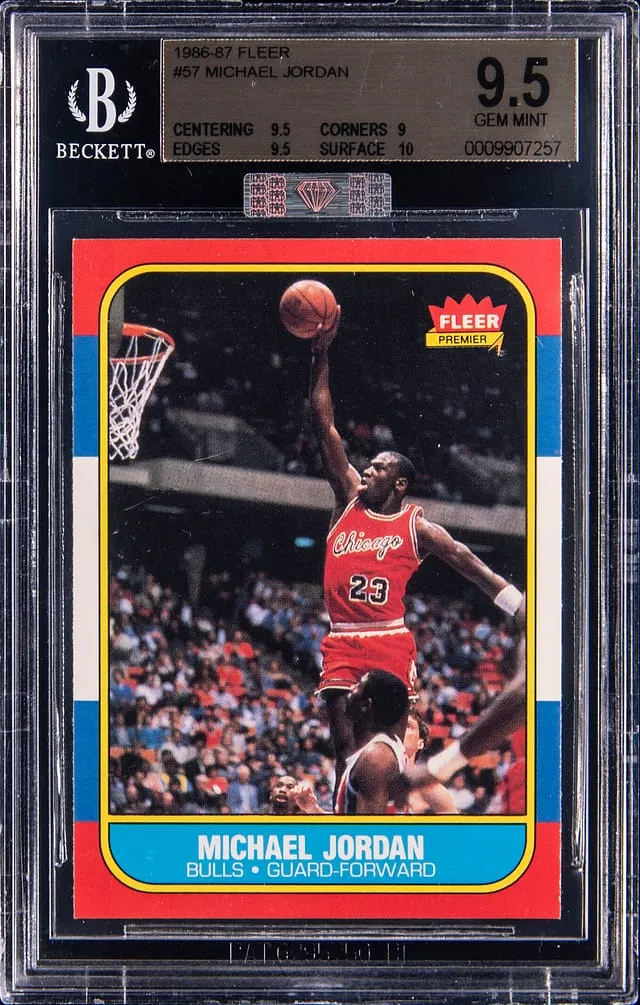
BGS 9.5 1986 Fleer Michael Jordan Rookie Sale
Goldin sold a BGS 9.5 1986-87 Fleer Michael Jordan rookie for $68,320. See where this gem mint copy fits in today’s Jordan and vintage market.
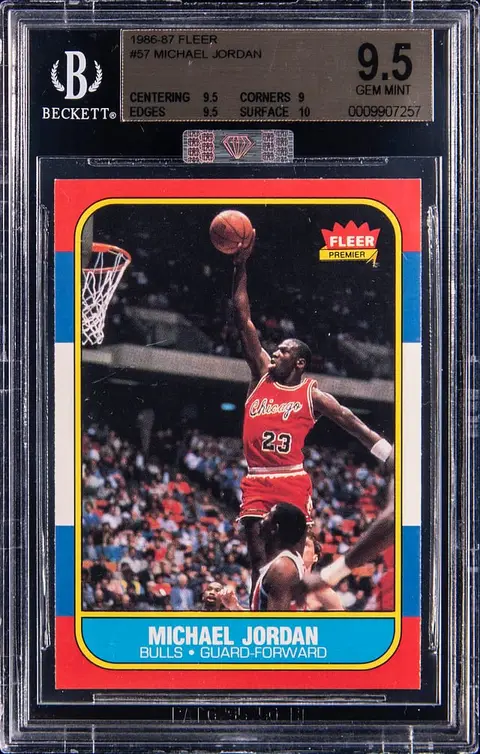
Sold Card
1986-87 Fleer #57 Michael Jordan Rookie Card - BGS GEM MINT 9.5 - MBA Silver Diamond Certified
Sale Price
Platform
Goldin1986-87 Fleer Michael Jordan Rookie cards sit at the center of the basketball hobby, and high-end graded copies continue to define the market for vintage and “junk wax era” basketball. On June 7, 2026, Goldin sold a 1986-87 Fleer #57 Michael Jordan Rookie Card graded BGS GEM MINT 9.5 with MBA Silver Diamond Certification for $68,320.
In this breakdown, we’ll look at what this specific card is, how this price fits into recent sales (“comps”), and why collectors still pay attention every time a strong Jordan rookie changes hands.
The card at a glance
- Player: Michael Jordan
- Team: Chicago Bulls
- Year / Set: 1986-87 Fleer Basketball
- Card number: #57
- Type: Flagship rookie card (widely treated as Jordan’s key pack-issued rookie)
- Grading company: Beckett Grading Services (BGS)
- Grade: GEM MINT 9.5
- Additional certification: MBA (Mike Baker Authenticated) Silver Diamond
- Sale price: $68,320
- Auction house: Goldin
- Sale date (UTC): 2026-06-07
There’s no serial numbering, autograph, or memorabilia patch here. The appeal is almost entirely about the card’s status as the iconic Jordan rookie combined with a high, modern third-party grade.
Why the 1986-87 Fleer Jordan #57 matters
For many collectors, this is the Jordan card:
- It’s his widely recognized pack-issued NBA rookie from a mainstream set.
- 1986-87 Fleer is a cornerstone release that re-launched major basketball card production after a relatively quiet early-1980s landscape.
- The design is instantly recognizable: red-white-blue border, Bulls warm-ups, and that mid-air drive to the basket.
Even though the 1980s are sometimes grouped into the “junk wax era” (a period when card production ramped up), high-grade examples of this Jordan still feel scarce because of centering issues, border chipping, and print defects. That’s where grading and sub-grades matter.
Understanding the grade: BGS 9.5 GEM MINT + MBA Silver Diamond
A BGS 9.5 GEM MINT is one of the highest widely available grades for this card. Beckett typically uses four sub-grades—centering, corners, edges, and surface—each on a 1–10 scale. Many collectors pay close attention to these sub-grades, especially for iconic cards like the Jordan rookie.
The additional MBA Silver Diamond sticker comes from Mike Baker Authenticated, a service that reviews already-graded cards and assigns a quality tier (such as Silver, Gold, or Black Diamond) based on how strong the copy is within its numeric grade. Silver Diamond generally indicates a solid, above-average example for that grade but not the very top of the scale.
So, while this is not a BGS 10 Pristine or an MBA Gold/Black-level outlier, it’s still a very strong, gem mint copy of one of the hobby’s key cards.
Market context: how $68,320 fits into recent sales
When collectors talk about “comps,” they mean comparable recent sales—past auction or marketplace results for the same card (and grade) that help frame what a current price looks like.
For the 1986-87 Fleer Jordan, a rough hierarchy of value usually looks like this:
- PSA 10: Historically the premium benchmark, especially for registry-focused collectors. High six figures in peak periods, with some past sales well over that during the 2020–2021 surge.
- BGS 9.5: Typically trades at a discount to PSA 10, but with premiums for strong sub-grades and eye appeal.
- PSA 9 and BGS 9: More accessible but still significant, especially in today’s more data-aware market.
In the last few years, prices for this card have cooled from the 2021 spike but continue to find a floor based on sustained long-term demand for Jordan and for this specific rookie. BGS 9.5 copies have often settled in a range below PSA 10 but comfortably above PSA 9, with individual results influenced by:
- Sub-grades and overall centering
- Eye appeal (print dots, color saturation, border chipping)
- Additional endorsements like MBA stickers
- Provenance and the reputation of the auction house
Within that context, $68,320 for a BGS 9.5 with MBA Silver Diamond at Goldin reads as a strong but not outlandish result: solidly in the premium segment for gem mint Jordan rookies in a more mature, post-boom market.
Because exact up-to-the-week comp data changes quickly, the most useful takeaway for collectors is relative positioning:
- This sale sits clearly above typical PSA 9 and BGS 9 levels.
- It remains below PSA 10 territory, which still commands a significant premium.
- The MBA Silver Diamond and Goldin’s broad audience likely helped support the realized price.
Collector significance and demand drivers
Several long-running themes support demand for this card:
All-time player status
Jordan is firmly in the all-time great conversation. That matters because demand is less tied to short-term performance and more to long-term legacy.Flagship rookie from a historic set
While earlier Jordan cards exist (such as Star issues), the 1986-87 Fleer #57 is the widely accepted mainstream rookie that anchors many collections.Era and condition sensitivity
Centering, color, and border chipping make high-grade copies meaningfully harder to find than raw population numbers might suggest. This is where grading and secondary review (MBA) continue to play a big role.Stable, global collector base
Jordan’s brand and the Bulls dynasty have worldwide reach. That broad base helps support a consistent stream of buyers and sellers around marquee auctions.
Recent hobby cycles have seen price volatility across many modern and ultra-modern cards, but the Jordan Fleer rookie tends to function as a reference point. Collectors often watch these sales not just to track Jordan, but to gauge sentiment toward blue-chip vintage and 1980s keys in general.
What this sale might signal for the market
While no single auction sets the market by itself, a $68,320 result for a BGS 9.5 MBA Silver Diamond at a major house like Goldin suggests:
- Continued depth of demand for high-end Jordan rookies, even outside PSA 10 territory.
- Ongoing segmentation by eye appeal, where extra layers of review, like MBA designations, help differentiate copies within the same numeric grade.
- A maturing price environment, where results are more closely anchored to historical comps and less to short-term speculation.
For newcomers and returning collectors, this sale is a reminder that:
- Not all 1986-87 Fleer Jordan rookies are valued equally; grade, sub-grades, and visual appeal create large differences.
- Auction-house context and additional certifications can nudge a card’s final hammer price.
- Tracking a handful of recent sales across grades (PSA 9, PSA 10, BGS 9, BGS 9.5) provides a more reliable picture than focusing on one headline result.
Takeaways for collectors and small sellers
If you own or are considering a 1986-87 Fleer Jordan:
- Know your grade and sub-grades. A BGS 9.5 with strong centering and corners can behave differently in the market than one with weaker sub-grades.
- Compare multiple comps. Use several recent auction results, not just the highest or most talked-about sale, to get a realistic range.
- Look beyond the label. Services like MBA exist because eye appeal varies; two cards with the same grade can look very different side by side.
If you’re newer to the hobby, this Goldin sale on June 7, 2026, illustrates how a single iconic card can act as a benchmark for an entire segment of the market. The numbers will move over time, but the core story—Jordan, 1986-87 Fleer, and the chase for the sharpest possible copy—continues to shape how basketball collectors think about value, scarcity, and history.