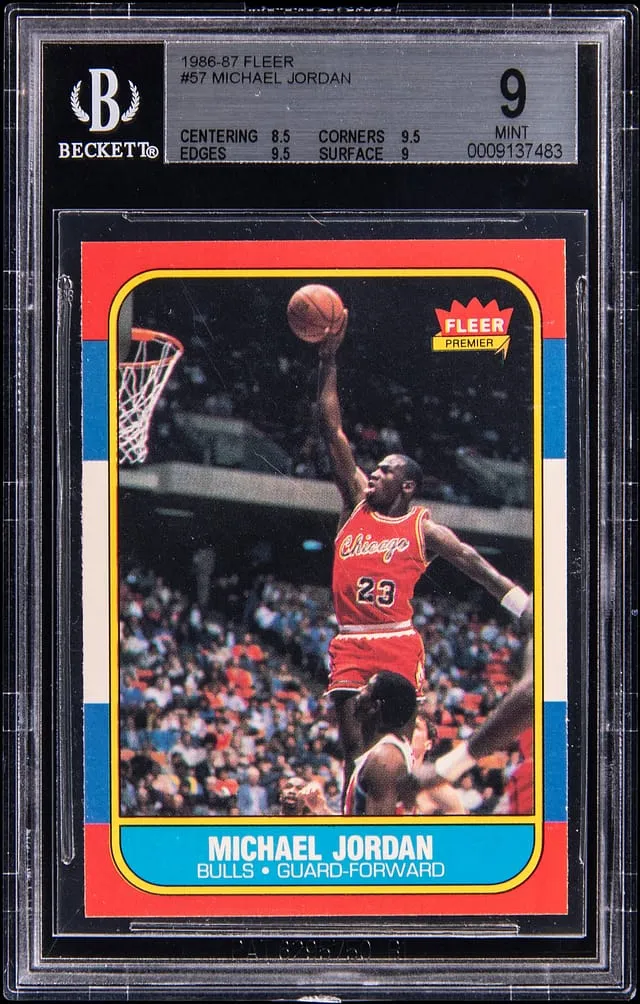
BGS 9 1986 Fleer Michael Jordan Rookie Sells for $20K
Goldin sold a BGS 9 1986-87 Fleer #57 Michael Jordan rookie card for $20,130 on May 8, 2026. See how this result fits recent comps and hobby context.
Sold Card
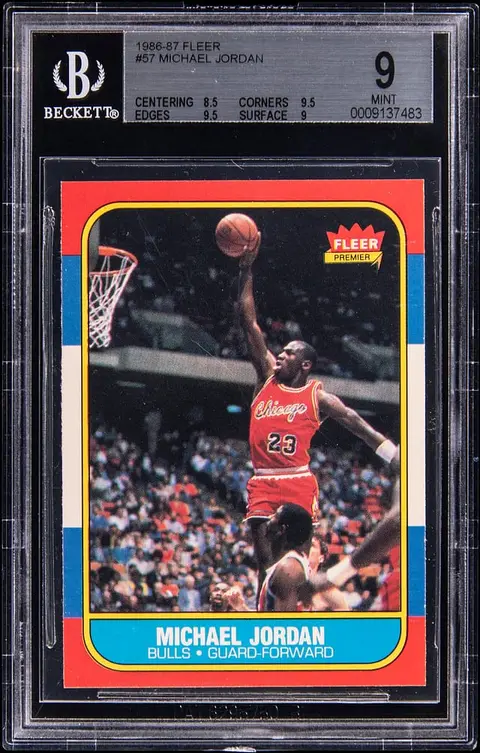
1986-87 Fleer #57 Michael Jordan Rookie Card - BGS MINT 9
Sale Price
Platform
Goldin1986-87 Fleer #57 Michael Jordan Rookie Card - BGS MINT 9 Sells for $20,130
On May 8, 2026, Goldin closed a copy of one of the most recognizable basketball cards ever made: a 1986-87 Fleer #57 Michael Jordan rookie card, graded BGS MINT 9, at a final price of $20,130.
For many collectors, the Jordan Fleer rookie is the entry point into vintage and 1980s basketball. This sale offers a useful, data-backed checkpoint for where a strong BGS 9 currently sits in the market.
The card at a glance
- Player: Michael Jordan
- Team: Chicago Bulls
- Year / Set: 1986-87 Fleer Basketball
- Card number: #57
- Status: Widely recognized as Jordan’s premier pack-issued rookie card
- Grading company: Beckett Grading Services (BGS)
- Grade: MINT 9
- Auction house: Goldin
- Sale date: May 8, 2026 (UTC)
- Sale price: $20,130
This is a standard base copy of the card (not a parallel, autograph, or patch). Its appeal comes from its status as Jordan’s iconic rookie, the importance of the 1986-87 Fleer set, and the condition.
Why the 1986-87 Fleer Jordan matters
For newer or returning collectors, it helps to frame why this particular Jordan card carries so much weight:
- Flagship rookie: While Jordan has earlier “XRC” (extended rookie) and star company issues, the 1986-87 Fleer #57 is widely treated as his flagship pack-pulled rookie.
- Era significance: The 1986-87 Fleer release effectively rebooted mainstream basketball cards after a quiet first half of the 1980s. It’s one of the cornerstone sets for the sport.
- Design and recognition: The bold red, blue, and yellow border, combined with Jordan’s soaring baseline shot, make the card instantly recognizable even to casual fans.
- Cross-collector demand: This card draws interest from basketball fans, Jordan fans, 80s nostalgia collectors, and general sports-card investors alike, creating a deep demand base.
From a hobby-era perspective, the 1986-87 Fleer set sits between what many call vintage and the later “junk wax” period. It was printed more than truly vintage sets from the 1950s–70s, but far less than the overproduced early 1990s. That middle ground is part of why condition and grading matter so much.
Understanding the grade: BGS MINT 9
A BGS MINT 9 means the card shows only very minor flaws: typically a bit of edge or corner wear, a print dot, or slight centering issues. Jordan Fleer rookies are notorious for:
- Off-centering: Many copies are noticeably shifted left/right or top/bottom.
- Print defects: Fish-eyes, color breaks, and surface dots are common.
- Edge and corner chipping: The colored borders make any whitening stand out.
Because of those condition challenges, high grades command a strong premium. BGS 9 sits in the upper tier of the population, below top-end BGS 9.5 (GEM MINT) and BGS 10 (PRISTINE). While population reports ("pop reports") can change over time as new cards are graded, they generally show far fewer BGS 9s and above compared to lower grades.
In collector language:
- A “pop report” is the grading company’s tally of how many copies of a card exist in each grade.
- “Comps” (comparable sales) are recent auction or marketplace results used as reference points when evaluating a card’s current price level.
Recent market context for BGS 9 Jordan rookies
Within the last few years, the 1986-87 Fleer Jordan rookie has been one of the most closely tracked cards in the hobby.
While exact realized prices move with broader market conditions, a general pattern has emerged:
- PSA 10 examples have historically commanded the largest premiums, with headline sales in the six-figure range during peak demand periods.
- PSA 9 / BGS 9.5 sit in the next tier, often seeing strong five-figure results.
- BGS 9 traditionally prices below BGS 9.5 and PSA 9 but above strong BGS 8.5 copies.
This specific sale at $20,130 through Goldin puts a BGS MINT 9 example clearly into the solid five-figure bracket. Compared with a wide range of recent sales for BGS 9 copies, this price sits in what can reasonably be viewed as a competitive, market-reflective range for a well-presented copy sold through a major auction platform.
The card has experienced notable cycles over time:
- A sharp run-up in prices during periods of heightened interest in Jordan (for example, around major documentary releases and hobby booms).
- Subsequent corrections as overall sports card markets cooled from peak levels.
- More recently, a settling into a band where serious collector demand and available supply are finding a new balance.
This Goldin result fits into that more mature phase of pricing: still a premium figure, but anchored by a long track record of auction data rather than a single spike.
How this sale fits into the broader Jordan RC picture
To understand one BGS 9 sale, it helps to place it among closely related versions:
- PSA 10: Top-of-the-line condition, often drawing the most headlines. Historically far more expensive than BGS 9s and 9.5s due to scarcity at that grade.
- BGS 9.5 (GEM MINT): Sits between BGS 9 and PSA 10 in most pricing ladders, often trading at a noticeable premium over BGS 9 due to stricter subgrades.
- PSA 9 / BGS 8.5: These form the “middle lanes” and can show more volatility as they are accessible to a wider buying pool.
A $20,130 sale for a BGS 9 helps:
- Anchor the mid-high tier: It provides a current data point for collectors and small sellers when thinking about where BGS 9 sits relative to PSA 9, BGS 9.5, and strong BGS 8.5 copies.
- Clarify condition premiums: The difference between a well-centered, clean BGS 9 and a weaker-looking 9 can be meaningful. Strong eye appeal can show up in the final auction number.
- Support cross-grade comparisons: Collectors can use this sale alongside PSA 8, PSA 9, and BGS 9.5 comps to estimate relative value steps between grades.
Why collectors still chase this card
Even with newer, flashier cards in the hobby (autographs, patches, numbered parallels), the 1986-87 Fleer Jordan rookie maintains consistent interest because it offers:
- Historical significance: It links directly to the beginning of Jordan’s NBA cardboard legacy.
- Cultural impact: Jordan’s global influence keeps demand broad and multi-generational.
- Recognizable benchmark: For many, owning a Jordan Fleer rookie—at almost any grade—is a collecting milestone.
The card also appeals to different collecting approaches:
- PC (personal collection) buyers who simply want Jordan’s flagship rookie in a grade they’re comfortable with.
- Set builders working on full 1986-87 Fleer runs.
- Condition-focused collectors chasing specific label/grade combinations (for example, BGS 9 with particular subgrade spreads).
What this means for newcomers and small sellers
If you’re newer to the hobby or returning after a break, here are a few practical takeaways from this Goldin sale:
- Grading tiers matter. Pricing can change significantly between an 8, 8.5, 9, and 9.5 on this card. When you look at comps, match the grade and grading company as closely as possible.
- Auction context matters. Results from established auction houses like Goldin can vary from fixed-price listings or smaller marketplaces. The buyer pool, marketing, and timing all play roles.
- Condition within the grade still counts. Not all BGS 9s are equal. Centering, color, and overall eye appeal can influence how strong a result looks compared to other sales at the same grade.
- Use multiple data points. One result at $20,130 is informative, but it becomes much more useful when viewed alongside several recent sales of the same card and grade.
Final thoughts
The May 8, 2026 Goldin sale of a 1986-87 Fleer #57 Michael Jordan Rookie Card in BGS MINT 9 for $20,130 reinforces this card’s role as a central reference point in the basketball card market.
For longtime hobbyists, it’s another data point in a decades-long pricing history. For newer collectors, it’s a clear, recent example of how era, player, set, and condition come together to shape what the market is willing to pay.
As always, the most important question is not what the last comp was—but what the card means to you. The Jordan Fleer rookie remains one of the rare cards that can answer both sides of that equation: emotional connection and a long, well-documented market track record.