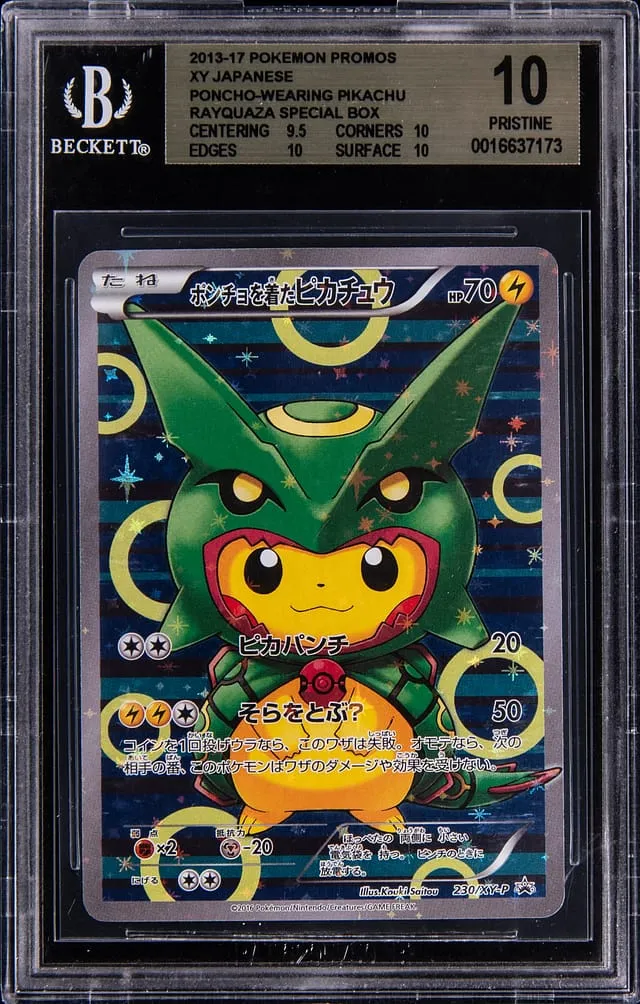
BGS 10 Poncho-Wearing Pikachu Rayquaza Sells for $12K
Goldin sold a BGS Pristine 10 Poncho-Wearing Pikachu Rayquaza promo for $12,204 on March 2, 2026. See how this key Japanese card fits current comps.
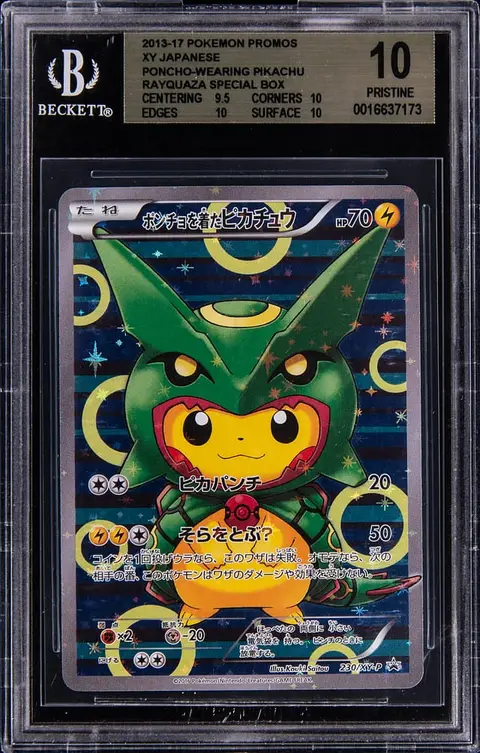
Sold Card
2013-17 Pokemon XY Japanese Promos Rayquaza Special Box #230 Poncho-Wearing Pikachu - BGS PRISTINE 10
Sale Price
Platform
Goldin2013-17 Poncho-Wearing Pikachu BGS 10 Pristine Sells for $12,204
On March 2, 2026, Goldin sold a 2013-17 Pokémon XY Japanese Promos Rayquaza Special Box #230 Poncho-Wearing Pikachu graded BGS PRISTINE 10 for $12,204. For a modern-era promo card, that is a serious result and an interesting data point for collectors who follow Japanese exclusives and character-based chase cards.
In this breakdown, we’ll walk through what this card is, why collectors care about it, how this price fits into recent sales, and what it might suggest about the broader market for Poncho-Wearing Pikachu and high-grade Japanese promos.
Card overview: what exactly sold?
- Character: Pikachu (wearing Rayquaza poncho)
- Year / era: 2013–2017 Pokémon XY era (ultra-modern, but pre-Sun & Moon)
- Release: Japanese Promo – Rayquaza Special Box
- Card number: #230
- Variant: Poncho-Wearing Pikachu (Rayquaza poncho artwork)
- Grading company: Beckett Grading Services (BGS)
- Grade: PRISTINE 10 (typically three 10 subgrades and one 9.5, or better)
- Attributes: Non-serial-numbered promo, Japanese exclusive, character-themed chase card rather than a traditional “hit.”
This is not a rookie card (a concept that applies more to sports) but it is a key issue within the Poncho-Wearing Pikachu run. The Rayquaza poncho artwork has become one of the more recognizable crossovers in the line, bringing together the hobby’s mascot with one of the most popular legendary Pokémon.
Why Poncho-Wearing Pikachu promos matter
The Poncho-Wearing Pikachu series consists of several Japanese-exclusive promos in which Pikachu cosplays as other popular Pokémon (like Charizard, Rayquaza, Mega evolutions, and others). These promos usually:
- Are tied to special products or events rather than standard booster boxes.
- Feature unique artwork that never appears in English sets.
- Have relatively constrained distribution, especially compared to mass-release English cards.
Collectors care about this particular subgroup because it sits at the intersection of three strong demand drivers:
- Pikachu collecting – Pikachu is one of the deepest character PCs (personal collections) in the hobby. Serious Pikachu collectors target unusual, art-driven promos like this.
- Rayquaza popularity – Rayquaza is a top-tier legendary with a strong following, especially around its EX and GX eras.
- Japanese promo culture – Japanese exclusives often have tighter print runs, strong design, and a history of being underappreciated outside Japan until supply dries up.
XY-era Japanese promos are ultra-modern in age, but many releases were not printed at the scale we now see in later Sword & Shield sets. That mix of eye-catching art, character crossover, and relatively lower availability has helped Poncho-Wearing Pikachu become a standalone mini-collection for a lot of hobbyists.
Understanding the BGS Pristine 10 grade
This copy is graded BGS PRISTINE 10. In Beckett’s system, this is one step below a Black Label 10. It usually means near-perfect subgrades (centering, corners, edges, surface) with one slight step down.
Why that matters:
- Gem Mint vs. Pristine: A BGS 9.5 (Gem Mint) is already a high-end grade. Pristine 10 adds another layer of scarcity.
- Condition scarcity: Even for modern promos, perfectly centered, clean-surface copies straight out of specialty boxes are not guaranteed, especially after nearly a decade of handling and shipping.
In many segments of the market, a Pristine 10 can command a noticeable premium over PSA 10 and BGS 9.5 equivalents, particularly for collector-favorite promos.
Market context: how does $12,204 fit in?
The Goldin sale price in USD: $12,204.
For context, collectors often look at “comps”, short for comparable sales—recently sold listings for the same card (or very close variants) to understand a rough market range.
Based on available public data up to early 2025 (and historical pricing patterns for similar Poncho-Wearing Pikachu promos):
- Lower grades and raw copies of Poncho-Wearing Pikachu Rayquaza promos have tended to sell in the low hundreds to low thousands of dollars range, depending on condition and timing.
- PSA 10 copies of key Poncho-Wearing Pikachu artworks (including Rayquaza and Charizard ponchos) have, at various points, landed in the mid to high four-figure range, with some touching low five figures in strong hobby periods.
- BGS Pristine 10 and BGS Black Label 10 examples are considerably rarer. Public sales specifically for this exact card and grade have been limited and not always frequent, which makes ultra-precise benchmarking difficult.
Against that backdrop, $12,204 at Goldin sits at the higher end of what we’ve seen for premium, top-pop Poncho-Wearing Pikachu slabs, but it is not out of character for a low-population, high-grade Japanese promo when it crosses a major auction house.
In short: it appears strong but believable rather than an outlier that breaks the category.
Pop report and grade scarcity
A pop report (population report) is the grading company’s tally of how many copies of a card exist in each grade.
While exact, up-to-the-minute population numbers can change as new submissions are graded, the pattern for this type of card and grade is consistent:
- Total graded copies across PSA and BGS are modest relative to mass-market English sets, reflecting narrower distribution and a more niche chasing audience.
- BGS Pristine 10 and Black Label 10 tend to be low-pop (small population) for Japanese promos, often in the single digits or low double digits.
When a card has both:
- Character and artwork demand, and
- A very small number of near-perfect graded examples,
it can create a sharp premium for the top grade, even if lower grades are comparatively more accessible.
Why this sale matters to collectors
This Goldin result is interesting for several types of collectors:
1. Character and art-focused collectors
For people who build PCs around Pikachu, Rayquaza, or specific artists, this sale is another reminder that Japanese promos with memorable art can carry serious long-term demand. While not every promo reaches this level, the market is clearly willing to pay a strong premium for standout pieces in elite condition.
2. Japanese promo specialists
Collectors who specialize in Japanese-exclusive promos will likely see this as:
- A validation of the Poncho-Wearing Pikachu sub-series as a mini “blue chip” group within promos.
- More evidence that high-grade, low-pop Japanese promos can compete with (or surpass) some English chase cards in value when they go through large, well-marketed auction platforms.
3. Condition-focused and BGS-focused collectors
For collectors who chase top-pop registries and ultra-high grades, a BGS Pristine 10 result like this shows:
- The gap between PSA 10 / BGS 9.5 and BGS 10 can be meaningful in dollar terms.
- When there are very few Pristine 10s available at any given time, the auction format can amplify competition, especially on a well-trafficked platform like Goldin.
Where this fits in the broader Pokémon market
Within the broader Pokémon hobby, this sale sits at the intersection of a few ongoing themes:
- Shift toward character and art collecting: More collectors are building collections based on characters, artists, and themes, not just chase rarity. Poncho-Wearing Pikachu is a textbook example.
- Respect for Japanese exclusives: Over the last decade, the hobby has grown more comfortable with the idea that Japanese promos can be just as important—or more important—than their English counterparts.
- Focus on top-condition copies: As overall supply of modern-era cards has grown, the market has increasingly separated average condition from near-perfect slabs, especially in low-pop, visually distinctive promos.
How to use this sale as a reference (without overreacting)
A single auction does not set the market by itself, but for a thinly traded, low-pop card, each sale is a meaningful data point. A few practical takeaways:
- Treat this Goldin result as a reference point, not a guarantee. The next BGS 10 could sell for more or less, depending on timing, buyers present, and the overall market mood.
- When checking comps, look at:
- Other Poncho-Wearing Pikachu variants (Charizard, Mega Charizard, etc.).
- Other BGS Pristine 10 or Black Label Japanese promos from the XY era.
- PSA 10 copies of the same card, to understand the Pristine premium.
- For buyers, it’s a reminder that moving from a PSA 10 or BGS 9.5 up to Pristine 10 often comes with a sharp price jump, which is about owning something that’s not only rare, but close to the top of the population report.
Final thoughts
The March 2, 2026 Goldin sale of the 2013-17 Pokémon XY Japanese Promos Rayquaza Special Box #230 Poncho-Wearing Pikachu, BGS PRISTINE 10, at $12,204 reinforces a few steady trends:
- Character-driven Japanese promos with iconic artwork can command sustained attention.
- BGS Pristine 10 remains a true premium tier for condition-focused collectors.
- Even within the ultra-modern era, not all promos are created equal—distribution, artwork, and grading scarcity all matter.
For collectors and small sellers tracking the Poncho-Wearing Pikachu line, this result is a clean, high-end comp to watch as future copies surface across different grades and marketplaces.