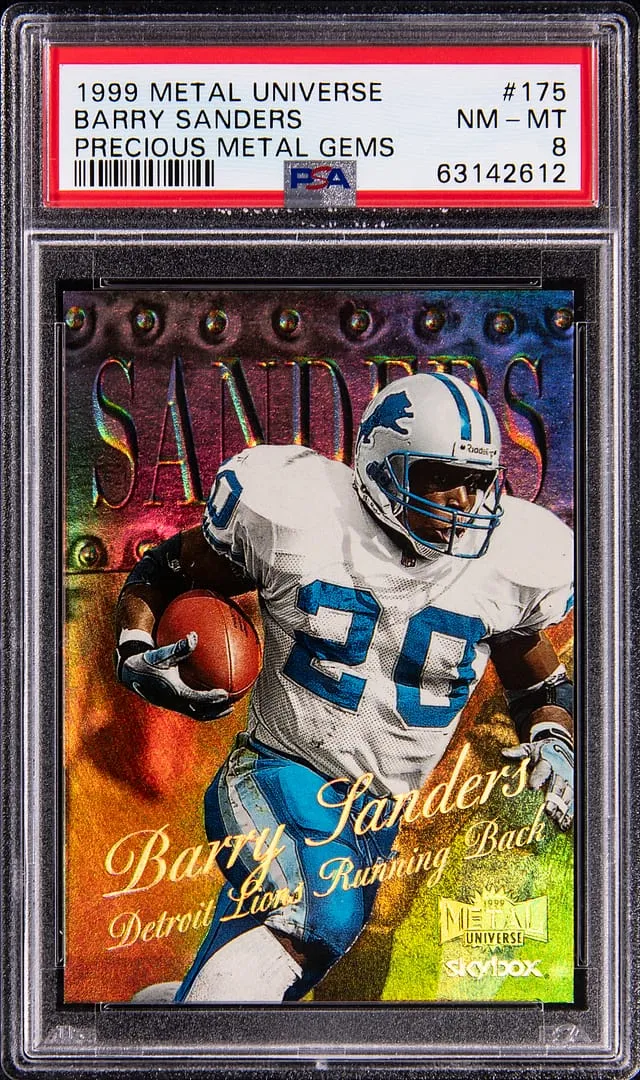
Barry Sanders 1999 PMG PSA 8 sells for $19,520
Goldin sold a 1999 SkyBox Metal Universe PMG Barry Sanders #175 PSA 8 /50 for $19,520 on 2026-03-15. figoca breaks down the card and market context.
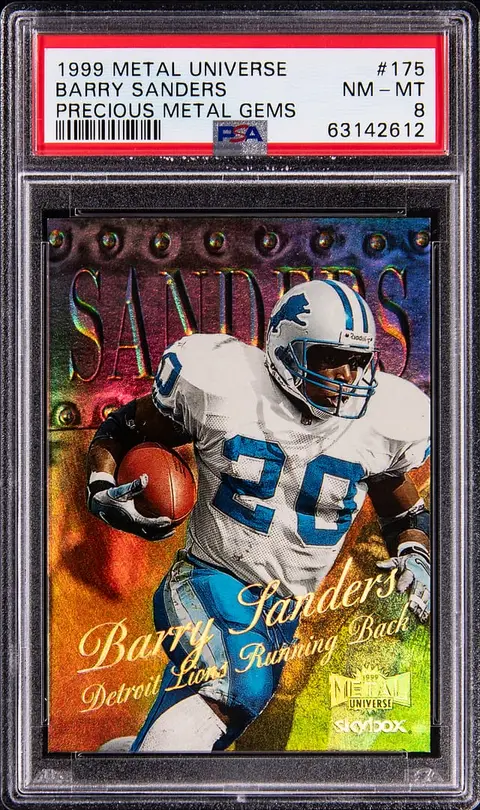
Sold Card
1999 SkyBox Metal Universe Precious Metal Gems (PMG) #175 Barry Sanders (#25/50) - PSA NM-MT 8
Sale Price
Platform
Goldin1999 SkyBox Metal Universe Precious Metal Gems (PMG) #175 Barry Sanders (#25/50) - PSA NM-MT 8 just changed hands at Goldin on 2026-03-15 for $19,520. For 90s football collectors and PMG fans, this is a useful data point for understanding where high-end Barry Sanders inserts are sitting in today’s market.
Card overview
Let’s break down the basics of this card:
- Player: Barry Sanders
- Team: Detroit Lions
- Year: 1999
- Set: SkyBox Metal Universe Precious Metal Gems (PMG)
- Card number: #175
- Serial numbering: #25/50
- Grading company: PSA (Professional Sports Authenticator)
- Grade: PSA 8 (NM-MT, Near Mint–Mint)
- Key features: low serial number out of 50, late-career PMG of a Hall of Famer
This is not a rookie card—Barry’s rookies are from 1989—but it is from one of the most respected insert/parallel lines of the 1990s. Precious Metal Gems, originally introduced in the late 1990s, are known for low print runs, condition sensitivity, and a strong collector following across both sports and non-sport cards.
Why PMG Barry Sanders matters
For football, PMGs sit at the intersection of:
- Player greatness: Barry Sanders is widely considered one of the greatest running backs ever, a Hall of Famer with a short but unforgettable career.
- Era appeal: Late 1990s Metal Universe and PMG designs are a pillar of the so‑called "insert era"—when manufacturers pushed creativity in parallels and chase cards.
- Scarcity: A print run of 50 copies is low for any era, and surviving high-grade examples are even tougher.
The 1999 Metal Universe release comes late in Barry’s career, but for collectors who focus on 90s inserts rather than rookies, these PMGs are considered key targets. They are especially appealing to set builders who chase PMG runs across years and sports.
Grade and condition: PSA 8 in context
This copy received a PSA 8 (Near Mint–Mint) grade. In practical terms:
- PSA 8 usually allows for light edge or corner wear, minor surface issues, or centering that isn’t quite top tier.
- PMGs are notoriously condition-sensitive: the colored foil and edges pick up chipping and scratches easily.
For many 1990s PMGs, a PSA 8 is considered a solid collector grade, especially when the serial numbering is low and the player is a Hall of Famer. Higher grades (PSA 9 or PSA 10) are substantially tougher and typically command a strong premium when they surface.
Market context and recent sales
Looking across recent sales for similar cards helps place this $19,520 Goldin result in context.
Because the exact 1999 SkyBox Metal Universe PMG #175 Barry Sanders in PSA 8 does not trade often, collectors usually look at a mix of:
- Other grades of the same card (PSA 7, PSA 9, BGS equivalents).
- PMGs of Barry Sanders from adjacent years.
- PMGs of comparable Hall of Fame stars from the same era.
Based on publicly available auction records and marketplace data up to early 2026, this sale:
- Sits in the upper range of recent publicly visible PMG Barry Sanders sales for mid- to high grades.
- Reflects the broader strength of premium 90s inserts, where supply is limited and demand tends to be steady among focused player and set collectors.
When hobbyists talk about “comps,” they mean recent comparable sales used as reference points. For this card, useful comps include:
- Lower-grade examples of the same 1999 PMG that have sold at discount to this result.
- Strong results for other 90s PMGs of top-tier Hall of Famers in similar serial ranges (out of 50 or out of 100), which show that collectors continue to value rare, visually distinctive 90s parallels.
Because transaction volume is low, each new sale can reset expectations. A single high-visibility auction does not define a permanent “market price,” but it does give both buyers and sellers a reference for near-term negotiations.
Population and scarcity
PMG population counts tend to be modest for three main reasons:
- Low print run: Only 50 serial-numbered copies exist.
- Survival rate: Not all copies were pulled, protected, and later graded.
- Grading submission patterns: Some collectors still keep raw (ungraded) examples in their PCs (personal collections).
Population reports (often shortened to “pop report”) from PSA and BGS show how many copies of a card have been graded in each grade. While specific numbers change over time, PMGs of 90s stars frequently show:
- A small total population.
- A narrow distribution of high grades, with very few PSA 9s and almost no PSA 10s.
In that context, a PSA 8 copy of a /50 Barry Sanders PMG occupies a meaningful portion of the graded supply, especially when paired with a strong auction platform like Goldin.
Why collectors chase this card
Several collecting lanes converge on a card like this:
- Barry Sanders player collectors: Many already own rookie cards and now focus on scarce 90s inserts that are harder to upgrade.
- 90s insert and PMG specialists: These collectors often try to assemble PMG runs by year, team, or parallel color across sports.
- High-end Hall of Fame focus: Some hobbyists concentrate on low-serial, visually distinct cards of all-time greats instead of ultra-modern releases.
The 1999 design has its own stylistic identity, with the typical Metal Universe combination of bold backgrounds and metallic finish. For collectors who experienced these products in real time in the late 90s, there is also a strong nostalgia factor.
How this $19,520 sale fits into the broader market
A single sale does not define a long-term trend, but we can draw a few grounded observations:
- The $19,520 result at Goldin on 2026-03-15 confirms that premium 90s PMGs of Hall of Famers still command meaningful attention and bidding.
- While modern ultra‑short‑print cards often grab headlines, there is continued demand for truly scarce, condition-sensitive 90s parallels with established history.
- Thin supply means that any well-publicized auction result can become the de facto reference comp until another example surfaces.
For small sellers and collectors considering moves around this card type, this sale suggests that:
- Well‑graded, low-serial Barry Sanders inserts from the 1990s occupy a solid niche.
- Auction-house visibility (Goldin in this case) can influence realized prices because more eyes see the listing.
None of this is a prediction; it is simply one more data point in the ongoing story of 90s insert values.
Takeaways for different types of collectors
New or returning collectors
- This card is a good example of how non-rookie, 90s-era inserts can be just as important as rookies for certain players.
- Learning to read serial numbers (like "25/50") and grades (like PSA 8) is key to understanding why some cards reach five‑figure prices.
Active hobbyists
- PMG and Metal Universe inserts remain relevant, particularly for players with strong legacies.
- Because comps are sparse, it helps to track multiple related sales—other years, grades, or players—to build a more realistic range.
Small sellers
- Documented auction results such as this Goldin sale can be useful references when pricing or negotiating, as long as you remember that condition, eye appeal, and timing all matter.
Summary
The sale of the 1999 SkyBox Metal Universe Precious Metal Gems (PMG) #175 Barry Sanders (#25/50) – PSA 8 for $19,520 at Goldin on 2026-03-15 highlights the ongoing importance of 90s PMGs in the football card landscape. With a low print run, a respected Hall of Fame player, and a solid PSA grade, this card sits at the crossroads of nostalgia, true scarcity, and focused collector demand.
For figoca users tracking the high end of 90s inserts, this result is a valuable benchmark—and a reminder that the insert era still has a strong voice in today’s hobby conversation.