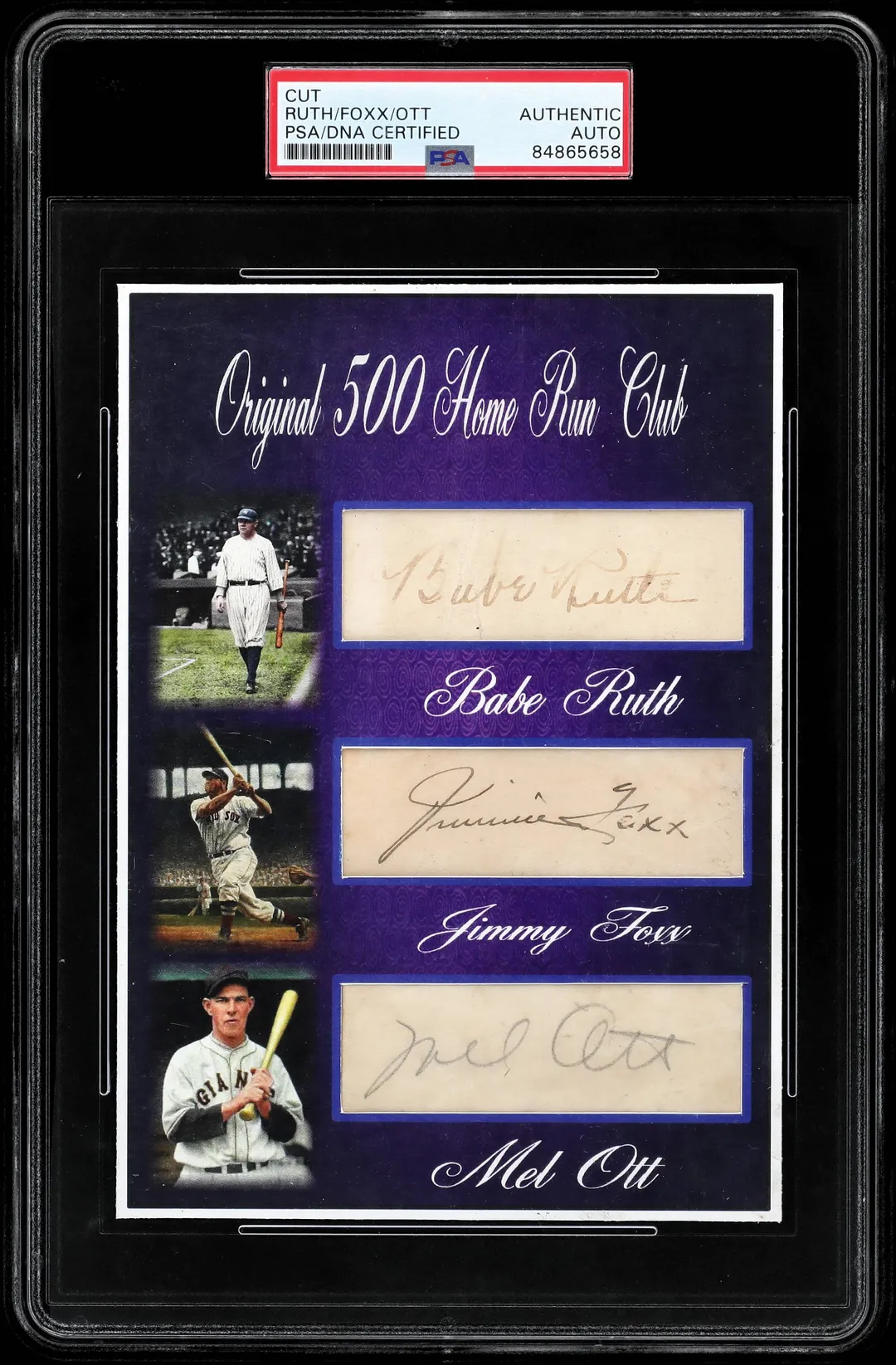
Babe Ruth–Foxx–Ott 500 HR Cut Sells for $19,519
Goldin sold a Babe Ruth, Jimmie Foxx, Mel Ott 500 Home Run Club PSA/DNA cut display for $19,519. Here’s what that means for vintage auto collectors.
Sold Card
Babe Ruth, Jimmie Foxx, Mel Ott Original 500-Home Run Club Multi-Signed Cut Display - PSA/DNA Authentic
Sale Price
Platform
GoldinBabe Ruth, Jimmie Foxx, Mel Ott 500-HR Club Cut: Why This $19,519 Goldin Sale Matters
On February 22, 2026, Goldin closed a notable vintage autograph piece: a Babe Ruth, Jimmie Foxx, Mel Ott Original 500-Home Run Club Multi-Signed Cut Display – PSA/DNA Authentic at $19,519.
This isn’t a traditional trading card. It’s a custom display built around an original multi-signed cut, authenticated by PSA/DNA. For collectors who focus on pre-war and early post-war legends, this kind of item sits at the crossroads of sports memorabilia and the modern card hobby.
In this breakdown, we’ll look at what exactly sold, why these three signatures together are such a big deal, and how this price fits into the broader vintage auto market.
What exactly was sold?
From the auction description and PSA/DNA labeling, the piece can be summarized as:
- Signers: Babe Ruth, Jimmie Foxx, Mel Ott
- Theme: Original "500 Home Run Club" multi-signed cut
- Format: Cut signature display (not a pack-issued card)
- Authentication: PSA/DNA – Authentic (meaning the signatures are verified genuine, but not assigned a numerical card grade)
- Type: Multi-signed cut, mounted in a display format
- Auction house: Goldin
- Sale date (UTC): February 22, 2026
- Price: $19,519
A few key clarifications for newer collectors:
- A cut signature is an autograph that’s been cut from an original document, check, letter, or other medium and then often mounted into a card-sized or display-sized holder.
- PSA/DNA Authentic confirms the autograph’s authenticity but doesn’t necessarily assign it a numerical grade (like 8, 9, or 10). In many vintage pieces, authenticity is the core value driver.
This is not a rookie card, not a pack-pulled insert, and not part of a standard trading card set. Instead, it’s a historically themed multi-signed piece combining three Hall of Fame sluggers.
Why Ruth–Foxx–Ott together is a big deal
Before modern “500 Home Run Club” inserts and commemorative sets existed, the idea of grouping these legends together was more of a memorabilia concept than a manufactured product. Having all three of these players’ signatures on a single original item is the core appeal:
- Babe Ruth – The hobby’s foundational figure. Ruth’s autograph has broad demand that cuts across card collectors, baseball historians, and general Americana collectors.
- Jimmie Foxx – One of the greatest right-handed power hitters of his era, with far fewer surviving signatures compared to more modern stars.
- Mel Ott – Another early 500-HR member and New York icon, with a shorter life and a more limited signed legacy than many later Hall of Famers.
Collectors care about pieces like this for a few reasons:
- Era scarcity – These signatures come from a time when autograph collecting wasn’t industrialized the way it is now. There were no stadium signing lines or mass-produced autograph cards.
- Theme appeal – The “500 Home Run Club” is one of baseball’s most recognized milestones. Any early or original piece grouping these names taps into that historical narrative.
- Cross-category demand – This item appeals to:
- Vintage card and autograph collectors
- Ruth-focused “PC” (personal collection) collectors
- 500 HR Club and Hall of Fame theme collectors
- General sports memorabilia buyers
Market context and recent sales
Because this is an original multi-signed cut display, it doesn’t have the same consistent, card-by-card sales history you’d see with, for example, a 1952 Topps Mantle in a specific grade.
Instead, the best way to understand price is to look at adjacent comps (comparable items):
- Single-signed Ruth cuts or checks authenticated by PSA/DNA regularly sell in the mid four-figures to low five-figures, depending on eye appeal, medium, and inscription.
- Ruth dual- or multi-signed items with another Hall of Famer (especially on a single document) can push higher, particularly when the other name is a major star and the layout is clean.
- Themed 500 HR Club items from later decades (like multi-signed bats and photos including modern players) often sit in a broad range from low four-figures to higher five-figures, with the biggest premiums going to earlier signers and better presentation.
Original triple-signed Ruth–Foxx–Ott pieces are not common enough to produce a neat, frequently updated price curve. Auction records that group all three of these players on one original piece tend to:
- Appear infrequently across major auction houses
- Show significant variability in price based on condition, format (photo, ball, document, cut), and overall presentation
Against that backdrop, $19,519 lands in a range that:
- Is well above the cost of most single Ruth cuts in average displays
- Sits within what collectors might expect to pay for a cleaner, themed multi-Hall of Famer piece
- Reflects the premium of having three pre-war 500 HR legends on a single, authenticated item
Without an identical, recent Goldin or other major-house sale of the exact same cut configuration, it’s better to view this as part of the broader upper-mid tier of vintage autograph memorabilia rather than label it definitively as a record or a bargain.
How PSA/DNA “Authentic” affects value
For this kind of piece, the key questions buyers usually ask are:
- Are the signatures real? – PSA/DNA’s authentication is the baseline expectation at this price level.
- How do the signatures look? – Darkness, completeness, and placement often matter more than a technical numerical grade.
- What is the presentation like? – The design of the cut display, the clarity of the signatures, and any accompanying photos or plaques can influence final price.
A higher numerical grade (for example, PSA/DNA Auto 9 or 10, or a graded encapsulated cut with a high eye-appeal score) can add a premium, but for rare combinations such as Ruth–Foxx–Ott, simply having clean, authenticated signatures together often does most of the work in setting value.
Why collectors care about this sale
From a hobby perspective, this Goldin sale is interesting for several reasons:
- Shows continued strength in blue-chip vintage names – Even as modern and ultra-modern cards go through cycles of hype and correction, Ruth and other pre-war icons tend to maintain steady interest.
- Highlights the appeal of themed pieces – Groupings like “500 HR Club” provide built-in storytelling. That makes them attractive both for display and for long-term collecting themes.
- Bridges the gap between memorabilia and cards – Many modern collectors are used to pack-pulled autograph cards. This sale is a reminder that cut signatures, letters, and original documents still form the foundation of the autograph market.
For newer collectors, this is a useful example of how not everything that trades in the hobby fits neatly into a card set checklist. Some of the most historically interesting items are one-of-a-kind or small-population memorabilia pieces.
What this could mean for similar pieces
It’s important not to treat any single auction as a guarantee of future values. Instead, a sale like this can:
- Provide a reference point for other Ruth multi-signed cuts with major Hall of Famers.
- Inform how sellers and buyers think about pricing original 500 HR Club-themed pieces, especially when they include early members of the club.
- Encourage more owners of complex, multi-signed vintage items to consider major auction houses when they decide to sell.
If you’re a collector or small seller looking at this result:
- Use it as context, not a promise. Look at other Ruth cuts, multi-signed pieces, and 500 HR Club items across recent auctions to build a broader picture.
- Pay close attention to presentation and signature quality when comparing comps. Two items with the same names and authentication can still trade at very different levels.
Takeaways for collectors
- This Goldin sale at $19,519 on February 22, 2026 reinforces the enduring draw of Babe Ruth and other pre-war power hitters in the autograph market.
- Original, themed multi-signed cuts—especially with three Hall of Fame 500 HR bats—sit in a niche where scarcity and historical appeal matter more than strict card-based rarity.
- For anyone building a long-term baseball history collection, this kind of piece is a reminder that some of the most interesting hobby items never came out of a pack.
As always, treat this result as one datapoint in a larger landscape. The vintage autograph market is built on nuance: signer combinations, eye appeal, provenance, and timing all intersect to create final prices.
For figoca readers watching the market, the takeaway is simple: iconic names plus strong themes continue to find serious buyers, especially when backed by top-tier authentication.