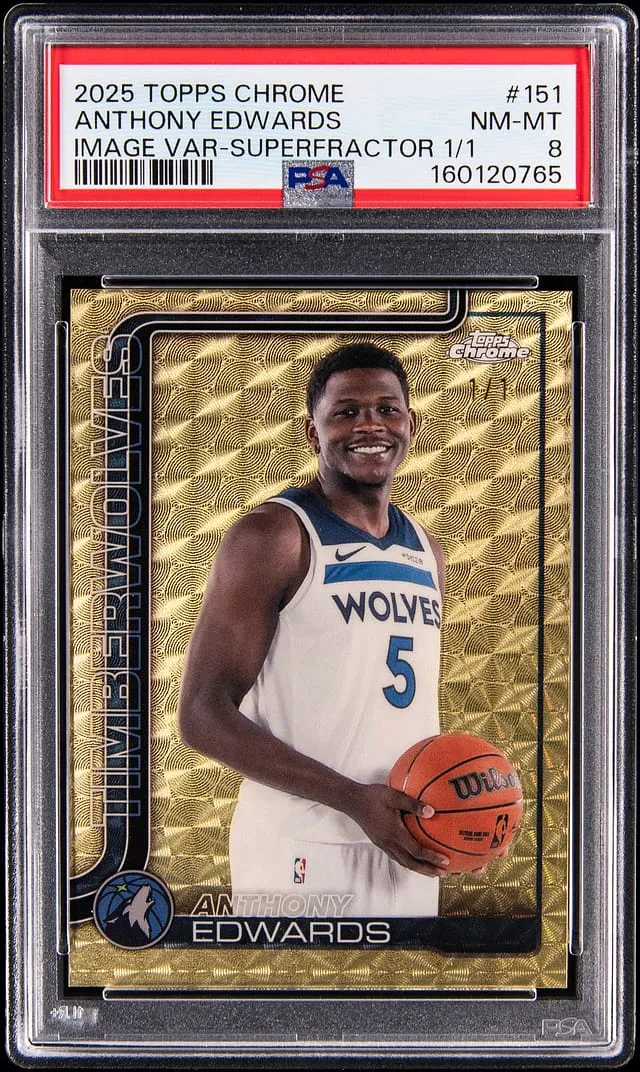
Anthony Edwards 2025-26 Topps Chrome SuperFractor Sale
Goldin sold a 2025-26 Topps Chrome Anthony Edwards Image Variation SuperFractor 1/1 PSA 8 for $823,500 on June 7, 2026. Here’s the market context.
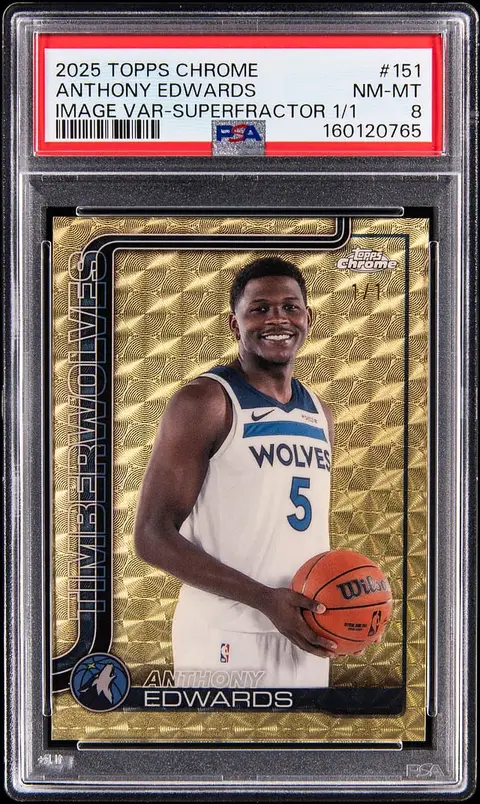
Sold Card
2025-26 Topps Chrome Image Variation SuperFractor #151 Anthony Edwards (#1/1) - Jersey Number - PSA NM-MT 8
Sale Price
Platform
Goldin2025-26 Topps Chrome Anthony Edwards SuperFractor Sells for $823,500
On June 7, 2026, Goldin closed a major ultra-modern basketball sale: a 2025-26 Topps Chrome Image Variation SuperFractor #151 Anthony Edwards, serial-numbered 1/1 and graded PSA NM-MT 8, realized $823,500.
For a still-active player in the middle of his prime, that is a serious number. Let’s break down what this card is, why it matters, and how this sale fits into the broader market.
What exactly is this card?
Card details
- Player: Anthony Edwards (Minnesota Timberwolves)
- Year: 2025-26
- Set: Topps Chrome Basketball
- Card number: #151
- Version: Image Variation SuperFractor
- Serial numbering: 1/1 (one-of-one, only copy produced)
- Jersey-number match: This specific copy is numbered 1/1, matching Edwards’ jersey number 1
- Grading: PSA NM-MT 8 (Near Mint–Mint) by PSA
- Attributes: Non-auto, non-patch; pure chrome parallel focused on rarity and aesthetics
This is not a rookie card (Edwards’ rookie season was 2020-21), but it sits in the category collectors often call a “key issue”: a standout, high-end card for a star player, anchored by a premium parallel and extreme scarcity.
The SuperFractor parallel in Topps Chrome is traditionally a 1/1 gold-spiral refractor. In the modern hobby, SuperFractors are seen as one of the definitive “top of the pyramid” parallels in any chromium Topps product.
On top of that, this card is an image variation. That means Topps used an alternate photo instead of the standard base-card image. Variations are usually short-printed and designed to give player collectors and set-builders an additional chase.
Why collectors care about this card
1. Anthony Edwards’ emerging superstar profile
Anthony Edwards has transitioned from high-upside prospect to franchise centerpiece and postseason headliner. By mid-2026 he has:
- Multiple deep playoff runs and high-usage scoring seasons
- A growing reputation as one of the league’s most explosive scorers
- Strong cultural visibility (highlights, interviews, and a growing fan base)
That combination—on-court performance plus presence—tends to make a player a magnet for high-end collectors, especially in the ultra-modern era.
2. Topps Chrome’s place in basketball
While Panini has held the NBA license for years, Topps’ Chrome brand carries decades of history from other sports and from the earlier basketball Chrome era. When Chrome reappears in basketball form, collectors bring that heritage with them.
Key points for this set:
- Chrome technology: Refractor-based parallels are familiar and widely collected across baseball, soccer, and the earlier NBA Chrome years.
- Parallel hierarchy: SuperFractor sits at or near the top of the parallel ladder. Even in non-rookie years, a SuperFractor of a major star is an event.
- Image variation: While not always as central as the base card, variations add a layer of scarcity and distinctiveness. They also appeal to player collectors who like owning multiple “looks” for the same player and year.
3. The 1/1 and jersey-number angle
In modern collecting, 1/1 means exactly one copy was printed. That alone creates a unique situation:
- There are no direct condition-comparable copies to measure against.
- A single transaction often sets the de facto market reference for that exact card.
Here, the numbering is noted as “#1/1 – Jersey Number.” Jersey-numbered cards (where the serial number matches the player’s uniform number) are treated by many collectors as a “bonus rarity.” With a one-of-one, it’s more of a thematic detail than a population fact—but it does matter to certain buyers, especially player and team superfans.
4. PSA 8 in the ultra-modern context
PSA graded this card NM-MT 8. For ultra-modern chrome, collectors often chase PSA 9 and 10, but with a 1/1 super-premium parallel, the grade is only one piece of the value puzzle.
A few things to keep in mind:
- For a one-of-one, there is no higher-graded copy to compete with—this is the only example that will ever exist.
- Surface print lines, edge flecks, or centering are quite common on chrome stock. An 8 is still a presentable, clean card in hand.
- With high-end 1/1s, many buyers treat the card more like a unique art piece than a population race.
How this $823,500 result fits into the market
The hammer-plus-buyer’s-premium total of $823,500 (converted from 8,235,000 cents) puts this card in an upper tier of post-2020 basketball sales.
Comps and price context
Because this is a true 1/1, there are no direct, repeatable “comps” (short for comparable sales—similar items you use to gauge market levels). Instead, collectors typically look at:
- Other Anthony Edwards SuperFractors, Gold /10, or Black /1 parallels across key products
- High-end rookies (2020-21) vs. later-year “key issues” like this 2025-26 Chrome
- Comparable stars’ 1/1 Chrome or Prizm–tier cards
From recent public data across major auction houses and marketplaces:
- Edwards rookie-year premium parallels (e.g., Prizm Gold /10, high-end Flawless, or NT RPA patches) have traded below this level, even in strong grades. That places this 2025-26 Chrome SuperFractor near the top of his card market.
- Other star players’ non-rookie SuperFractors generally close for less than their flagship rookies, unless tied to a special moment, inscription, or extremely important new set. That makes this realized price notable—this card is operating closer to “marquee rookie” territory than typical non-rookie pricing.
Because modern high-end markets can move quickly, it’s more accurate to say this Goldin sale establishes a strong benchmark for future Edwards non-rookie 1/1 chrome-style cards, rather than trying to force it into a narrow price range comparison.
Historical significance for Edwards collectors
Based on currently available public results, this is among the stronger confirmed sales for any Anthony Edwards non-rookie parallel.
That matters for a few reasons:
- It signals sustained demand that goes beyond early-career speculation.
- It reinforces Edwards as one of the modern players whose card market can support six-figure-plus results in multiple product lines.
- It gives player collectors a new “white whale” card to talk about, even if it stays locked away long term.
Factors likely influencing this result
While we can’t see the bidders’ motivations directly, several reasonable factors likely supported the final number:
Performance and trajectory
Edwards has been trending upward in both stats and narrative. Deep playoff visibility and highlight-driven popularity often translate into more confident bidding on top-tier pieces.Ultra-modern consolidation
The ultra-modern era (roughly 2018 onward) has seen a shift from wide speculation across many players to more focused conviction on a smaller group of stars. Edwards increasingly appears in that short list.Brand and auction house
Goldin is one of the main venues where top-end basketball lots surface. That typically means:- More eyes on the listing
- A higher chance that both advanced collectors and investment-minded buyers see the card
Aesthetic + thematic appeal
The Chrome SuperFractor pattern, the alternate image, and the jersey-number detail all add non-statistical reasons to chase this specific card.
What this means for different types of collectors
New or returning collectors
If you’re newer to the hobby, this sale might feel distant from your typical budget—but it still offers useful lessons:
- Hierarchy matters: Even within one player, not all cards are equal. Flagship brands, top parallels, and special prints (like 1/1s) sit at the top.
- Player story is key: Edwards’ on-court performance and narrative are as important as the cardboard itself.
- Think in tiers, not just numbers: You don’t need a SuperFractor to collect meaningfully. Silver refractors, numbered parallels, and base RCs can be more approachable ways to follow the same player.
Active hobbyists
For ongoing hobby participants, this sale is another data point in the evolving ultra-modern landscape:
- It reinforces that mature, high-end demand exists for non-rookie key issues of rising stars, not just their debut-year cards.
- It suggests that Chrome-branded basketball, when paired with a true 1/1 SuperFractor, can command serious attention—even in a market that has become more cautious since the 2020–2021 spike.
- It highlights the importance of tracking both player performance cycles and product cycles (when major sets release and when their top hits surface at auction).
Small sellers and flippers
For smaller sellers, this type of sale is less a direct target and more of a market signal:
- High-end 1/1 results can pull attention back into a player’s broader market, sometimes creating short-term activity in more accessible cards.
- They can also reset expectations around what collectors consider a “grail” (a top target) for that player.
Key takeaways
- The 2025-26 Topps Chrome Image Variation SuperFractor #151 Anthony Edwards #1/1, PSA 8 sold at Goldin on June 7, 2026 for $823,500.
- This is a non-rookie, ultra-high-end parallel that functions as a key issue for Edwards, combining:
- A Chrome SuperFractor 1/1
- Image variation
- Jersey-number match (1/1 for jersey #1)
- The realized price places it among the stronger publicly known sales for any Anthony Edwards non-rookie card.
- For the broader hobby, it reinforces that:
- Topps Chrome SuperFractors remain a central chase in modern chromium basketball.
- Edwards is firmly established as a player whose market can support significant six-figure results beyond his rookie year.
As always, this sale is best viewed as context, not a forecast. It shows where one unique, top-of-the-pyramid card changed hands on a specific date at a specific venue. For collectors at every budget level, the real value is in understanding the structure behind that number—brand, player, parallel, scarcity—and using that knowledge to make more informed collecting decisions.