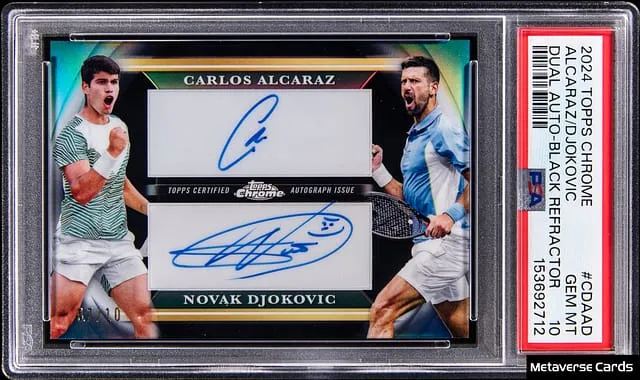
Alcaraz & Djokovic 2024 Topps Chrome Dual Auto Sale
A PSA 10 Black Refractor /10 dual auto of Carlos Alcaraz and Novak Djokovic sold for $12,200 at Goldin. Here’s what it means for tennis card collectors.
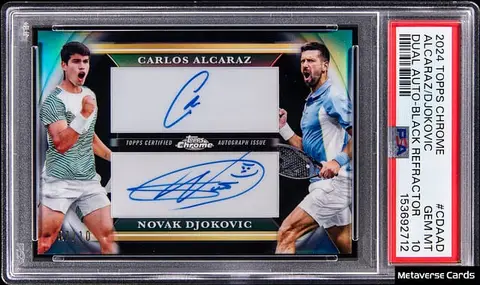
Sold Card
2024 Topps Chrome Dual Autographs Black Refractor #CDA-AD Carlos Alcaraz/Novak Djokovic Dual-Signed Card (#07/10) - PSA GEM MT 10 - Pop 2
Sale Price
Platform
GoldinThe 2024 Topps Chrome Dual Autographs Black Refractor #CDA-AD Carlos Alcaraz/Novak Djokovic Dual-Signed Card (#07/10) just recorded a notable sale at Goldin on 2026-06-07, closing at $12,200. For a modern tennis issue, this is a meaningful data point that helps frame where high-end Alcaraz and Djokovic pieces are starting to settle in the broader multi-sport market.
Card overview
Let’s start with the basics collectors care about:
- Year & product: 2024 Topps Chrome
- Card: Dual Autographs Black Refractor
- Card number: #CDA-AD
- Players: Carlos Alcaraz and Novak Djokovic
- Serial numbering: Hand-numbered 07/10
- Autographs: Dual on-card signatures
- Grading: PSA GEM MT 10
- Population: PSA pop report shows Pop 2 in this grade for this exact parallel
This is an ultra-modern, low-serial, dual-autograph refractor featuring the defining men’s tennis rivalry of the era: Djokovic, the most decorated player of his generation, alongside Alcaraz, the heir apparent. While it is not a rookie card in the strict sense—Alcaraz and Djokovic both have earlier issues—it is a key modern premium card because it pairs both stars on a scarce, dual-signed chromium parallel from a major licensed set.
What makes this card special?
From a collector’s perspective, several attributes stack on top of each other:
- Dual on-card autographs: Both signatures are hard-signed directly onto the card, not on stickers. Dual on-card autos are significantly harder to pull and coordinate than single autos.
- Black Refractor /10: Within Topps Chrome, Black Refractors with serial numbering to 10 copies are an established premium tier. Ten total copies, plus any condition loss, make the true available supply very thin.
- PSA 10 with Pop 2: A PSA GEM MT 10 is PSA’s highest standard grade, signaling sharp corners, clean edges, strong surface, and centering within tight tolerances. A population ("pop") of 2 means PSA has only graded two examples of this card at a 10, underscoring its grading scarcity.
- Icon + rising star pairing: Djokovic’s resume (Slams, weeks at No. 1) has long-term historical weight. Alcaraz is still in the early chapters but is already winning majors and drawing comparisons to all-time greats. Dual cards that capture a baton-pass moment between eras often age well from a historical and storytelling perspective.
Market context and recent sales
Because this is a low-serial, Pop 2 modern tennis auto, public sales are naturally thin. That can make direct comparisons tricky, but we can still use nearby data:
- Exact card, same parallel: There are very few publicly documented sales of this specific Black Refractor /10 dual auto in PSA 10. With only 10 copies in existence and 2 in GEM MT 10, most examples are likely in long-term collections or have not been graded at this level.
- Nearby parallels and grades: For ultra-modern tennis, strong dual autos and low-serial Alcaraz and Djokovic singles in premium parallel form often trade in the mid-four to low-five-figure range, depending on numbering, card brand, and grade.
- Unslabbed vs. graded: Raw (ungraded) copies of comparable dual autos typically sell at a discount to top-graded examples. PSA 10s compress the risk of condition surprises and can command a meaningful premium when pop is low.
Against this backdrop, the $12,200 result at Goldin sits in the range you’d expect for a scarce, dual on-card auto featuring both the current all-time great and the player most likely to challenge his legacy.
Because confirmed public sales for this exact configuration are scarce, it’s hard to call this result definitively high or low. Instead, it serves as a useful benchmark for future sales of:
- Other serial numbers of the same Black Refractor /10
- Lower grades of this card (PSA 9, BGS 9.5, etc.)
- Alternate parallels of the same dual auto (for example, golds, reds, or base refractors if produced)
Why collectors care about this card
1. A snapshot of a generational transition
Tennis rarely delivers clean crossover moments on cardboard that feature two eras together. This card pairs:
- Novak Djokovic, whose Grand Slam count and dominance anchor him in the “GOAT conversation.”
- Carlos Alcaraz, whose early Grand Slam wins and game style have drawn comparisons to Nadal and Federer while he faces Djokovic head-to-head on the biggest stages.
This dual auto captures that transition period in one premium piece. For collectors who like narrative—who beat whom, in which finals, how eras changed—cards like this become more than just ink and cardboard.
2. Ultra-modern tennis is still maturing
Compared to basketball, baseball, or football, high-end tennis cards are a younger and thinner market on the modern side. That can cut both ways:
- Supply of truly premium pieces like dual on-card autos /10 is tiny.
- The number of active, price-setting collectors is still growing.
When a card like this surfaces at a major venue such as Goldin and reaches a public number like $12,200, it quietly helps shape expectations for what the best Alcaraz and Djokovic cardboard might command going forward.
3. Set and brand context
Topps Chrome is a well-known chromium line, especially in baseball and soccer. Its move into tennis gives collectors a familiar framework:
- Refractors: Parallel versions with a rainbow-like finish; a core chase for Chrome products.
- Numbered parallels: The Black Refractor /10 version is one of the more premium serial tiers.
For collectors who already understand Topps Chrome from other sports, this card feels structurally familiar: a low-numbered, on-card auto dual superstar parallel, aligned with what is traditionally important in Chrome-based flagship products.
Price context: what $12,200 tells us
Using this Goldin sale as a reference point, a few grounded takeaways emerge:
- Grade scarcity matters: With only two PSA 10s in the population, buyers are paying for both the player combination and the security of a top grade.
- Dual autos carry a structural premium: Coordinating two hard-signed autographs is harder than one; that tends to show up in both pack odds and resale pricing.
- Tennis is finding its lane among other sports: While $12,200 won’t rival the biggest basketball or baseball grails, it’s a solid figure in the context of ultra-modern tennis, especially for a card that isn’t a 1/1 or a rookie patch auto.
These observations aren’t forecasts or guarantees, just markers of how the market is currently treating similar attributes.
What this sale could mean for collectors
For active collectors, this sale can be used in a few practical ways:
- Benchmarking comps: When looking up comps (recent comparable sales used to estimate a fair range), this result now joins the short list of public data points for high-end Alcaraz/Djokovic dual autos.
- Grading decisions: Owners of raw copies or lower-grade examples of similar dual autos can use this result as one reference point when weighing grading or regrading.
- Collection planning: For tennis-focused collectors, this sale helps clarify how the market is stacking priorities between single-player Alcaraz rookies, Djokovic legacy pieces, and dual-era cards like this one.
Final thoughts
The 2024 Topps Chrome Dual Autographs Black Refractor #CDA-AD Carlos Alcaraz/Novak Djokovic (#07/10) PSA GEM MT 10 (Pop 2) sale at Goldin on 2026-06-07 is another data point in the slow, steady buildout of a modern tennis card market.
With its low serial numbering, dual on-card signatures, PSA 10 grade, and Pop 2 status, it neatly combines scarcity, condition, and historical narrative. As more high-end tennis pieces find public results, this $12,200 sale will likely serve as one of the key early benchmarks collectors look back on when they talk about how the Alcaraz–Djokovic era was first recognized in cardboard terms.
For now, it stands as a clean example of how the hobby is starting to treat the very best modern tennis cards—with measured but growing respect, backed by real, trackable sales data.