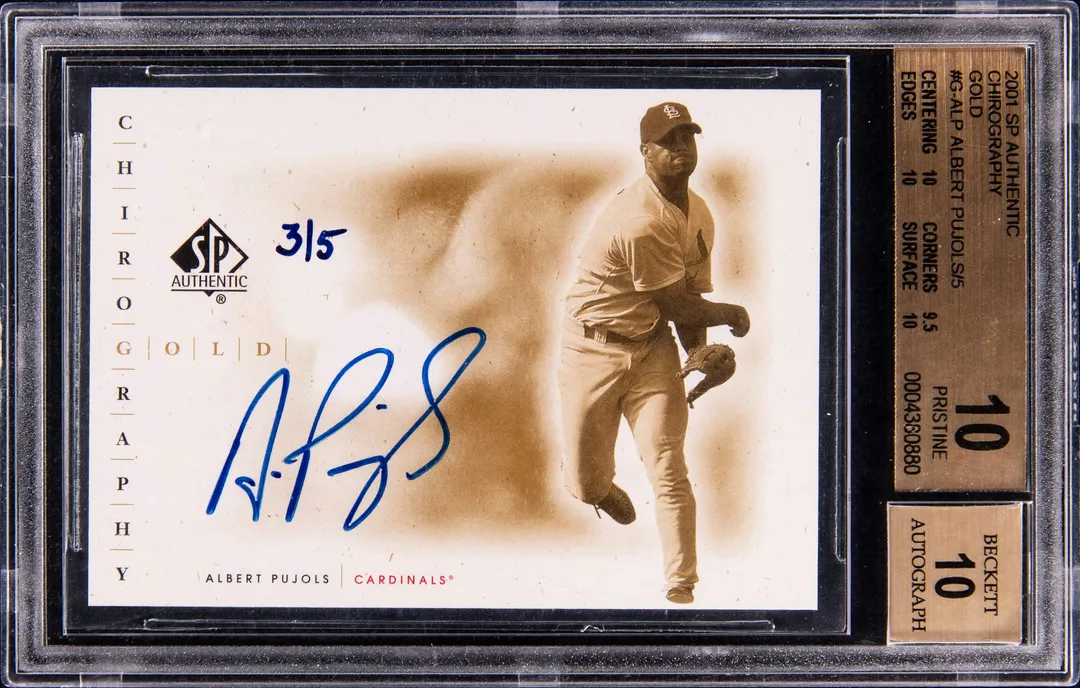
Albert Pujols 2001 SP Chirography Gold BGS 10 Sale
Goldin sold a 2001 SP Authentic Chirography Gold Albert Pujols BGS Pristine 10/10 for $591,700. See how this pop 1 rookie auto fits the market.
Sold Card
2001 Upper Deck SP Authentic Chirography Gold #G-AP Albert Pujols Signed Rookie Card (#3/5) - BGS PRISTINE 10, Beckett 10 - Pop 1
Sale Price
Platform
GoldinIn early February 2026, one of the most condition-sensitive Albert Pujols rookie autos in the hobby quietly set a new bar at Goldin.
On February 8, 2026 (UTC), a 2001 Upper Deck SP Authentic Chirography Gold #G-AP Albert Pujols Signed Rookie Card, serial-numbered 3/5 and graded BGS PRISTINE 10 with a Beckett 10 autograph, sold for $591,700. This copy is also a population 1 ("pop 1") in that grade, meaning it is the only example Beckett has ever awarded a true Pristine 10 with a 10 auto for this specific card.
Below, we’ll break down why this card matters, how it fits into the broader Pujols rookie landscape, and what this sale tells us about the current market.
Card overview: what exactly sold at Goldin?
Let’s start by clearly identifying the card and its key attributes:
- Player: Albert Pujols (St. Louis Cardinals)
- Year: 2001
- Set: Upper Deck SP Authentic
- Insert/Subset: Chirography Gold
- Card number: #G-AP
- Type: Signed rookie card (on-card autograph)
- Serial numbering: Gold parallel, numbered 3/5
- Grading company: Beckett Grading Services (BGS)
- Grade: BGS PRISTINE 10 with 10 autograph
- Population: Pop 1 in BGS Pristine 10/10
The SP Authentic Chirography line is Upper Deck’s on-card autograph insert, and the Gold version /5 sits near the top of Pujols’s early autograph hierarchy from 2001. It is not his flagship base rookie, but rather a premium, low-serial signed issue that appeals to collectors who prioritize rarity and eye appeal.
Why BGS PRISTINE 10 matters
Most modern cards, even well-kept ones, top out at BGS 9.5 GEM MINT. A BGS PRISTINE 10 essentially means the card is close to perfect across centering, corners, edges, and surface, with at least three 10 subgrades and no major defect in the fourth.
For an early 2000s, foil-heavy, on-card autograph insert:
- Printing and chipping issues are common.
- Foil surfaces make scratches and print lines easy to see.
- On-card autographs can smudge or streak.
So a Pristine 10 with a 10 autograph grade is not just a nice upgrade above a 9.5—it’s a significant scarcity tier of its own. The pop 1 note confirms that this combination of card + grade + auto is currently unique in the Beckett population report.
Where this card fits in the Pujols rookie hierarchy
Albert Pujols has several key 2001 rookies and early autos that collectors track closely. While exact rankings can vary by collector preference, his premium tier typically includes:
- 2001 Bowman Chrome Rookie Auto (and Refractors): often treated as his “flagship” rookie autograph in the modern Chrome sense.
- 2001 SP Authentic Future Watch Auto (especially low serial versions): a cornerstone for Upper Deck/UD collectors.
- 2001 Ultimate Collection / SPx / higher-end UD auto issues: smaller print runs, often on-card, with brand strength.
The 2001 SP Authentic Chirography Gold /5 sits in that conversation as a:
- Very low-serial, on-card auto from a respected brand and year.
- Tough card in high grade due to foil and design.
It’s not as widely discussed as the Bowman Chrome rookie auto among newer collectors, but among advanced Pujols and early-2000s Upper Deck collectors, this Chirography Gold is viewed as a true premium rarity.
Market context: how strong is $591,700?
While full, up-to-the-minute auction data will continue to evolve, we can place this sale within the broader context of Pujols’s top cards and similar issues.
When hobbyists talk about “comps”, they mean recent comparable sales used to gauge market value. For this exact card—2001 SP Authentic Chirography Gold #G-AP /5, BGS Pristine 10/10—public comps are extremely thin or non-existent, mainly because:
- There are only five copies of the Gold parallel.
- Only one has achieved this Pristine 10/10 grade.
- High-end Pujols collectors often hold long term, so turnover is low.
Instead, we look at adjacent comps:
- Other 2001 Albert Pujols premium autos in top grades (Bowman Chrome, SP Authentic Future Watch, Ultimate Collection, etc.).
- Lower-grade copies of the same Chirography Gold /5 (if and when they surface) in BGS 9/9.5 or PSA 9/10.
Across the last few years, Pujols’s very best rookie autos in top grades have:
- Trended upward around major milestones—3,000 hits, 700 home runs, and his farewell tour.
- Shown resilience even as some other modern and ultra-modern segments cooled.
A sale at $591,700 firmly places this card in the upper tier of Pujols’s entire card catalog, alongside his very best Bowman Chrome and SP Authentic rookie autos. For a non-Bowman, non-flagship insert, that is noteworthy.
Without overselling it, this result suggests:
- Condition scarcity is being heavily rewarded. The pop 1 Pristine 10/10 label carries real weight.
- Ultra-low serial rookie autos from major brands still command serious attention.
- Serious Pujols collectors appear willing to stretch for one-of-a-kind grade/condition combinations.
Why collectors care about this card
A few key factors drive interest in this specific Chirography Gold:
1. Albert Pujols’s legacy
Pujols is widely regarded as one of the greatest right-handed hitters of the modern era:
- 3-time MVP
- 10-time All-Star
- 2-time World Series champion with the Cardinals
- 700+ home runs, 3,000+ hits, 2,000+ RBIs
He retired with a Hall of Fame resume already assured, and his first-ballot induction is treated as a given in the hobby. That kind of career gives long-term support to his very best rookie issues.
2. Era and scarcity
The early 2000s are often seen as a transition phase between the “junk wax” era and the modern, more print-conscious hobby. Sets like 2001 SP Authentic:
- Were produced in far smaller quantities than late-80s/early-90s mass-printed products.
- Still predate some of the extreme low-print-run trends of ultra-modern.
Within that context, a serial numbered /5 on-card rookie auto is genuinely scarce. It’s not a parallel-of-a-parallel from a 20-color rainbow—it’s a single, clearly defined, extremely low-print-run chase card.
3. On-card autograph appeal
“On-card auto” means Pujols signed directly on the card surface, not on a sticker later applied to the card. Many collectors prefer on-card autos because:
- They feel more personal and connected to the player.
- They usually integrate better with the card design.
For Hall of Fame-level rookies, the combination of on-card signature + low serial numbering + early-career photo is a strong long-term draw.
4. Grade scarcity and eye appeal
With a BGS Pristine 10:
- Centering, corners, edges, and surface are all near flawless.
- Visual appeal matters, especially for high-end buyers.
- Pop 1 status adds a layer of exclusivity—this is currently the best-graded copy known to Beckett.
In practice, that means this card appeals to two overlapping groups:
- Pujols player collectors building top-tier rookie portfolios.
- High-end condition-focused collectors who chase the best-graded version of important cards.
What this sale might signal for the market
It’s important not to overinterpret any single auction result. Still, a few reasonable takeaways from this $591,700 Goldin sale on February 8, 2026:
Hall of Fame-caliber rookies remain a core focus. Even as some speculative segments cool, established legends like Pujols continue to attract serious money at the very top end.
Scarcity plus condition is a powerful combination. A /5 on-card rookie auto is already rare; adding pop 1 Pristine 10/10 turns it into a true outlier.
Non-flagship premium inserts can compete with the big names. While Bowman Chrome and SP Authentic Future Watch get most of the headlines, a card like Chirography Gold /5 shows that well-designed, low-print-run inserts from strong brands are firmly in the conversation.
Goldin’s role in showcasing high-end pieces. The auction house continues to be a venue where rare, high-grade cards find deep-pocketed buyers, and results like this help establish fresh benchmarks collectors can reference.
How collectors and small sellers can use this information
Not everyone is chasing a six-figure Pujols, but this sale still offers some practical lessons.
For collectors:
- When you look at Pujols rookies, consider the full menu: Bowman Chrome, SP Authentic, Ultimate, Chirography, and other early autos each appeal to slightly different segments.
- “Comps” for ultra-rare, pop 1 cards will always be thin; focus less on exact dollar predictions and more on understanding where a card sits within a player’s overall hierarchy.
For small sellers and flippers:
- Pay attention to how grade bumps (e.g., from BGS 9.5 to 10, or PSA 9 to 10) can dramatically widen the gap between seemingly similar cards.
- Track how major auction houses like Goldin handle storytelling and presentation around rare pieces; that same approach—clear photos, good descriptions, strong provenance—helps at any level.
Final thoughts
The 2001 Upper Deck SP Authentic Chirography Gold #G-AP Albert Pujols Signed Rookie Card (#3/5) in BGS PRISTINE 10 with a 10 auto is a niche but meaningful cornerstone in the Pujols market.
Its $591,700 sale at Goldin on February 8, 2026, doesn’t rewrite the entire Pujols price structure on its own, but it does:
- Reinforce the premium that serious collectors place on true scarcity and elite condition.
- Underscore the continued strength of Hall of Fame-level rookie autos from the early 2000s.
For collectors who like to study the top of the market—even if they never plan to buy at this level—this card is a useful reference point for how the hobby currently values the very best examples of legendary careers.