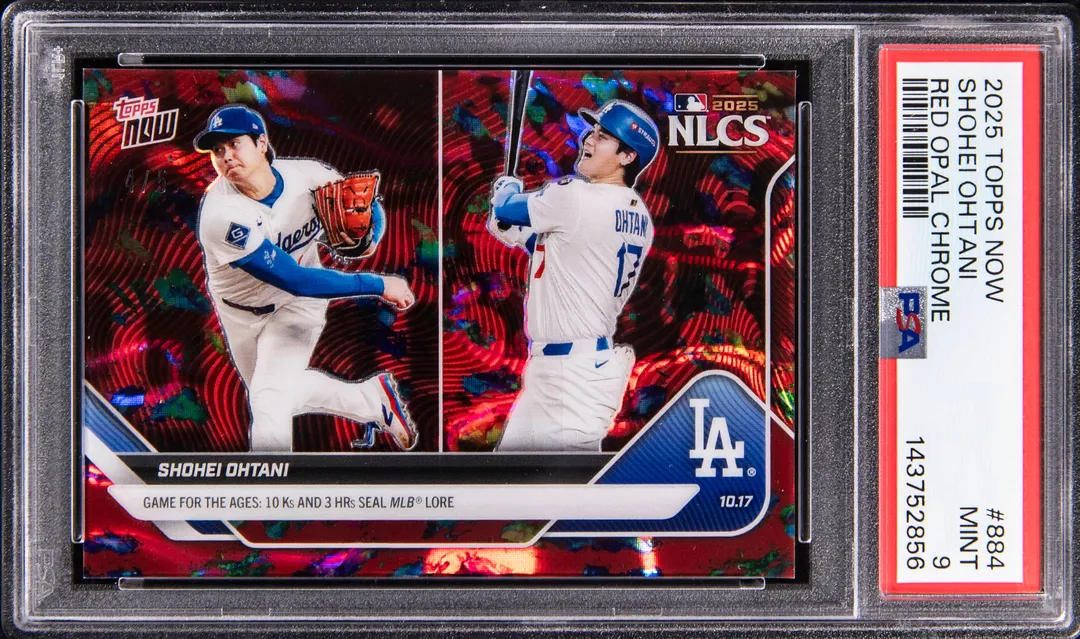
2025 Topps Now Red Opal Ohtani /5 PSA 9 Sells for $13K
Breakdown of the $13,420 Goldin sale for the 2025 Topps Now Red Opal Chrome #884 Shohei Ohtani /5 PSA 9 Pop 1 and what it means for collectors.
Sold Card
2025 Topps Now Red Opal Chrome #884 Shohei Ohtani (#4/5) - PSA MINT 9 - Pop 1
Sale Price
Platform
GoldinShohei Ohtani’s 2025 Topps Now Red Opal Chrome #884 just logged a notable modern-sale result, and it’s a good case study in how collectors look at low-serial, event-driven cards in the ultra‑modern era.
At Goldin on 02/08/26 (UTC), a 2025 Topps Now Red Opal Chrome #884 Shohei Ohtani, serial numbered 4/5 and graded PSA MINT 9, sold for $13,420. The slab carries a pop 1 designation in PSA’s population report, meaning this is currently the only copy recorded in that grade for this exact card and serial color.
Below, we’ll unpack what this card is, why collectors care, and how this sale fits into the broader Ohtani and Topps Now market.
Card basics: what exactly sold?
Let’s break down the title:
- Player: Shohei Ohtani
- Team: Los Angeles Dodgers (2025 Topps products reflect his move from the Angels)
- Year: 2025
- Set: Topps Now (Chrome finish)
- Card number: #884
- Parallel: Red Opal Chrome, serial numbered to just 5 copies (this one is #4/5)
- Grading company: PSA (Professional Sports Authenticator)
- Grade: PSA 9 (MINT)
- Attributes: Ultra‑low serial /5 parallel, modern chromium finish, event-based Topps Now card
- Rookie status: Not a rookie card; this is an established‑star, post‑rookie issue.
Topps Now is an on‑demand product line where cards are printed in real time to capture specific games and moments during the season. Buyers order during a short window, and the print run is capped based on orders. For select Topps Now releases, we see a Chrome treatment plus color parallels like this Red Opal.
Within that structure, a Red Opal /5 is near the top of the scarcity ladder for non‑autographed parallels. When paired with a headliner like Ohtani, that puts the card squarely in the “hobby chase” category for player collectors and modern‑high‑end buyers.
Grading, pop report, and scarcity
The card is graded PSA 9 (MINT). In PSA terms, that usually implies:
- Sharp corners
- Clean edges
- Strong surface with only minor imperfections
- Centering that is very good, though not quite gem‑mint
The seller’s title notes “Pop 1”, short for population 1. A pop report is the grading company’s census of how many copies of a given card have received each grade. Pop 1 in this context means:
- This is currently the only PSA 9 example of the 2025 Topps Now Red Opal Chrome #884 in PSA’s database.
- With the serial number at just 5 total copies made, the maximum eventual PSA population across all grades is five—assuming every copy is submitted to PSA, which is unlikely.
In ultra‑modern, low‑serial cards, condition scarcity is layered on top of print scarcity. With a /5 parallel, collectors are effectively dealing in single‑digit copy counts worldwide. Grading then slices that small pie again by condition, which is what makes a Pop 1 label meaningful.
Market context: where does $13,420 sit?
This sale closed at $13,420 on Goldin on 02/08/26 (UTC). For context, it helps to step back and look at three levels:
- This exact card and parallel
- Comparable Ohtani Topps Now and Topps Chrome parallels
- Ohtani’s broader premium card market
Because this is a very new 2025 Topps Now release and a /5 parallel, public data for this exact card in other grades or raw (ungraded) is very thin or nonexistent at the time of writing. That’s common for cards with print runs under 10: one or two copies surface early, and the rest may sit in personal collections for years.
So, instead of forcing a 1:1 comparison that doesn’t exist, it’s more useful to frame this sale against similar Ohtani profiles:
- Other low-serial Topps Now Ohtani parallels from earlier years (Angels era) in PSA 9–10 have typically sold in a wide band, depending on the moment captured and the color: from the low four figures into the mid‑five‑figure range.
- Chrome and Sapphire Ohtani parallels with print runs between /5 and /10—especially those tied to debut, record, or award‑related moments—have generated strong auction performances, often outpacing more common serials like /50 or /99 by several multiples.
Within that landscape, $13,420 for a /5, PSA 9, Dodger‑era Topps Now parallel lands in a range that feels consistent with Ohtani’s status as one of the few active players whose premium, low‑serial modern cards can command mid‑five‑figure attention. It doesn’t resemble an outlier record shot up into six figures, but it also isn’t a casual price point; it’s the level where serious Ohtani collectors and high‑end modern buyers typically intersect.
Without a string of prior public comps for this exact card, it’s hard to label the result definitively “high” or “cheap.” What we can say is that the sale:
- Confirms meaningful demand for Dodger‑uniform Ohtani parallels, not just his early Angels issues.
- Shows that a PSA 9 can still secure a premium result when the underlying card is both low‑print and desirable.
Why collectors care about this card
Several factors combine to give this particular card some weight in the Ohtani market:
1. Ohtani’s two‑way superstar profile
Shohei Ohtani is one of the rare modern players whose on‑field résumé already invites historical comparison. MVP awards, elite pitching and hitting seasons, and global popularity make him one of the central figures of the ultra‑modern hobby.
For collectors, that translates into:
- Broad demand across countries and languages.
- Deep player collections that chase not just rookies, but also unique, low‑print later‑career cards.
- Willingness to pay notable premiums for the rarest parallels, especially those under /25 and /10.
2. Dodgers era and narrative value
The move from the Angels to the Los Angeles Dodgers created a natural dividing line in Ohtani collecting. Some collectors focus on:
- Angels era: early career and MVP seasons, with emphasis on 2018 rookies and award‑season issues.
- Dodgers era: a fresh chapter on a marquee franchise with postseason expectations and massive media coverage.
A 2025 Topps Now card in Dodgers blue taps into that second narrative. For player collectors building a complete Ohtani timeline, these Dodger‑era, low‑serial issues become key holdings that distinguish their collection from those that stop at rookie and early‑career cards.
3. Topps Now and moment-driven collecting
Topps Now is inherently moment‑based: each card documents a specific game, performance, or milestone. Even if you’re not chasing the entire Topps Now run, certain moments stand out over time, and the rarest parallels from those checklists tend to age well in the eyes of collectors.
The Chrome treatment and Red Opal color layer a more premium feel on top of the standard Topps Now print. Within a given Topps Now release, collectors often rank versions roughly as:
- Base Topps Now (print run defined by orders)
- Chrome versions
- Color Chrome parallels, especially those under /25
- Ultra‑short‑print parallels like /10 and /5
This Red Opal /5 sits near the top of that hierarchy for non‑autograph parallels, which is why it can draw significant auction interest even though it’s not a rookie card.
4. Ultra‑modern supply dynamics
Ohtani’s flagship rookies (for example, 2018 Topps Update) have fairly large print runs relative to high‑end collector demand. In contrast, post‑rookie low‑serial issues like this one exist in single‑digit quantities.
As more collectors decide they want some form of premium Ohtani representation—beyond a base rookie—these super-short‑print cards become logical targets. The math is straightforward:
- Global interest in Ohtani is very high.
- Only five copies of this specific Red Opal parallel exist.
- Only a subset of those will be graded PSA, and an even smaller subset will hit auction.
That supply‑demand imbalance is what gives a Pop 1 /5 Ohtani card room to command a five‑figure result.
How to think about this sale as a collector or small seller
This Goldin sale tells us a few practical things about the current Ohtani and modern market:
Severe scarcity trumps small grade differences.
In ultra‑low‑print cards, collectors will often prioritize owning a copy over insisting on gem‑mint. A PSA 9 can absolutely anchor a PC (personal collection) when there are only five copies in existence.Event-driven sets are still relevant.
Topps Now may not always carry the same brand weight as a flagship base rookie, but for current‑year, current‑team storylines, you can see real demand—especially when combined with Chrome and low‑serial color.Auction houses remain important for thin‑comp cards.
When comps (recent comparable sales) are scarce, sellers often prefer auction houses like Goldin, PWCC, or Heritage. They provide marketing reach and competitive bidding that can help establish a market level for a card that rarely appears on fixed‑price marketplaces.
If you’re collecting or selling within this lane:
- For collectors: focus on moments and parallels that genuinely matter to you. With such low serial numbers, you may only get one chance to acquire a specific card.
- For small sellers: documenting sale history, set details, and pop report data clearly can help buyers understand why a card is special, especially on newer Topps Now releases.
Takeaways for the 2025 Topps Now Red Opal Chrome #884
To sum up the key points around this sale:
- A 2025 Topps Now Red Opal Chrome #884 Shohei Ohtani (#4/5) graded PSA MINT 9 (Pop 1) sold for $13,420 at Goldin on 02/08/26 (UTC).
- This is a Dodger‑era, ultra‑short‑print parallel, not a rookie, but highly relevant for Ohtani’s ongoing narrative.
- With only five total copies and a Pop 1 in PSA 9, condition and supply scarcity are both very real drivers here.
- In the context of other premium Ohtani parallels, the result aligns with his standing as one of the few modern players who can regularly support five‑figure prices for non‑rookie, non‑auto cards.
For figoca users tracking the modern high‑end market, this sale is another data point showing how tightly collectors are focusing on low‑serial, story‑rich cards of the game’s most important active stars—and how quickly price levels can escalate when you move from /50 into true single‑digit territory.