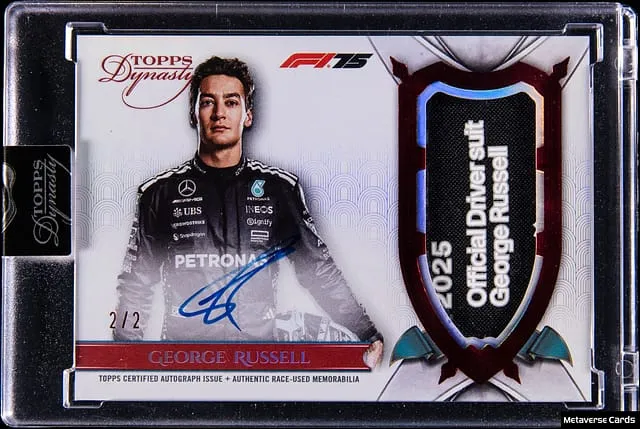
2025 Topps Dynasty F1 George Russell Patch Auto #2/2
Figoca reviews the $13,420 Goldin sale of a 2025 Topps Dynasty F1 George Russell Suit Nameplate Patch Autograph #2/2 and its market context.
Sold Card
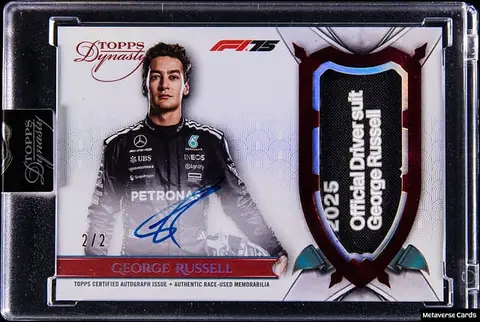
2025 Topps Dynasty F1 Suit Nameplate Patch Autograph #DAF-GRU George Russell Signed Patch Card (#2/2) - Topps Encased
Sale Price
Platform
Goldin2025 Topps Dynasty F1 George Russell Suit Nameplate Patch Auto #2/2 Sells for $13,420
On June 7, 2026, Goldin sold a 2025 Topps Dynasty F1 Suit Nameplate Patch Autograph #DAF-GRU George Russell card, serial‑numbered 2/2, for $13,420. The card is factory‑encased by Topps and features an on‑card autograph and a multi‑color race‑worn suit nameplate patch.
Below, we’ll break down what this card is, why it matters to Formula 1 collectors, and how this sale fits into the broader F1 modern card market.
Card overview: what exactly sold?
Card details
- Player: George Russell
- Team: Mercedes-AMG Petronas Formula One Team (at time of issue)
- Year: 2025
- Set: 2025 Topps Dynasty Formula 1
- Card: Suit Nameplate Patch Autograph
- Card number: #DAF-GRU
- Serial numbering: #2/2 (only two copies produced)
- Autograph: On-card (signed directly on the card surface)
- Memorabilia: Race‑worn suit nameplate patch
- Encapsulation: Topps factory seal/Topps Encased (not third‑party graded)
This is not a rookie card. George Russell’s key early F1 issues are from the first licensed Topps F1 products (notably 2020 Topps Chrome F1 and 2020 Topps Dynasty F1). However, within 2025 Dynasty, a Suit Nameplate Patch Autograph numbered to 2 is near the top of the player’s hierarchy for that year.
In modern high‑end products, a nameplate patch refers to a piece of the driver’s suit that shows part of the name or branding panel, often with bold lettering and color. It tends to be more visually distinct (and more chased) than a plain color patch.
What makes 2025 Topps Dynasty F1 important?
Topps Dynasty is the flagship ultra‑premium Formula 1 product:
- One hit per box, typically a patch autograph or cut signature.
- Very low print runs, with most cards serial‑numbered to 10 or fewer.
- On‑card signatures and large memorabilia patches.
For F1, Dynasty has been the go‑to “grail” product since its debut in 2020. Russell’s Dynasty cards from each year form a ladder for collectors:
- Entry tier: Higher‑numbered patch autos (e.g., /10 or /5).
- Mid‑tier: Premium patches or attractive numbering.
- Top tier: 1/1s, nameplates, sponsor logo patches, and ultra‑low numbered cards like this /2.
Even without a third‑party grade, a Topps‑encased Dynasty card usually carries strong confidence from collectors because of the brand’s track record and the product’s price point.
Market context: how does $13,420 fit in?
The hammer price was $13,420 at Goldin on June 7, 2026 (UTC).
When collectors talk about “comps” (short for “comparables”), they mean recent completed sales for the same card or very similar cards. As of now, public data on this exact 2025 Dynasty Russell Suit Nameplate Patch Auto #2/2 is limited; with only two copies made, it may be the first time this particular version has surfaced at a major auction house.
However, we can still place the sale in context by looking at closely related cards:
- Prior‑year George Russell Dynasty cards (especially 2020–2023) with low serial numbers and premium patches.
- Other 2025 Dynasty Russell cards with different patch variations and numbering.
- High‑end Dynasty cards of comparable tier drivers (e.g., non‑champion but front‑running talents) in similar /2 or /3 patches.
Across those categories, Russell’s strongest cards tend to land in a tier below all‑time greats like Lewis Hamilton and Max Verstappen but above mid‑grid drivers. This $13k‑range sale is consistent with that middle‑to‑upper echelon positioning: a serious price for a serious card, but not near the record levels reserved for multiple‑time world champions.
Because /2 cards rarely trade, it’s difficult to label the price as definitively “high” or “low.” Instead, it’s useful to see it as a data point that:
- Confirms continuing demand for top‑tier Russell pieces in the ultra‑premium lane.
- Helps set a reference range for future Russell Dynasty /2 or /3 patches from adjacent years.
George Russell’s hobby profile in 2026
George Russell sits in an interesting place for collectors:
- Established as a Mercedes race winner and regular front‑runner.
- Still in the phase of his career where upside and longevity are part of the appeal.
- Well‑known personality, often featured heavily in F1 media and broadcasts.
Collectors often sort modern F1 drivers into tiers:
- All‑time legends / multi‑title stars (Hamilton, Verstappen, Schumacher in older products).
- Championship contenders / race winners (where Russell generally sits).
- Prospects, rookies, and journeymen.
Dynasty cards for tier‑2 drivers can show meaningful price sensitivity to on‑track performance. A strong season, more wins, or a sustained title challenge can support high‑end prices; poor performances or team struggles can work the other way.
That’s why many collectors treat a card like this as a long‑term performance mirror rather than a short‑term flip. The card tracks the driver’s career narrative over time.
Why this specific card matters to collectors
Several factors combine to make this a notable George Russell piece:
Ultra‑low serial number (#2/2)
With only two copies of this exact Suit Nameplate Patch Autograph, true scarcity is built in. Unlike higher‑print modern parallels, a /2 card is effectively a one‑time opportunity for most collectors.Premium memorabilia (suit nameplate patch)
The nameplate patch connects the card directly to Russell’s race‑worn gear. For many F1 collectors, that physical connection to the car or suit is part of the charm of Dynasty and sets it apart from regular autographs.On‑card autograph
On‑card autos are signed directly on the card, rather than on a sticker. For high‑end issues, collectors tend to prefer on‑card signatures because they feel more personal and visually integrated.Topps factory encapsulation
The Topps Dynasty seal serves a similar purpose to grading slabs for some buyers: it provides confidence that the card is authentic and untouched since packing out. Some owners later submit Dynasty cards for grading, but many choose to keep them in the original Topps case.Part of a key modern F1 run
Since 2020, Topps Dynasty F1 has effectively created an annual run of ultra‑premium cards for every major driver. Collectors who chase player‑specific “rainbows” or year‑by‑year runs often target:- Early‑year issues (closest to a driver’s F1 debut).
- Their favorite card design years.
- The rarest patches (nameplate, team logo, sponsor logo, 1/1s, and /2s like this).
Within that ecosystem, this 2025 Suit Nameplate /2 is a natural candidate for a top‑three Russell card of the year.
Price context for hobbyists and small sellers
A single $13,420 sale can feel remote if you’re mostly buying and selling cards in the $50–$500 range. It’s still useful as a benchmark:
- “Top of the pyramid” insight: High‑end sales like this show what the very top of a player’s market can look like. They’re not targets for most buyers, but they anchor expectations for everything below.
- Relative pricing: If a top Russell Dynasty /2 patch auto is at $13k+, that helps put mid‑tier Russell autos, numbered parallels, and earlier‑year cards into perspective.
- Risk and volatility: Ultra‑premium, low‑population cards usually have fewer data points. Prices can move more sharply between sales because there aren’t many recent comps, and buyer pools are smaller.
For small sellers, the main takeaway isn’t to chase five‑figure cards, but to understand the hierarchy:
- Patches with strong visual appeal and low numbering tend to sit at the top.
- On‑card autos and brand‑name sets (like Dynasty, Chrome, Sapphire) generally command premiums.
- Unnumbered, non‑auto cards of the same player live further down the ladder.
Where this sale fits in the broader F1 trend
Since F1 cards went mainstream around 2020, the market has gone through several phases: rapid growth, correction, and then more selective demand focused on established products and drivers.
This 2025 Topps Dynasty F1 George Russell Suit Nameplate Patch Auto #2/2 sale suggests:
- Dynasty remains a central high‑end product for F1 collectors.
- Key drivers still attract strong bidding for their best pieces, even as lower‑tier cards see more pressure.
- Scarce, story‑driven memorabilia cards—particularly with clear visual appeal and on‑card autographs—continue to define the high end of the F1 hobby.
Final thoughts for collectors
If you collect George Russell:
- This card is close to the top of his 2025 catalog.
- Even if a /2 nameplate isn’t within budget, this result can help you gauge where other Russell Dynasty cards, especially /10 or /5 patches, might reasonably sit relative to one another.
If you’re newer to F1 cards:
- Use this sale as a lens into how modern ultra‑premium cards are structured: serial numbers, patch quality, autograph type, and brand all matter.
- Pay attention to comps (recent, confirmed sales) and remember that a single auction—especially for a card with a population of two—represents one data point, not a guaranteed future price.
As always, treat auction results as information, not instruction. Understanding the story behind a sale like this can help you build a collection that makes sense for your own budget, time horizon, and interest in the sport.