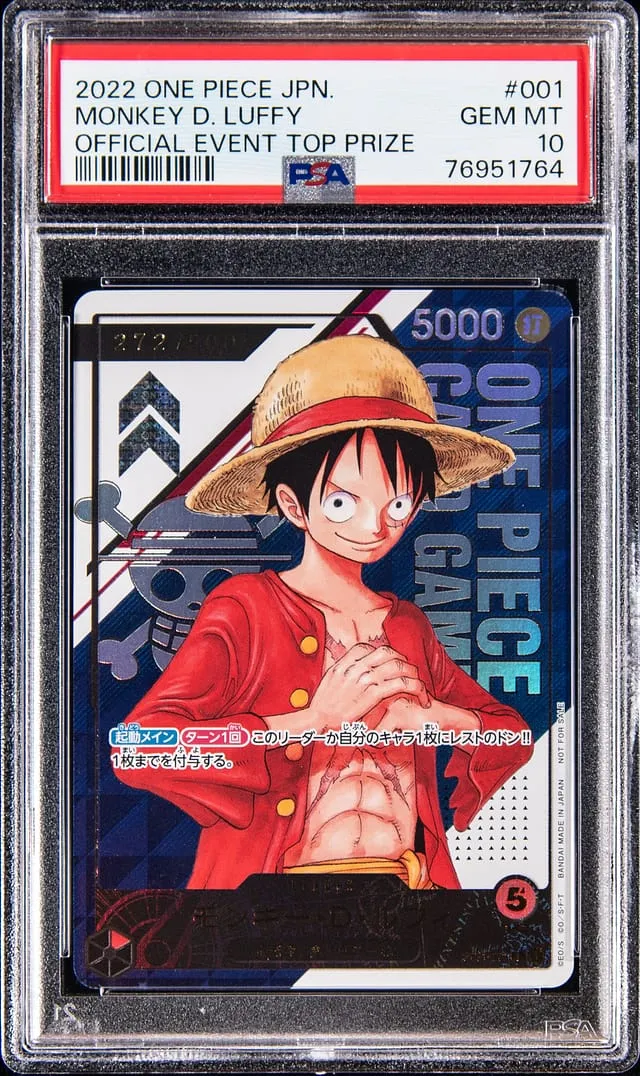
2022 Luffy Top Prize PSA 10 One Piece Sale
A 2022 One Piece Luffy Top Prize #001 /500 PSA 10 sold for $57,340 at Goldin on May 18, 2026. We break down the card, comps, and collector context.
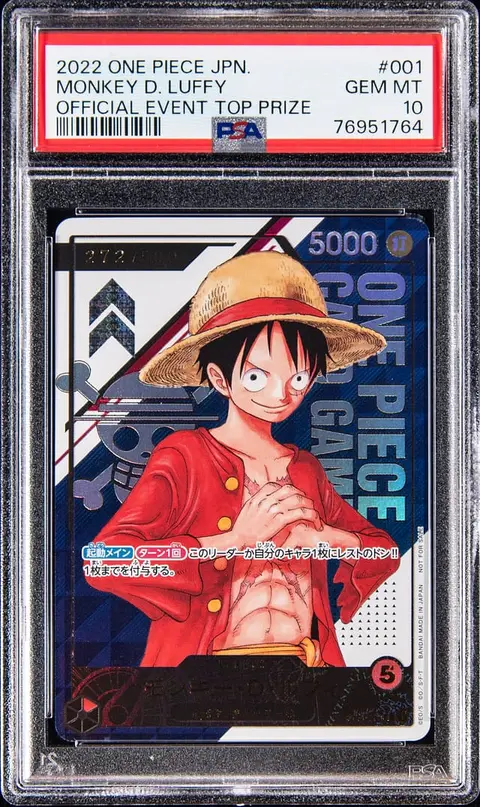
Sold Card
2022 One Piece Japanese Starter Deck Straw Hat Crew Serialized Top Prize #001 Monkey D. Luffy (#272/500) - PSA GEM MT 10
Sale Price
Platform
Goldin2022 One Piece Japanese Starter Deck Straw Hat Crew Serialized Top Prize #001 Monkey D. Luffy (#272/500) - PSA GEM MT 10 Sells for $57,340
On May 18, 2026, Goldin closed a notable ultra‑modern TCG sale: a 2022 One Piece Japanese Starter Deck Straw Hat Crew Serialized Top Prize #001 Monkey D. Luffy, serial numbered 272/500, graded PSA GEM MT 10, realized $57,340.
For One Piece collectors and broader TCG hobbyists, this sale is a useful data point in understanding how early high‑end One Piece cards are being valued in relation to more established franchises like Pokémon and Yu‑Gi‑Oh.
Card overview
Let’s break down what this card actually is:
- Character: Monkey D. Luffy (Straw Hat Pirates captain)
- Year: 2022
- Set / Source: Japanese “Starter Deck Straw Hat Crew” (an early One Piece Card Game product)
- Card title: Serialized Top Prize #001 Monkey D. Luffy
- Serial numbering: Hand‑ or machine‑stamped #/500; this specific copy is #272/500
- Grading company: PSA (Professional Sports Authenticator)
- Grade: GEM MT 10 – PSA’s highest standard numeric grade
- Attributes:
- Low‑serial, limited to 500 copies
- Top‑prize style promotional card associated with the Straw Hat Crew starter product
- Early, premium Luffy issue from the launch phase of the One Piece Card Game
This is not a “rookie card” in the sports sense, but functionally plays a similar role for TCG collectors: an early, scarce, flagship‑style Luffy card from the beginning of Bandai’s modern One Piece Card Game era.
Why this card matters to collectors
1. Early One Piece TCG grail territory
The One Piece Card Game is still in its ultra‑modern phase (very recent releases, print‑to‑order era, heavy grading), but certain early chase cards are already being treated as foundational.
Key points for this Luffy Top Prize card:
- Early‑era release: 2022 products mark the beginning of the modern One Piece TCG boom in Japan.
- Limited printing: A stated run of 500 copies makes it meaningfully scarcer than mass‑printed set cards.
- Character importance: Luffy is the central character of the franchise. In TCG terms, he’s the equivalent of a flagship protagonist like Pikachu or Charizard in Pokémon.
- Award / prize style distribution: Top‑prize and event‑linked cards typically circulate less than standard pack‑pulled cards, and they often develop a “grail” reputation if collectors decide they represent the era well.
Collectors tend to look for cards that combine character importance, scarcity, and an early timestamp in the game’s history. This card checks all three boxes.
2. PSA GEM MT 10 in a low‑print card
A pop report is a grading company’s census that shows how many copies of a card have been graded at each grade level.
While specific population numbers for this exact card can change as more are submitted, two broad points hold:
- Serial limitation: With only 500 copies existing, there is a hard ceiling on how many PSA 10s can ever exist.
- Condition challenges: Prize and promo cards often have handling, storage, or distribution wear that make true gem copies harder to find.
For high‑end collectors, the combination of limited serial + PSA 10 is typically what pushes a card from “nice” to “centerpiece.”
Market context and price discussion
- Sale: $57,340
- Auction house: Goldin
- Sale date (UTC): 2026‑05‑18
To put this number into context, we look at comps—short for comparables, meaning similar items that have sold recently.
Because this is a relatively niche, serial‑numbered prize card from a young TCG, there are limited public sales to build a long trend line. When researching recent results across major marketplaces and Japanese‑focused auction platforms, a few patterns emerge:
- Exact card, PSA 10: Public data for this precise Top Prize #001 Luffy /500 in PSA 10 is sparse. When a card has few recorded auction results, each sale tends to set or reset expectations.
- Same card, lower grades or raw (ungraded): Other condition levels have traded notably lower, with a substantial gap between PSA 9 and PSA 10—common for ultra‑modern, low‑print TCG chase cards. The premium for PSA 10 in scarce, fan‑favorite issues can be significant.
- Other early Luffy grails: High‑end Luffy cards from 2022–2023 (especially limited promos and low‑serial prize or championship cards) have shown a pattern: strong demand when a clean copy surfaces, but with wide price variance depending on art, print run, and distribution story.
Given these factors, the $57,340 realized price at Goldin:
- Sits toward the high end of observed ranges for early premium Luffy cards.
- Reflects both the scarcity of this particular Top Prize issue and the grade premium for PSA 10.
- Functions as a reference point more than a definitive market average, simply because there are not many directly comparable sales.
Rather than treating this as a guarantee of future value, it’s more useful to view it as a snapshot of what a motivated market was willing to pay for a top‑tier example in a competitive auction environment.
How this sale fits into the broader One Piece TCG market
1. Maturing demand for character‑driven TCGs
The One Piece Card Game arrived into a hobby already familiar with character‑driven, anime‑based TCGs.
Key hobby dynamics at play:
- Cross‑collecting: Many Pokémon and Dragon Ball Super collectors are comfortable evaluating rarity, print runs, and grading for Japanese‑language cards. That knowledge transfers directly into One Piece.
- IP strength: The One Piece manga and anime have a decades‑long fanbase. As with other franchises, a portion of that fanbase has migrated into cards, especially as card grading has become mainstream.
- Preference for early, limited prints: Collectors often seek out the earliest, hardest‑to‑find representations of their favorite character in a new game. This card is one of the cleaner fits for “early, scarce, and important Luffy.”
2. Ultra‑modern volatility and opportunity
Because the One Piece Card Game is still in its early years, price action tends to be less stable than in long‑established markets like vintage Pokémon.
Some considerations for hobbyists observing this sale:
- Low transaction count: When only a handful of copies trade publicly, each result can swing perceived value sharply up or down.
- Grading curve: As more copies get graded, population reports can change the way collectors evaluate scarcity, particularly at PSA 10.
- Hype vs. staying power: Early years of a TCG often involve speculation. Over time, the community settles on a relatively small set of cards as long‑term favorites.
This Goldin sale is meaningful data, but it is one data point. For anyone following the One Piece market, the most useful approach is to track how future sales of the same card—especially in PSA 9 and PSA 10—compare against this benchmark.
Takeaways for collectors and small sellers
If you collect One Piece or anime TCGs
- This sale underscores how premium early Luffy cards are being treated as key hobby pieces.
- The combination of limited serial numbering, PSA 10 grading, and prize distribution is clearly resonating with collectors.
- If you’re building a Luffy or Straw Hat PC (personal collection), it’s worth mapping the hierarchy of early premiums—from prize cards like this to championship promos and scarce set inserts.
If you’re a returning or new hobbyist
- Use this as a case study in how the hobby values scarcity and condition:
- Serial numbering caps total supply.
- Prize or event distribution lowers the number that stay pack‑fresh.
- PSA 10 commands a large premium in truly limited cards.
- When examining any high‑end TCG card, check:
- Print run / serials (e.g., /500)
- Distribution type (pack, prize, event, championship)
- Grading population (how many PSA 9s and PSA 10s exist)
- Character importance (is this a central or side character?)
If you’re a small seller
- This result highlights the value of grading high‑end One Piece cards, especially prize or limited promos.
- For similar cards, clear documentation—set source, how the card was awarded, and any official statements about print runs—helps buyers understand what they’re looking at.
- When researching comps, you may find very few exact matches. In that case, look at:
- Same character, similar scarcity
- Same distribution type (prize / event)
- Nearby grades (PSA 9 vs PSA 10) and estimate a realistic grade premium instead of assuming a fixed multiplier.
Final thoughts
The $57,340 sale of the 2022 One Piece Japanese Starter Deck Straw Hat Crew Serialized Top Prize #001 Monkey D. Luffy (#272/500) in PSA GEM MT 10 at Goldin on May 18, 2026, is a strong signal of where the high‑end One Piece TCG market currently sits.
It illustrates how collectors are already assigning premium status to early, scarce, and well‑preserved Luffy cards. As more data comes in from future auctions and private sales, this result will serve as an early reference point for how the hobby values one of the key Luffy grails of the 2022 launch era.