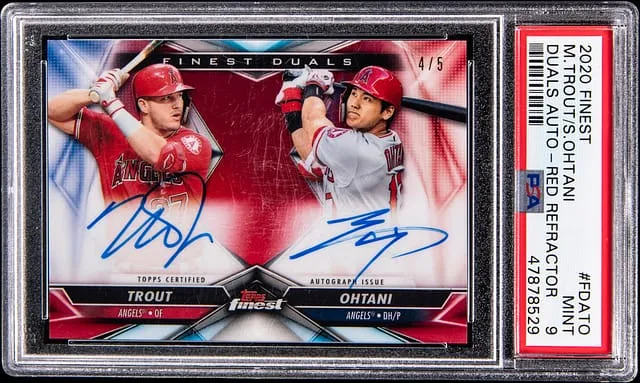
2020 Finest Trout/Ohtani Red Dual Auto PSA 9 Sale
Goldin sold a 2020 Topps Finest Trout/Ohtani Red Dual Auto /5 PSA 9 for $14,640 on June 7, 2026. A key data point for modern dual autograph collectors.
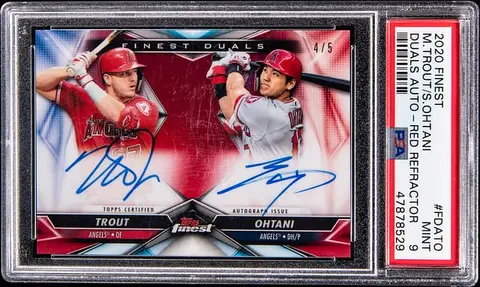
Sold Card
2020 Topps Finest Duals Autograph Red Refractor #FDA-TO Mike Trout/Shohei Ohtani Dual-Signed Card (#4/5) - PSA MINT 9
Sale Price
Platform
Goldin2020 Topps Finest Duals Autograph Red Refractor #FDA-TO Mike Trout/Shohei Ohtani Dual-Signed Card (#4/5) - PSA MINT 9 Sells for $14,640
On June 7, 2026, Goldin closed a notable modern baseball auction: a 2020 Topps Finest Duals Autograph Red Refractor #FDA-TO featuring both Mike Trout and Shohei Ohtani, serial-numbered 4/5 and graded PSA MINT 9, sold for $14,640.
For collectors tracking elite modern autos, Trout–Ohtani duals from the 2018–2021 window have become an important segment of the market. This specific Topps Finest red refractor is one of the lowest-numbered dual on-card autographs of the Angels-era pairing.
Card overview
- Year: 2020
- Product: Topps Finest
- Subset: Finest Duals Autographs
- Card number: #FDA-TO
- Players: Mike Trout and Shohei Ohtani
- Team: Los Angeles Angels
- Parallel: Red Refractor
- Serial numbering: 4/5 (five copies produced)
- Autographs: Dual on-card autographs (both players sign directly on the card surface)
- Grading company: PSA
- Grade: PSA MINT 9
This is not a rookie card for either player—Trout’s key rookies are from 2011, and Ohtani’s are from 2018—but it is a key dual-autograph issue pairing two of the most collected modern players on a low-serial refractor parallel.
Topps Finest is a long-running chromium (shiny, foil-board) brand. Within it, the Duals Autograph cards are a premium insert line. The Red Refractor, limited to just five copies, sits near the top of the parallel ladder, below only true 1-of-1s and, depending on the checklist, sometimes a Superfractor.
Market context and recent comps
In hobby language, “comps” are comparable recent sales used to understand where a card’s market has been. For a card as scarce as this—only five copies exist, and only a subset of those will ever be graded—direct comps are naturally thin.
Based on available public auction data and marketplace archives up to mid-2026:
- Other 2020 Topps Finest Trout/Ohtani Duals Autos in higher print-run parallels (like standard refractors or /25 golds) typically transact for low to mid four figures, depending on grading and eye appeal.
- Lower-numbered dual autos of Trout and Ohtani from other premium Topps chromium lines (such as Topps Chrome or Bowman's Best) have, in strong grades, reached into the mid to high four-figure range, with occasional outliers higher for especially scarce or iconic designs.
- True Trout–Ohtani 1-of-1 dual autographs in PSA 9 or BGS 9.5 from comparable brands have historically pushed well above this sale level, as expected given their unique status.
Within that landscape, the $14,640 result for this PSA 9 Red Refractor /5 sits in what can reasonably be described as the upper band for non–1-of-1 modern dual autos of this pairing, particularly from a non-flagship (but still respected) product like Topps Finest.
A few important notes that shape the price context:
- Serial numbering: Only five Red Refractors were produced. Even if all five survived in gradable condition, a meaningful portion may not hit the open market often. That relative illiquidity tends to make each sale more event-like and less predictable.
- Grade: PSA MINT 9 is one step below GEM MINT 10, but for modern chromium with on-card ink, a 9 is still viewed as a strong collector grade. Surface and centering can be challenging with dual autos, and autograph placement can influence buyer preference even among the same numeric grade.
- Brand tier: Topps Finest is respected and hobby-established, but it usually sits just below flagship Topps Chrome or ultra-premium releases when comparing peak prices. That makes a near-$15K result for a Finest dual particularly noteworthy.
Because exact PSA population (“pop report”) numbers for this specific serial and grade combination are small by design, it’s often more helpful to think in terms of relative scarcity (only five total) and relative demand (Trout and Ohtani are both top-tier hobby names) rather than over-focusing on the label alone.
Why this card matters to collectors
1. A snapshot of the Angels era
Dual Trout–Ohtani cards from 2018–2021 capture a unique, if ultimately bittersweet, period: two generational talents anchored to the same franchise.
- Mike Trout is widely regarded as one of the best all-around players of his generation, with a hobby profile anchored by his 2011 rookie issues.
- Shohei Ohtani is a once-in-a-century two-way star whose 2018 rookies and scarce autos have become modern centerpieces.
This card places both on the same chromium canvas, both signing on-card, during the prime of their Angels tenure. Collectors often treat these dual autos as a way to represent an entire era in a single piece.
2. Modern ultra-short print dual auto
Within the modern and ultra-modern eras (roughly mid-2000s onward), true scarcity is often defined not just by age but by print run and configuration.
Key factors here:
- Low serial numbering (/5): Only five copies means even well-funded player collectors may never own one.
- Dual on-card autographs: Both signatures are applied directly to the card surface. For many collectors, this is more desirable than sticker autos, where signatures are on a separate label.
- Recognizable parallel: "Red Refractor" is a familiar and generally premium color in the Topps chromium ecosystem, which helps the card resonate across product lines.
In other words, this is not just another Trout auto or another Ohtani auto—it belongs to a relatively small club of true dual on-card /5s for the pair.
3. Trout and Ohtani hobby trajectory
By mid-2026, the hobby view of these two players is shaped by both performance and narrative:
- Trout’s early-decade injuries have introduced some uncertainty about long-term counting stats, but his peak remains historically strong, and his established rookie and auto market provides a solid base of demand.
- Ohtani’s combination of pitching and hitting achievements and major awards has made him one of the central figures of the ultra-modern era. His movement between teams and continued high-level performance tend to re-focus attention on his key autos and duals.
When you combine a stable long-term star (Trout) with a headline-dominating modern icon (Ohtani) on a single, scarce card, the collector base widens. Some collectors chase Ohtani only, some Trout only; this piece appeals to both groups.
How this sale fits into the bigger picture
The $14,640 Goldin result from June 7, 2026, does a few things for the market:
- Reinforces dual Trout–Ohtani autos as a defined tier. This sale helps frame where a top-end but not 1-of-1 dual Finest auto sits relative to other premium duals.
- Highlights the role of product hierarchy. Seeing a Topps Finest dual auto approach or exceed prices of some cards from traditionally “higher” brands underscores how strongly design, scarcity, and player pairing can matter.
- Provides a reference point for sellers and buyers. Collectors holding parallel versions of this card (for example, higher-numbered refractors or raw/ungraded copies) now have another data point when thinking about offers, trades, or insurance valuations.
For context, this result should be read as one data point in a small sample size. With only five copies printed, and potentially fewer in PSA holders, each sale can be influenced by timing, who showed up to bid, and broader market sentiment around Trout and Ohtani at that moment.
Takeaways for collectors and small sellers
If you are new to this corner of the market or returning after a layoff, here are a few practical ways to interpret this sale:
- Think in tiers, not exact formulas. Rather than trying to derive a precise multiplier for every parallel, consider broad tiers: 1-of-1s at the top, then /5 reds like this, then mid-numbered parallels, then base autos. This sale situates the 2020 Finest Red /5 squarely in the high tier for dual Trout–Ohtani chromes.
- On-card dual autos tend to be more defensible. When you see two elite signatures on-card, on a known brand, with low numbering, you’re usually looking at the kind of piece that stays relevant for collectors even as products and checklists change.
- Use multiple comps where possible. For a card with only five copies, comps from other products, years, or parallels can still be helpful as benchmarks. Just be explicit with yourself about differences in brand prestige, numbering, and condition.
- Avoid assuming straight-line trends. A result like $14,640 does not guarantee anything about future prices. It is simply the latest public clearing price in a market that can move with player performance, broader economic conditions, and hobby sentiment.
Final thoughts
The 2020 Topps Finest Duals Autograph Red Refractor #FDA-TO Trout/Ohtani PSA MINT 9 is a clear example of how modern scarcity, star power, and product history intersect.
A low-serial dual on-card auto of two generational players reaching $14,640 at Goldin on June 7, 2026, won’t surprise close watchers of the Trout and Ohtani markets, but it does offer a clean, data-backed reference point. For collectors focused on Angels-era duals, it’s another reminder that this specific pairing—on chromium, in short print, with both signatures—sits near the top of the modern baseball hierarchy.
As always, this information is best used as context, not as a prediction. For collectors, it’s an opportunity to better understand how the hobby currently values one of the key Trout–Ohtani dual autographs from the 2020s.