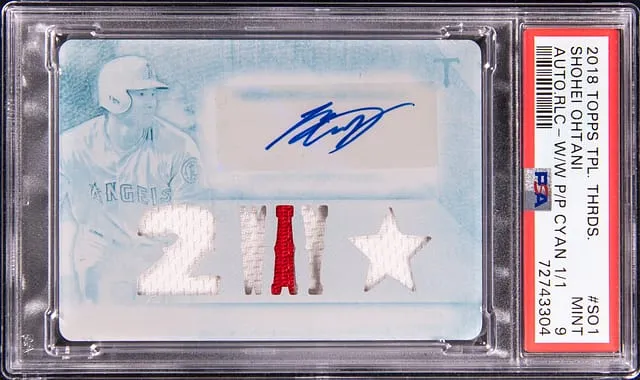
2018 Ohtani Triple Threads White Whale 1/1 Sells
A PSA 9 2018 Topps Triple Threads Shohei Ohtani White Whale 1/1 auto patch sold for $18,300 at Goldin. Here’s what it means for modern baseball cards.
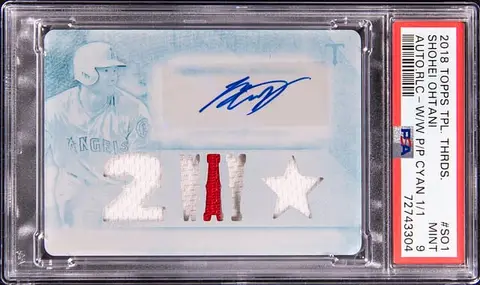
Sold Card
2018 Topps Triple Threads Autograph Relics White Whale Cyan Printing Plate #TTAR-SO1 Shohei Ohtani Signed Patch Rookie Card (#1/1) - PSA MINT 9
Sale Price
Platform
GoldinShohei Ohtani’s most important early cards have quietly become reference points for the modern baseball market, and this sale is a good example.
On March 15, 2026, Goldin auctioned a 2018 Topps Triple Threads Autograph Relics White Whale Cyan Printing Plate #TTAR-SO1 Shohei Ohtani Signed Patch Rookie Card (#1/1), graded PSA MINT 9, for $18,300.
This blog walks through what this specific card is, why collectors care, and how the price fits into the current Ohtani and modern baseball market.
The card at a glance
Here’s how this card breaks down in hobby terms:
- Player: Shohei Ohtani
- Team on card: Los Angeles Angels
- Year: 2018
- Set: Topps Triple Threads
- Card type: Autograph Relics “White Whale”
- Specific parallel: Cyan Printing Plate, 1/1 (one of one)
- Rookie card status: 2018 is Ohtani’s true MLB rookie year
- Serial numbering: Stamped 1/1 on the plate
- Autograph: On-card (signed directly on the plate)
- Memorabilia: Multi-color patch relic
- Grading company: PSA (Professional Sports Authenticator)
- Grade: MINT 9
Triple Threads is one of Topps’ mid-to-high end products, known for multi-piece relics, on-card autographs, and low-serial-number “White Whale” printing plates. White Whale plates combine several hobby perks in a single card: one-of-one status, autograph, relic patch, and visually distinctive plate surfaces.
Why this Ohtani matters to collectors
1. An early, premium Ohtani rookie
2018 is Ohtani’s first MLB card year, and his key rookies—from Topps Chrome and Bowman’s Best to higher-end brands—have become anchors for the modern card market.
Within his 2018 catalog, Triple Threads sits in the “premium but not unobtainable” tier. It doesn’t have the same flagship status as Topps Series 1/Update or the prospect lore of 2018 Bowman Chrome, but it offers:
- Designed-for-display, thick-stock cards
- Multi-color, game-used or player-used patches
- On-card signatures on many key hits
That combination has made Ohtani’s Triple Threads rookie autos a staple for collectors who want something more elaborate than a base rookie but not quite at National Treasures or Flawless price levels.
2. Printing plate + auto + patch + rookie year
A printing plate is one of the four metal plates (cyan, magenta, yellow, black) used in the printing process for a specific card. In modern products, these often get packed out as 1/1 chase cards.
This card combines several collector-friendly features:
- It’s a true 1/1 plate tied to a major star’s rookie-year card.
- It carries an on-card autograph, generally preferred over stickers because the player signs directly on the card.
- It includes a multi-color patch relic, which tends to be more desirable than single-color swatches.
- It’s from a recognizable, established Topps brand.
For player collectors and Ohtani “supercollectors” (those who chase as many significant cards of a single player as possible), these layered attributes make it a target even without being part of his core flagship run.
3. Modern, ultra-modern context
This is an ultra-modern card (roughly post-2016), a period defined by:
- High print runs at the base level
- Heavy reliance on short-printed parallels, serial numbers, and 1/1s for true rarity
- More frequent use of autographs and relics
In this landscape, not all 1/1s are equal. Player, brand, year, and type of card still matter a lot. An Ohtani rookie-year 1/1 auto patch from a known Topps line typically sits well above most non-rookie, non-auto plates in the same era.
Market context: where does $18,300 fit?
A price is only meaningful in context. Here’s how to think about this sale relative to the broader Ohtani market and similar Triple Threads cards.
Comps and nearby benchmarks
Because this is a one-of-one, there are no identical duplicates to compare to, but we can look at comps—recent sales of similar cards—to place the Goldin result.
Useful comparison points include:
- Other 2018 Ohtani rookie-year autograph patch 1/1s from Topps Triple Threads and adjacent Topps products.
- High-end 2018 Ohtani on-card auto patches from sets like Topps Dynasty, Museum Collection, and Five Star.
- Other Ohtani 1/1 printing plates from 2018, both signed and unsigned.
Across public auction data in the last few years, these patterns generally hold:
- Unsigned Ohtani rookie printing plates (non-auto, non-patch) sell significantly lower than five-figure levels, even when graded.
- Rookie-year Ohtani on-card autos with patches from mid-tier premium sets often sit in the mid-four to low-five-figure range depending on brand, design, and numbering.
- Top-tier Ohtani RPA-style 1/1s from the most premium brands can push into much higher territory, but those are different lanes entirely.
Within that spectrum, a sale at $18,300 for a PSA 9 graded Triple Threads White Whale 1/1 rookie-year auto patch tracks as:
- Clearly above the more common numbered Triple Threads rookie autos (e.g., /18 or /27)
- Below the very top of the Ohtani rookie pyramid (true flagship rookies, Bowman Chrome autos, and the biggest patch autos from ultra-premium products)
- In line with what the market has generally shown for strong but “second-tier” (in branding terms) premium 1/1s of Ohtani
Because Ohtani’s market has seen several waves of interest—MVP seasons, his move to Los Angeles, and ongoing milestones—individual results can fluctuate. The $18,300 result is best viewed as one more data point adding structure to the Ohtani 1/1 landscape rather than a dramatic outlier.
Grading impact: PSA MINT 9 on a plate
Printing plates are notoriously tough to grade well:
- They’re metal and can show surface scuffs, chipping, and manufacturing marks.
- Corners and edges are often imperfect right out of the pack.
A PSA MINT 9 on a plate is strong. While collectors usually care more about the underlying 1/1 status than population (pop report = how many copies of that card/grade exist at a grading company), a high grade still:
- Helps presentation and perceived quality
- Supports long-term confidence in condition
- Creates a clear distinction from raw (ungraded) plates with visible wear
In other words, the grade probably didn’t transform the price range, but it’s a meaningful positive for collectors who prefer their key cards slabbed and high-grade.
Why this sale matters beyond the single card
1. Ohtani as a market anchor
Ohtani has been one of the main “benchmark” players in the current hobby era. Like Trout a few years earlier, his sales:
- Act as reference points for how modern baseball is valued.
- Influence how collectors think about risk and reward in ultra-modern chase products.
- Anchor pricing for similarly structured cards of other stars.
This sale continues to show that the market distinguishes between:
- Core, widely recognized rookies (Topps flagship, Topps Chrome, Bowman Chrome autos).
- Premium but second-tier brands that still command real money, especially in 1/1 and patch-auto formats.
2. White Whales and niche high-end brands
Triple Threads is a good textbook case for how collectors treat mid-to-high-end brands:
- Base and mid-tier parallels are collectible but not usually market-defining.
- The biggest hits—White Whales, low-number auto relics—can still reach five figures for the right player.
- Design and year matter: being tied to Ohtani’s rookie season keeps this particular White Whale relevant in a way many veteran-year plates are not.
This sale reinforces that serious collectors are still willing to pay up for:
- Rookie-year 1/1s
- On-card autos with strong patches
- Recognizable inserts/parallels within established brands
3. One-of-one nuance in an era of many 1/1s
Modern products produce a lot of 1/1s—plates, parallels, brand-specific variants. The hobby has become more selective about which one-of-ones earn a premium.
This result suggests collectors still differentiate heavily based on:
- Year: Rookie vs later career
- Player: MVP-level global stars vs solid stars
- Card type: Auto patch plates from a named insert/parallel vs unnumbered or lower-tier 1/1s
A 1/1 label alone doesn’t guarantee a high outcome; context does. Here, that context—Ohtani, 2018, autograph, patch, Triple Threads White Whale—adds up to a justifiable premium.
Takeaways for collectors and small sellers
If you’re newer to the hobby or returning after a break, this Ohtani sale offers some practical lessons:
Know the hierarchy of a player’s rookies. For Ohtani, Bowman Chrome autos and key Topps rookies sit at the very top, but premium second-tier brands like Triple Threads can still be very strong, especially in 1/1 formats.
Rookie-year + autograph + patch + 1/1 is a powerful combo. The closer a card comes to this full combination—especially for star players—the more it tends to command.
Brand and design still matter. A 1/1 from a recognizable line with a defined parallel name (“White Whale”) generally has more long-term clarity than a random 1/1 from an obscure insert.
Grading is more nuanced on plates. High grades on metal 1/1s are nice to have, but the uniqueness and player drive most of the value.
Use comps as guides, not promises. Looking at similar sales across Goldin and other marketplaces can help you understand ranges, but past prices aren’t guarantees of future outcomes.
Final thoughts
The $18,300 sale of the 2018 Topps Triple Threads Autograph Relics White Whale Cyan Printing Plate #TTAR-SO1 Shohei Ohtani Signed Patch Rookie Card (#1/1) in PSA MINT 9 at Goldin on March 15, 2026, is a clear, data-backed example of how the market is currently treating:
- Rookie-year Ohtani 1/1s
- Premium but not ultra-premium brands
- Complex cards that combine autograph, patch, and printing plate elements
For Ohtani collectors, it’s a notable acquisition and a clean comp to reference when thinking about other high-end, rookie-year 1/1s. For the broader hobby, it’s another piece in the evolving puzzle of how ultra-modern, star-driven 1/1s are being valued as the market matures.