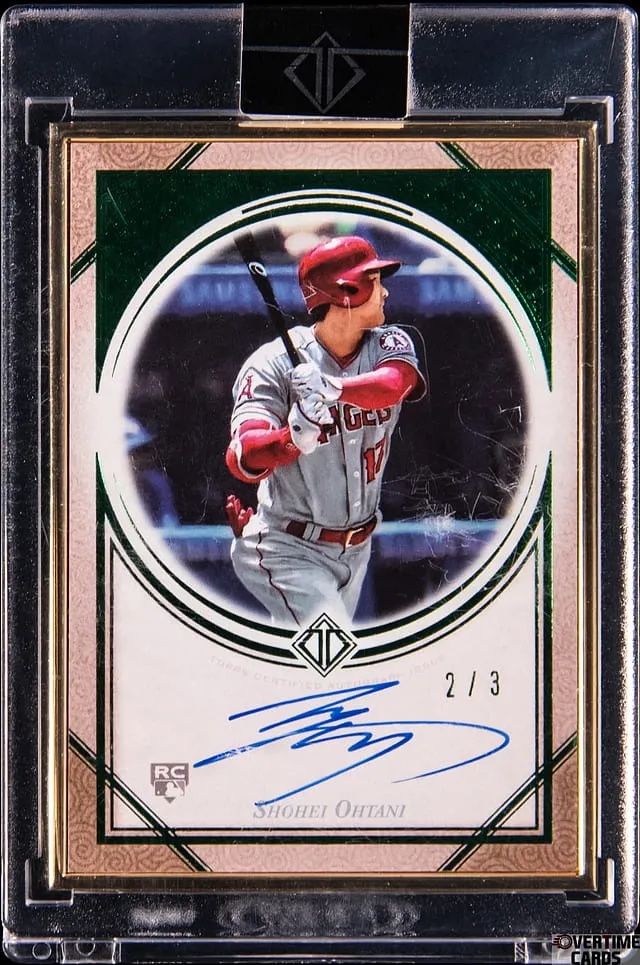
2018 Ohtani Transcendent Emerald Auto /3 Sells for $33K
Goldin sold a 2018 Topps Transcendent Shohei Ohtani Emerald Autographs /3 rookie for $33,379. See how this ultra-short-print fits his high-end market.
Sold Card
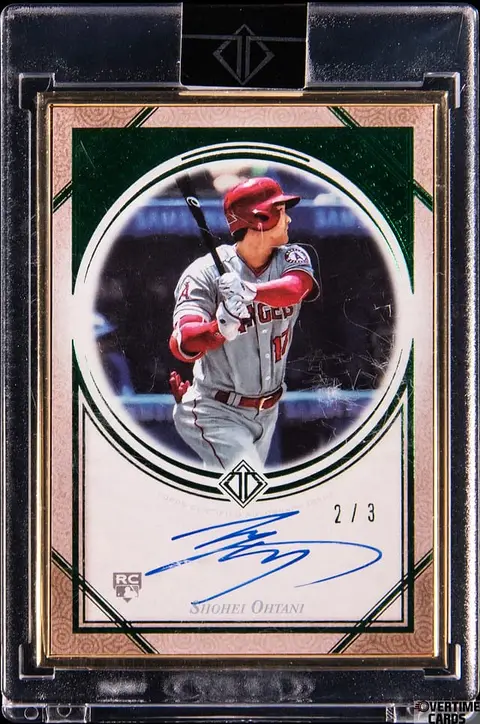
2018 Topps Transcendent Autographs Emerald #TA-SO27 Shohei Ohtani Signed Rookie Card (#2/3) - Topps Encased
Sale Price
Platform
Goldin2018 Topps Transcendent Shohei Ohtani Emerald Auto /3 Sells for $33,379
On May 15, 2026, Goldin closed a notable ultra-modern baseball sale: a 2018 Topps Transcendent Autographs Emerald #TA‑SO27 Shohei Ohtani signed rookie card, serial‑numbered 2/3 and Topps‑encased, realized $33,379.
For collectors who track Ohtani’s premium rookies and high‑end Topps releases, this is a useful data point in understanding where truly scarce, luxury‑tier Ohtani pieces are settling right now.
Card breakdown: what exactly sold?
Let’s start with the essentials of the card:
- Player: Shohei Ohtani
- Team: Los Angeles Angels
- Year: 2018
- Product: Topps Transcendent Baseball
- Subset: Transcendent Autographs
- Card number: #TA‑SO27
- Parallel: Emerald
- Serial numbering: Hand‑numbered 2/3 (only three copies produced)
- Rookie status: 2018 issue — collected as a rookie‑year autograph
- Autograph type: On‑card (signed directly on the card surface)
- Encapsulation: Factory Topps Encased (sealed by Topps as issued from the product)
- Grading: Not third‑party graded in this sale; presented in original Topps holder
Topps Transcendent is the company’s highest‑end annual baseball release. Boxes are produced in extremely limited quantities and sold at a premium price point, often including VIP event invitations. The Transcendent Autographs checklist functions as the backbone of the product, featuring on‑card signatures of current stars, legends, and rookies.
Within that structure, Emerald parallels are among the low‑print, premium color variants. A print run of three copies moves this card from “desirable” into “genuinely scarce” territory, even by modern standards where serial‑numbering is common.
Where this card sits in the Ohtani rookie landscape
Shohei Ohtani’s 2018 rookie year generated a wide range of cards, from mass‑produced flagship rookies to extremely short‑printed, high‑end autographs. For context:
- Flagship rookies (Topps Series 1, Update, Chrome) are what many collectors think of first. They have higher print runs but strong long‑term demand.
- Premium rookies (like 2018 Topps Transcendent, Dynasty, Definitive, Five Star) sit in a much narrower, more expensive lane: on‑card ink, low serial numbering, and higher entry costs.
This Transcendent Emerald /3 falls squarely in the luxury rookie‑year auto category:
- It is not his main flagship rookie, but
- It is an on‑card, extremely low‑serial, brand‑defining issue from Topps’ most exclusive product line.
For high‑end Ohtani collectors, these are often treated as centerpiece items rather than supporting pieces.
Market context and recent sales
Because the Emerald /3 parallel is so short‑printed, public sales are naturally sparse. That makes traditional “comps” (comparable recent sales used to estimate value) harder to pin down than for more common cards.
What we can say using available, recent market context:
Transcendent Ohtani rookie autos (non‑Emerald)
- Higher‑print versions (e.g., /25, /50, or unnumbered Transcendent autos) have been trading in a wide band, generally well below this $33,379 level, depending on condition and exact parallel.
- When those appear at auction, hammer prices typically reflect strong demand but considerably more liquidity than a /3.
Other low‑serial Ohtani rookie‑year premium autos
- High‑end issues like Dynasty and Definitive with serial numbers in the single digits (e.g., /5, /10) have shown that there is a willing buyer base for truly scarce Ohtani ink.
- Top copies with compelling aesthetics or patches have occasionally reached or surpassed this Transcendent Emerald range, but those sales are usually for 1/1s, logo patches, or gem‑mint graded examples.
This sale’s position in that spectrum
- At $33,379, this result is clearly in the upper tier of Ohtani’s rookie‑year autograph market, but not at the absolute top, where 1/1s, unique inscriptions, or BGS/PSA gem‑mint copies can land.
- Given the scarcity (/3), on‑card auto, and Transcendent branding, the price aligns with what we generally see for premium, ultra‑short‑print Ohtani rookies in a healthy market.
Because public, exact‑match comps for 2018 Transcendent Autographs Emerald #TA‑SO27 /3 are limited, it’s better to view this sale as part of a cluster of similar high‑end Ohtani rookies, rather than a precise benchmark. Within that cluster, this hammer looks solidly in line with expectations for a top‑end, non‑1/1 Ohtani piece in 2026.
Why collectors care about this card
Several factors make this card meaningful to different types of collectors:
1. Shohei Ohtani’s unique two‑way profile
Ohtani remains one of the most unusual modern players: an elite hitter and (when healthy) a front‑line pitcher. That two‑way profile has driven sustained hobby interest. For collectors, owning a premium rookie‑year auto ties directly into that broader story.
2. Rookie‑year, on‑card autograph
Rookie‑year autographs are often treated as key issues for modern players, similar to how flagship rookies function in earlier eras. On‑card ink — where the athlete signs directly on the card rather than on a sticker — is preferred by many collectors because it feels more personal and visually clean.
3. Topps Transcendent’s position in the hobby
Topps Transcendent occupies a particular niche:
- Extremely limited production
- High box and case prices
- VIP experiences and special event invites
- A checklist that emphasizes stars and legends
Because of that, Transcendent autos often function as status pieces within a player’s card portfolio. They may not be the most widely known among casual collectors, but serious player collectors and high‑end buyers recognize them as flagship cards for the brand.
4. Serial‑numbered /3 scarcity
In ultra‑modern cards (roughly mid‑2010s onward), serial‑numbering is common, but print runs under 10 still stand out:
- /50 or /25 parallels can appear frequently enough to establish clear price ranges.
- /10 and /5 start to feel genuinely thin on the ground.
- /3 is in practice close to super‑short‑print territory: a small enough supply that only a few dedicated collectors can ever own one.
For Ohtani, who has both a global fanbase and a dedicated supercollector community, that level of scarcity matters. When one surfaces at a major house like Goldin, it can reset expectations for the card’s perceived tier.
The role of encasing and grading
This particular copy was sold in Topps’ original Transcendent encasement, not a third‑party grading slab.
Some considerations:
- Topps Encased provides assurance that the card and autograph came directly from the manufacturer and were sealed at the factory.
- On the other hand, many high‑end buyers prefer PSA, BGS, or SGC grading, especially when condition (corners, edges, surface, centering) could materially impact value.
The result here — reaching $33,379 without a numerical third‑party grade — suggests:
- The market is comfortable valuing this as a scarce, high‑end Ohtani auto first, and a condition‑chase card second.
- Some buyers may even prefer unbroken factory encasement for certain premium Transcendent cards, at least until they decide whether to cross into a grading slab.
How this sale fits broader Ohtani and ultra‑modern trends
While each high‑end sale has its own story, a few broader themes show up here:
Continued demand for true scarcity
Even with a large number of different Ohtani cards on the market, genuinely low‑serial, on‑card, rookie‑year autos continue to attract strong bidding. This sale is consistent with that pattern.Strength of player‑collecting lanes
Ohtani has a well‑defined collector base: some focus on rookies, others on autos, others on rare parallels. A card like this sits at the intersection of several of those lanes, which tends to help when it does surface at auction.Transcendent’s steady role as a high‑end anchor
Even as new products and formats appear, Transcendent has kept its place as a top‑shelf option in the Topps lineup. Sales like this reinforce that the brand’s premium positioning still resonates.
Takeaways for different types of collectors
This information is not financial advice and isn’t a prediction of future prices. It’s just a snapshot of how the market treated this specific card on May 15, 2026.
If you’re new or just returning to the hobby
- This sale highlights how rookie‑year + on‑card auto + low serial‑numbering can create a premium tier for modern stars.
- You don’t need a Transcendent Emerald /3 to collect Ohtani; his 2018 Topps flagship, Chrome, and lower‑tier autos provide much more accessible entry points. But understanding the top of the market gives context for everything else.
If you’re an active hobbyist
- Use results like this as context, not a price guide. A /3 Emerald from Transcendent is a different animal than a /25 or /50 from a mid‑tier product.
- When checking comps, try to compare across similar tiers: on‑card vs. sticker autos, rookie‑year vs. later issues, and print runs within roughly the same band.
If you’re a small seller or consigner
- For scarce, high‑end cards like this, major auction houses such as Goldin matter because they can aggregate enough bidders to discover a realistic price.
- Clear identification in your listing — year, set, parallel, serial number, and whether it’s rookie‑year — helps buyers quickly understand where your card sits in the hobby hierarchy.
Final thoughts
The $33,379 sale of the 2018 Topps Transcendent Autographs Emerald #TA‑SO27 Shohei Ohtani rookie‑year auto /3, sold Topps Encased at Goldin on May 15, 2026, is another data point confirming the ongoing strength of truly scarce Ohtani rookies.
It doesn’t set an all‑time record for Ohtani, nor does it sit at the very top of his market, but it reinforces a consistent theme: when a low‑print, on‑card, rookie‑year autograph from a premium brand surfaces, collectors are ready to compete for it.
For Ohtani collectors and market watchers alike, keeping track of these occasional Transcendent and other ultra‑short‑print sales helps build a clearer picture of how the high‑end segment of his rookie market is evolving over time.