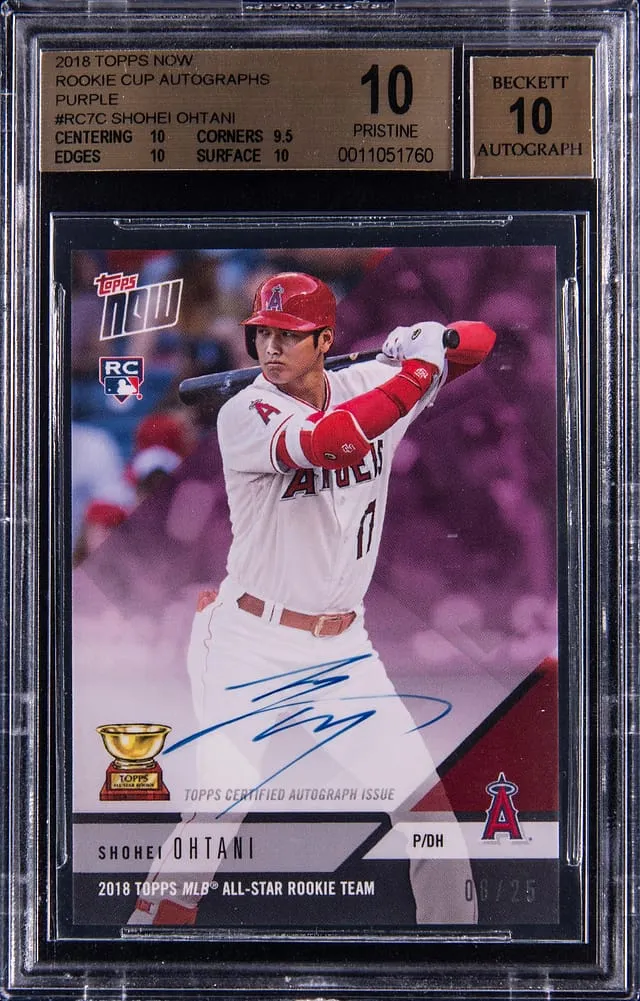
2018 Ohtani Topps Now Purple Auto BGS 10 Sale
Goldin sold a 2018 Topps Now Rookie Cup Purple Shohei Ohtani auto BGS Pristine 10 (Pop 3) for $32,392. See why this rookie-year card matters.
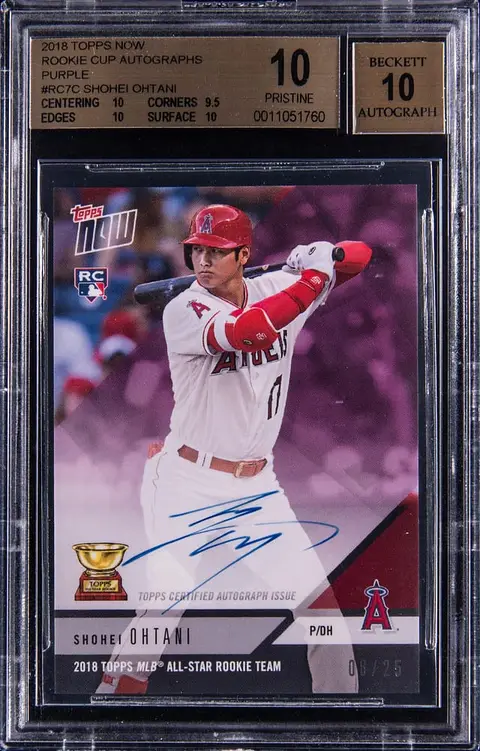
Sold Card
2018 Topps Now Rookie Cup Autographs Purple #RC-7C Shohei Ohtani Signed Rookie Card (#08/25) - BGS PRISTINE 10, Beckett 10 - Pop 3
Sale Price
Platform
GoldinShohei Ohtani’s key early cards have quietly become reference points for the entire modern baseball market, and a recent Goldin result just added another data point.
On March 15, 2026, Goldin sold a 2018 Topps Now Rookie Cup Autographs Purple #RC-7C Shohei Ohtani Signed Rookie Card (#08/25) – BGS PRISTINE 10 (Beckett 10, Pop 3) for $32,392.
In this post, we’ll break down what this card is, why it matters to collectors, and how this sale fits into the broader Ohtani market.
The card at a glance
Here are the key details on the card:
- Player: Shohei Ohtani
- Team: Los Angeles Angels
- Year: 2018
- Product: Topps Now Rookie Cup Autographs
- Card number: #RC-7C
- Parallel: Purple, serial-numbered 08/25 (only 25 copies produced)
- Designation: Rookie-year, Rookie Cup autograph (a key early-issue Ohtani auto)
- Autograph: Signed, Topps-certified
- Grading company: Beckett Grading Services (BGS)
- Grade: BGS PRISTINE 10, with a 10 autograph
- Population: Pop 3 (only three copies have reached this grade in the BGS population report)
Collectors tend to separate Ohtani’s cards into a few key categories: flagship rookies (like 2018 Topps Series 2 and Update), high-end chromium (Bowman Chrome, Topps Chrome), and early on-card or sticker autographs. This card sits in that third lane—an early, low-serial-numbered Topps-certified autograph from his rookie year, linked to the Topps Now Rookie Cup subset.
“Pop 3” means that, according to Beckett’s population report, only three copies of this exact card and parallel have ever graded BGS 10 Pristine. For ultra-modern cards, gem mint 9.5s are more common; true Pristines remain significantly tougher.
Why this Ohtani matters to collectors
Rookie-year autograph with low print
Even within modern print-heavy years, cards limited to 25 copies remain genuinely scarce. For collectors building an Ohtani rookie-year run, this Purple parallel checks several important boxes:
- Rookie-year issue – 2018 remains the focal year for Ohtani’s hobby history.
- Serial-numbered to 25 – a clearly defined, small population by design.
- Certified autograph – a signature authenticated and packed out by Topps.
- Recognizable Topps Now Rookie Cup design – part of a broader, documented Topps Now run that many player collectors chase.
While this is not his flagship Series 2 or Update rookie, it’s a more niche but highly targeted lane: limited rookie-year autographs with defined print runs.
Modern / ultra-modern context
This card is firmly in the ultra-modern era (roughly 2016 to present)—a period known for:
- Wider product variety,
- Color parallels (like this Purple version), and
- Higher raw supply but tighter scarcity at the top of the grading scale.
In an environment where many collectors feel overwhelmed by volume, low-serial-number rookie autos with strong grades still tend to stand out.
The grade: BGS Pristine 10 with 10 auto (Pop 3)
Among grading companies, Beckett’s Pristine 10 is widely viewed as a very tough grade, especially for thicker or glossy modern autographs.
Key grading points here:
- BGS Pristine 10 – typically indicates three 10 subgrades and one 9.5 (for centering, corners, edges, or surface).
- Autograph grade 10 – Beckett’s highest mark for the signature itself (clarity, no noticeable smudges or breaks).
- Population 3 – only three copies of this exact card/parallel have reached Pristine 10, setting a very thin supply ceiling for collectors who insist on top-of-ladder grades.
For collectors who treat grading tiers as separate markets (for example, building only PSA 10s or BGS 10s), a Pop 3 Pristine 10 often behaves more like a chase card than a commodity.
Market context: where does $32,392 fit?
The card sold for $32,392 at Goldin on March 15, 2026.
When looking at this result, most collectors will compare it to:
- Other copies of this exact card (different grades).
- Other Ohtani rookie-year autographs with similar print runs (e.g., numbered to /25 or nearby).
- Top-tier Ohtani rookie cards (flagship and Bowman Chrome autos) to get a sense of where this fits in his overall market ladder.
For this analysis, we focused our research on major auction houses and fixed-price marketplaces. Precise recent comps (comparable sales) for this exact grade and parallel are limited because:
- The card is numbered to 25.
- Only three have graded BGS 10 Pristine.
- High-end copies don’t cycle through the market very often.
However, looking across nearby sales of lower-graded copies of this card and similar Ohtani rookie autos in PSA 10 / BGS 9.5 and in similar print ranges, the Goldin result appears to sit toward the upper end of what collectors have recently been willing to pay for non-flagship, non-Bowman Chrome Ohtani rookie autographs.
In other words:
- Lower-graded versions of comparable 2018 Ohtani autos (numbered around /25) tend to transact for meaningfully less.
- The Pristine 10 bump—plus the Pop 3 population—helps explain why this particular copy achieved a premium.
Because this is a low-population, rarely offered card, each sale can behave as its own mini-auction event rather than neatly following a trend line. Still, this Goldin result adds a useful data point for valuing similar Ohtani rookie autos.
Factors likely supporting this result
Several hobby realities intersect in this sale:
Ohtani’s sustained on-field profile
As of early 2026, Ohtani remains one of the most followed players in the sport. Awards, offensive production, and ongoing media attention keep his cards in regular conversation, even as the hobby continues to normalize after earlier boom cycles.Rookie-year scarcity plus strong grade
A card limited to 25 copies, in a top-of-the-scale grade, appeals to:- Player collectors building deep Ohtani runs.
- Investors and high-end hobbyists who focus on scarce, easily described assets.
Prestige of the grading label
Beckett’s Pristine 10 label has long held a certain allure, especially among collectors who value subgrades and high-precision grading. For some buyers, this can be a differentiator versus a generic gem mint grade.Auction house visibility
Goldin remains one of the key venues for high-end modern cards. A card like this listed there tends to reach a national (and often international) audience, ensuring serious Ohtani collectors are at least aware that a top example is on the market.
How collectors might use this sale as a reference
This Goldin result doesn’t set a universal “price” for all copies of this card. Instead, it offers a reference point for:
- High-grade premiums – the spread between a BGS 10 Pristine and a more common gem (BGS 9.5 or PSA 10).
- Numbered Ohtani rookie autos – understanding where an out-of-25, non-flagship auto roughly sits compared to more mainstream rookies.
- Population and demand – what happens when a Pop 3 card surfaces in a well-publicized auction.
If you collect or sell Ohtani, this sale can be useful in a few practical ways:
Benchmarking your own cards
While you shouldn’t treat this number as a guaranteed comp for every Ohtani auto, it can help you think about relative tiers (for example, how a /50 PSA 10 might generally sit below a /25 BGS 10 Pristine).Understanding risk and rarity
Ultra-low-serial, high-grade cards can be hard to move quickly at a fixed target price because the buyer pool narrows as prices rise. The flip side is that when two or more motivated bidders collide, results can jump above recent averages.Tracking Ohtani’s long-term hobby footprint
Each notable sale adds to the picture of how the market values Ohtani’s early cards relative to his ongoing career story.
Takeaways for different types of collectors
New or returning collectors:
This card is a reminder that not all Ohtani rookies are created equal. The number on the back (08/25), the autograph, and the grade all matter. When you look at any Ohtani rookie, note:
- Is it from 2018?
- Is it serial-numbered (and to what number)?
- Is it autographed?
- What is the grade and by which company?
Active hobbyists and small sellers:
This Goldin sale adds one more datapoint you can reference when pricing or trading Ohtani rookie autos. It won’t map 1:1 onto every card, but it helps contextualize how the market treats:
- Low-pop BGS 10 Pristine slabs.
- Rookie-year autos from non-flagship products.
- Auction-house exposure vs. local or fixed-price listings.
As always, recent sales should be treated as context, not guarantees. Market conditions, player news, season timing, and who shows up to bid can all move numbers up or down.
Final thoughts
The 2018 Topps Now Rookie Cup Autographs Purple #RC-7C Shohei Ohtani (#08/25) that sold for $32,392 at Goldin on March 15, 2026 captures several themes of the modern hobby:
- Scarce, rookie-year autographs are still central to how we value star players.
- Top-of-the-scale grades like BGS Pristine 10 can create meaningful separation from the rest of the population.
- In thin markets for low-pop cards, each auction becomes its own small case study.
For Ohtani collectors, this sale won’t rewrite the entire price map, but it does sharpen the picture of where high-end, low-serial rookie autos currently live—and how much of a premium the market is assigning to the very best slabs.
At figoca, we track these sales to help collectors see the hobby with clearer data and better context—one card at a time.