2018 Ohtani Five Star Golden Graphs Gold PSA 10 Sale
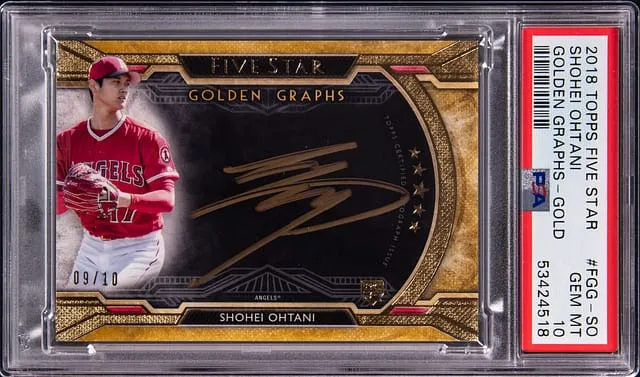
Goldin sold a 2018 Topps Five Star Golden Graphs Gold Shohei Ohtani PSA 10 rookie auto /10 for $40,260. Here’s what this Pop 1 result means.
Sold Card
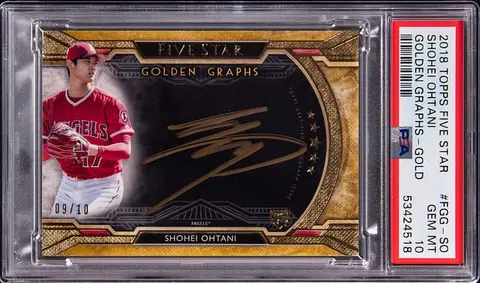
2018 Topps Five Star Golden Graphs Gold #FGG-SO Shohei Ohtani Signed Rookie Card (#09/10) - PSA GEM MT 10 - Pop 1
Sale Price
Platform
GoldinShohei Ohtani’s premium rookies continue to define the ultra‑modern baseball market, and a recent Goldin sale underscored just how far the very best examples have come.
On March 15, 2026, Goldin sold a 2018 Topps Five Star Golden Graphs Gold #FGG-SO Shohei Ohtani Signed Rookie Card, serial numbered 09/10, graded PSA GEM MT 10, for $40,260. This particular copy is a population 1 in PSA’s census – the only PSA 10 recorded at the time of sale.
In this post, we’ll unpack what this card is, why it matters, and how this result fits into the broader Ohtani and high‑end rookie autograph market.
Card overview: what exactly sold?
Let’s break down the key details of the card:
- Player: Shohei Ohtani
- Team (on card): Los Angeles Angels
- Year: 2018
- Product: Topps Five Star Baseball
- Insert / subset: Golden Graphs
- Parallel: Gold
- Card number: #FGG-SO
- Serial numbering: Hand-numbered 09/10 on the card (only 10 Gold copies produced)
- Autograph: On-card gold ink autograph
- Rookie designation: 2018 release, widely collected as a rookie-year autograph
- Grading company: PSA (Professional Sports Authenticator)
- Grade: GEM MT 10
- Population: Pop 1 in PSA 10 at the time of sale
2018 Topps Five Star is a premium, two-card-per-box product built entirely around autographs. The Golden Graphs subset is known for its darker design and gold-ink on-card signatures. Within that subset, the Gold parallel numbered to 10 is one of the scarcer color variants for key names.
For Ohtani collectors, any low-numbered, on-card, rookie-year autograph is a focal point. This card checks several important boxes at once: ultra-low print run (only 10 copies), premium brand, strong visual appeal, and the highest PSA grade with a lone pop.
Why the PSA GEM MT 10, Pop 1 label matters
A “pop report” (or population report) is the grading company’s public count of how many copies of a given card have received each grade. When a card is described as Pop 1, that means only one card in the world has achieved that grade with that grading company, making it the top of that specific grading population.
For a thicker, premium card stock like 2018 Five Star, pristine grades are harder to achieve due to issues like edge chipping and surface scratches. That’s why a PSA GEM MT 10 on a low-serial Five Star autograph tends to carry a meaningful premium over lower grades, especially when it is the only 10 in existence.
In this case, collectors aren’t just paying for a /10 Ohtani rookie auto; they’re paying for the single best PSA-graded example currently available in the market.
Market context: how does $40,260 fit in?
When collectors talk about “comps,” they mean comparable recent sales from other marketplaces or auction houses. For a specific card like a 2018 Five Star Golden Graphs Gold /10, comps can be limited, especially when:
- The print run is tiny (10 copies total), and
- Only one has hit a PSA 10 grade.
Because of this, the market tends to look at a combination of:
- Other copies of the same card in lower grades or raw (ungraded), when available.
- Close parallels from the same Golden Graphs Ohtani run (e.g., different color parallels /25, /20, /5, or 1/1).
- Other high-end Ohtani rookie-year autographs of similar scarcity and brand tier.
Across major marketplaces over the past couple of years, a few broad patterns have emerged for Ohtani’s high-end rookies:
- Five Star Ohtani rookie autos (non-Golden Graphs, higher print runs) have generally sold at lower levels than his true flagship rookies or super-premium brands, but still command a solid premium as on-card signatures from 2018.
- Low-numbered Ohtani rookie autos /10 or lower from respected brands typically generate five-figure results, with especially strong prices for PSA or BGS gem-mint copies.
- One-of-one and logo patch autograph rookies from products like Topps Dynasty, Topps Chrome, or Bowman’s Best have set some of the upper benchmarks for Ohtani, but those are different lanes than a Five Star Golden Graph.
For this exact card – a Golden Graphs Gold /10, PSA 10 Pop 1 – public sales are sparse to non-existent before this Goldin result. That makes $40,260 less of a comparison-driven price and more of a marker: a new reference point for future sales of similar Ohtani rookie autos in top grades.
Given what we see from other Ohtani rookie autos with comparable scarcity and brand strength, this result sits comfortably in the high end of his non-flagship, premium autograph market rather than at an outlier, record-shattering level.
How it compares to related Ohtani cards
To understand this sale, it helps to place the card among Ohtani’s broader rookie portfolio:
- Flagship and chromium rookies (2018 Topps Series 2, Topps Chrome, Chrome Update) remain the most widely recognized, especially in base and refractor forms. Their top parallels (Superfractors, low-number color) often draw the most headlines.
- Prospect autos from 2017 Bowman Chrome (Angels uniform) are often treated as his key early autographs, with color refractors and high grades at the top of many want lists.
- Premium 2018 autograph products like Topps Five Star, Dynasty, and Museum Collection offer lower print runs and more elaborate designs. Within this slice of the market, low-numbered on-card Ohtani rookies are heavily targeted by advanced collectors.
The 2018 Five Star Golden Graphs Gold /10 sits in that third category: a premium, lower-print-run rookie auto rather than a mass-known “flagship” card. Collectors who prioritize scarcity and eye appeal — particularly those building Ohtani master collections or Five Star-focused runs — are often willing to stretch for a Pop 1 PSA 10, especially in gold ink.
Why collectors care about this specific issue
Several factors make this card stand out, even within Ohtani’s crowded rookie landscape:
Rookie-year, on-card autograph
Many of Ohtani’s most chased cards share this trait. 2018 is his formal MLB rookie season, and collectors often separate rookie-year autographs from later issues when ranking long-term importance.Low serial number (/10)
With only 10 Gold copies produced, each sale can reset expectations. Thin supply means even a small shift in demand can have a noticeable impact on realized prices.Gold ink, premium design
Golden Graphs cards use darker backgrounds that make the gold autograph stand out. Visually distinctive designs often hold collector interest even as the market cycles.PSA GEM MT 10, Pop 1
“Top of the pop” cards often trade more like unique pieces than like a commodity. A collector who values both the card and the grade has only one option at this level, which can drive competitive bidding in auctions like Goldin’s.
Timing: Ohtani’s ongoing relevance
This sale landed on March 15, 2026, just as another MLB season approached. Ohtani’s profile in the hobby has been shaped by:
- Two-way success as both an elite hitter and pitcher.
- Awards and milestones that continually keep his name at the center of baseball coverage.
- Strong international popularity, which broadens the collector base beyond a single market.
While specific award outcomes or seasonal performances can move shorter-term pricing, high-end rookie autographs like this one tend to be viewed more as long-term cornerstone pieces in Ohtani collections. That doesn’t mean they’re guaranteed to go up or hold value — markets do change — but it does mean they attract a particular kind of buyer: someone thinking beyond a single season.
What this Goldin result tells us
A single auction doesn’t define the entire market, but it does give useful information:
- Price level: $40,260 establishes a clear, public benchmark for a PSA 10 Pop 1 version of this card.
- Demand for ultra-scarce Ohtani rookies: Competitive bidding into the mid–five figures for a non-flagship, premium Ohtani rookie auto underscores persistent demand at the high end.
- Role of grading: The Pop 1 PSA 10 label appears to have played a meaningful role. A lower-grade copy could reasonably land in a different range, depending on condition, eye appeal, and timing.
For collectors tracking Ohtani, this sale joins a growing list of high-end results that collectively map out the upper tiers of his rookie market.
Takeaways for collectors and small sellers
A few practical lessons from this result:
Know your lane within a player’s market.
Ohtani’s rookie catalog is deep. Flagship rookies, prospect autos, and premium autograph sets each behave a bit differently in terms of demand and pricing.Population data matters.
Checking PSA’s or other graders’ population reports can help you understand how common or rare a specific grade really is. Pop 1 at a high grade can significantly change how a card is perceived.Low print runs compress supply.
With only 10 copies of this Gold parallel, the market doesn’t get many chances to “re-price” the card. Each major sale can meaningfully influence future expectations.Use comps as guideposts, not guarantees.
Recent sales provide context, but they are not promises of what the next sale will bring. Conditions change: player performance, broader hobby sentiment, and the exact card/grade combination on offer all play a role.
Final thoughts
The March 15, 2026 Goldin sale of the 2018 Topps Five Star Golden Graphs Gold #FGG-SO Shohei Ohtani Signed Rookie Card (#09/10), PSA GEM MT 10 Pop 1, at $40,260 highlights the continued strength of truly scarce, high-grade Ohtani rookie autographs.
For Ohtani-focused collectors, it’s a reminder that some of his most important rookie pieces extend beyond the flagship base cards and into low-numbered, premium autograph sets. For the broader hobby, it’s another data point showing how modern and ultra-modern cards — when they combine scarcity, grade, and a globally relevant player — can anchor the upper end of the market.
As always, the best use of a sale like this is informational: a reference point you can put alongside your own goals, budget, and collecting priorities — whether that means chasing your own Ohtani rookie auto or simply understanding where the high end of the market is currently settling.