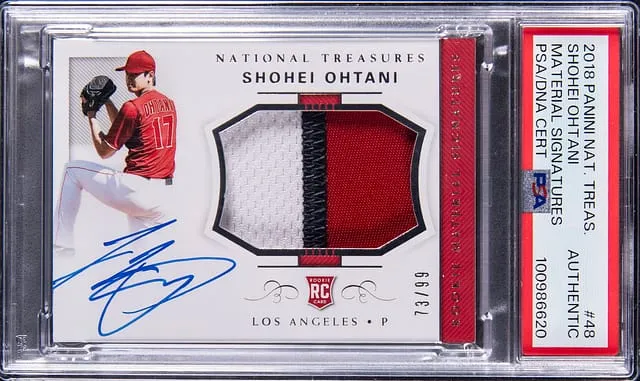
2018 NT Shohei Ohtani Patch Auto RC Sells for $12,210
Breakdown of the $12,210 Goldin sale of a 2018 Panini National Treasures Shohei Ohtani Material Signatures rookie patch auto /99.
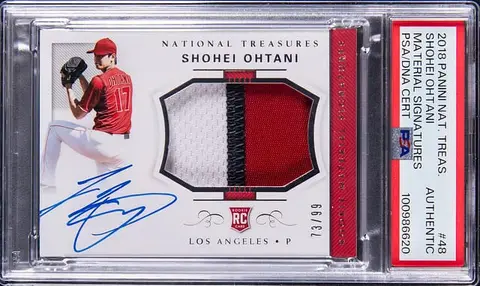
Sold Card
2018 Panini National Treasures Material Signatures #48 Shohei Ohtani Signed Patch Rookie Card (#73/99) - PSA Authentic, PSA/DNA Authentic
Sale Price
Platform
GoldinShohei Ohtani’s rookie-year cards have become a reference point for the entire modern baseball market, and one of his key high-end issues just traded hands.
On March 15, 2026, Goldin sold a 2018 Panini National Treasures Material Signatures #48 Shohei Ohtani Signed Patch Rookie Card, serial-numbered 73/99, for $12,210. The card was authenticated by PSA (card graded Authentic) with a PSA/DNA Authentic signature.
In this post, we’ll break down what this card is, why it matters to collectors, and how this sale fits into the broader Ohtani and modern-NT market.
The Card at a Glance
Card details
- Player: Shohei Ohtani
- Team (on card): Los Angeles Angels
- Year: 2018
- Set: Panini National Treasures Baseball
- Subset: Material Signatures
- Card number: #48
- Serial numbering: 73/99 (print run limited to 99 copies)
- Rookie card: Yes – rookie-year RPA-style auto patch from a premium set
Grading and authentication
- Grading company: PSA
- Card grade: PSA Authentic (card is genuine, but not given a numerical grade)
- Autograph: PSA/DNA Authentic (on-card signature verified as genuine)
- Attributes:
- On-card autograph (signed directly on the card surface)
- Multi-color game-used or player-worn patch (typical for National Treasures Material Signatures)
- Low serial number /99, which is considered relatively scarce in the ultra-modern era
National Treasures is Panini’s flagship high-end product for baseball, known for thicker card stock, jumbo patches, and on-card autographs. While it’s not a fully licensed MLB product (Panini lacks MLB team logo rights for these years), its Rookie Patch Autos (RPAs) are still treated as cornerstone premium rookies for many collectors.
Why This Ohtani NT Material Signatures Matters
A key rookie autograph in a premium brand
For modern players, collectors often separate rookies into tiers:
- Flagship base rookies (Topps / Bowman paper or Chrome)
- Mid-to-high-end parallels and autos
- True premium rookies – typically RPA-style cards from brands like National Treasures, Flawless, and Immaculate
This 2018 National Treasures Material Signatures #48 falls into the third category: a premium, low-print-run rookie-year auto patch from a recognized high-end set.
Even though Panini baseball from this era is unlicensed, National Treasures has built a following somewhat similar to its role in basketball and football: a go-to destination for collectors who care about patch quality, thick stock, and on-card ink more than official logos.
Ohtani’s dual-threat profile
Shohei Ohtani’s combination of elite pitching and elite hitting has made his rookie-year cards a central focus of the ultra-modern market. As of early 2026, Ohtani is widely viewed as one of the most significant players of his generation, and his early career production has consistently supported strong hobby demand.
For collectors, that means:
- Rookie autos are often prioritized over non-auto rookies.
- Patch autos (especially on-card) are treated as centerpieces of an Ohtani PC (personal collection).
This National Treasures Material Signatures is not his absolute top-tier rookie (many collectors would point to logo-licensed Topps/Bowman autos for that), but within the Panini lane it is a clear headliner.
Market Context and Recent Sales
Because market data for individual serial-numbered cards can be thin, collectors often look at “comps” (recent comparable sales) rather than a single auction. These can include:
- The same card in different serial numbers or different grades.
- Closely related parallels from the same set (e.g., lower-serial versions, different patch windows).
For the 2018 National Treasures Ohtani Material Signatures /99, the sales landscape typically includes:
- Raw copies (ungraded)
- PSA Authentic or BGS Authentic examples
- Numerically graded copies (PSA, BGS, SGC)
At the time of this writing, public auction records show this Goldin sale at $12,210 landing in the middle-to-upper band of what collectors have come to expect for authenticated but non-numerically graded examples of this card, especially with a solid patch and verified on-card signature.
Numeric gem-mint examples (such as PSA 10 or BGS 9.5/10) can command a meaningful premium over Authentic-labeled copies, while lower-grade or unattractive patch examples typically sell at a discount.
Because most auction platforms do not always break out patch quality or eye appeal in their summaries, headline prices can show some variance even when serial numbers and grades match. Collectors relying on comps usually:
- Check patch color and design.
- Compare autograph strength (bold vs. streaky).
- Factor in whether the card is numerical grade vs. Authentic only.
Within that context, this $12,210 result appears consistent with a healthy, but not extreme, level of demand for a high-end Ohtani rookie patch auto in 2026 market conditions.
How Grading and “Authentic” Labels Affect Value
This specific card is labeled PSA Authentic rather than receiving a numerical grade. That means:
- PSA has confirmed the card is genuine.
- PSA did not assign a number (1–10) for condition.
Collectors often choose Authentic labels when:
- The card has minor condition issues but strong eye appeal.
- The owner values encapsulation and authentication more than condition debate.
For high-end, thick-stock patch autos like National Treasures, small dings on corners and edges are common right out of the pack, which can make high numeric grades difficult.
PSA/DNA Authentic for the autograph confirms that Ohtani’s signature is genuine. For on-card autos, a clean, centered, non-faded signature is a major part of the card’s overall desirability.
Market-wise, the usual pattern is:
- Gem-mint numeric grades > mid-grade numeric > Authentic, all else being equal.
- However, a great patch and strong autograph can sometimes help an Authentic example compete with lower numeric grades in actual sale prices.
Set and Era: Ultra-Modern, Low-Print, High-Variability
2018 National Treasures Baseball is part of the ultra-modern era—roughly mid-2010s onward—where print runs are more controlled, parallels are clearly serial-numbered, and collectors pay close attention to scarcity, brand hierarchy, and autograph type.
Key traits of this era that impact this card:
Serial numbering matters
At /99, this card is relatively scarce compared to mass-produced base rookies, but not as scarce as true chase parallels (/25, /10, /5, 1/1). For many collectors, /99 is the entry-level tier of “true high-end” for RPAs.Autograph type matters
On-card autographs—where the player signed directly on the card—are generally more desirable than sticker autos. National Treasures is appreciated specifically for on-card signatures on major rookies.Patch quality matters
Multi-color, logo, or nameplate patches often bring stronger prices versus single-color swatches, even within the same serial tier.Brand stacking
Ohtani has important rookies across several products (Topps, Bowman, Panini). National Treasures fills the “premium Panini patch auto” category, which sits alongside but slightly to the side of his fully licensed Topps/Bowman autos in many collectors’ minds.
What This Sale Tells Collectors
The $12,210 Goldin result on March 15, 2026 suggests a few takeaways for the active hobbyist:
High-end Ohtani demand is still broad-based
It isn’t just his flagship Topps and Bowman rookies that draw attention. A strong, authenticated premium Panini RPA-style card continues to attract meaningful bidding.Condition nuance is priced in
Even with an Authentic label instead of a numeric grade, this card brought a robust number relative to other premium Ohtani rookies. That reflects collectors’ willingness to weigh patch, autograph, and overall look, not just the slab label.Auction house visibility matters
Goldin’s reach into both high-end hobbyists and newer participants helps establish clear public comps for cards like this. When a card sells in a visible venue with date-stamped results, it provides a cleaner pricing reference for collectors.Comps are a range, not a single answer
For anyone trying to buy, sell, or trade an Ohtani NT Material Signatures, this sale is a data point—not a guarantee of future values. The next copy may feature a different patch, a different grade, or appear in a different market environment.
How Collectors Can Use This Data
If you’re collecting or trading Ohtani or similar ultra-modern stars, here are practical ways to use a sale like this:
As a reference point, not a target
Treat this Goldin result as one anchor in a range. Look up additional comps across other auction houses and marketplaces, and adjust for patch quality, grade, and timing.To understand brand and tier
Compare what National Treasures premiums are doing next to Topps or Bowman chrome autos. It helps clarify whether you prefer logo-licensed flagship cards, or you’re comfortable leaning into patch autos from Panini.To refine your own buying criteria
Decide how much weight you give to:- Autograph strength
- Patch complexity
- Numerical grade vs. Authentic
- Serial tier (/99 vs. lower-numbered)
Final Thoughts
The 2018 Panini National Treasures Material Signatures #48 Shohei Ohtani Signed Patch Rookie Card (#73/99), sold by Goldin on March 15, 2026 for $12,210, is a textbook example of how the modern high-end market treats a star’s premium rookie patch autograph.
It sits at the intersection of a major player, a respected premium brand, on-card ink, and low serial numbering. For collectors tracking Ohtani’s hobby footprint—or trying to understand how ultra-modern RPAs are valued—this sale offers a clear, data-backed snapshot of where one of his key Panini rookies currently stands.
As always, market conditions can change quickly, so it’s wise to review multiple recent sales, follow player performance, and collect primarily the cards you’re comfortable owning over the long term, regardless of short-term price moves.