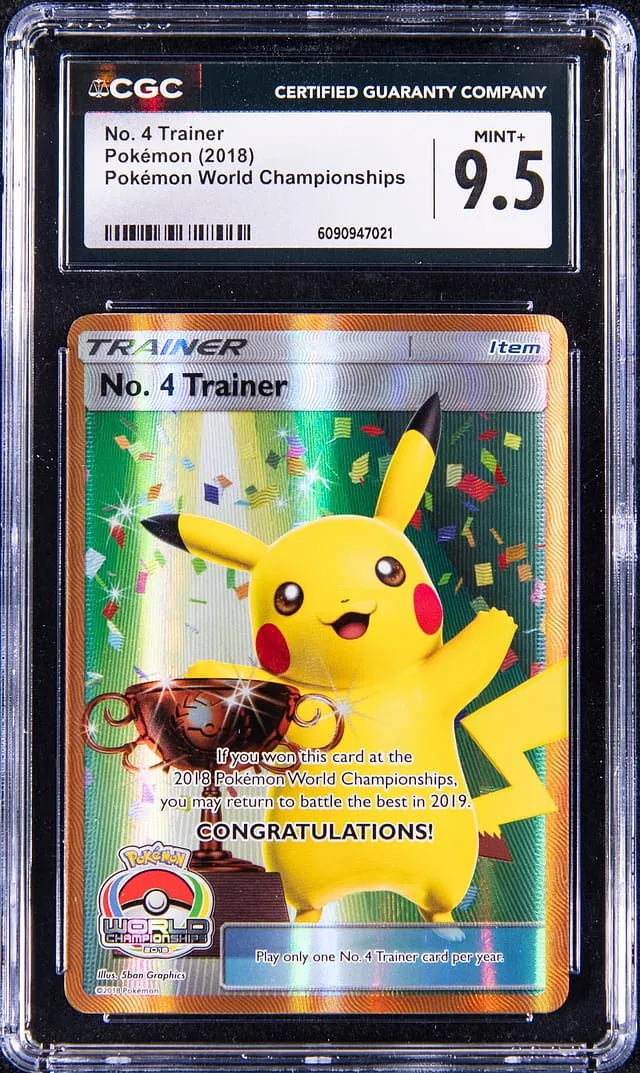
2018 No. 4 Trainer Pikachu Trophy CGC 9.5 Sale
Goldin sold a 2018 No. 4 Trainer Pikachu World Championships Trophy Card CGC 9.5 for $26,975. See what this means for Pokémon trophy collectors.
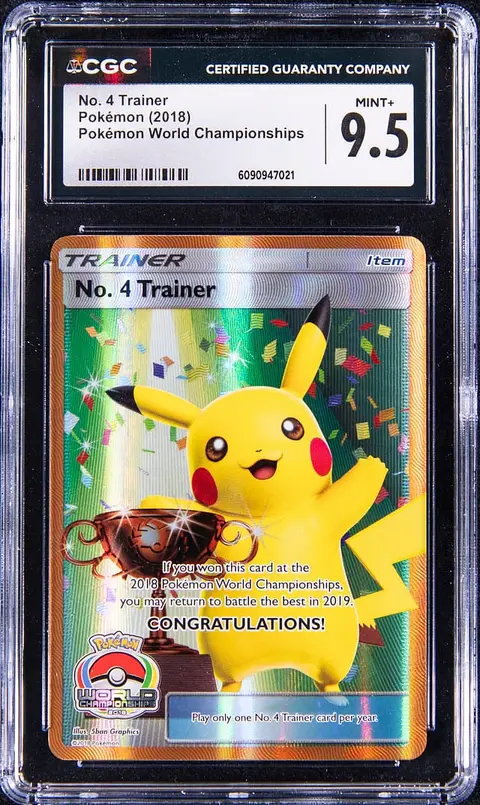
Sold Card
2018 Pokemon World Championships No. 4 Trainer Pikachu Trophy Card - CGC MINT+ 9.5
Sale Price
Platform
Goldin2018 Pokémon World Championships No. 4 Trainer Pikachu Trophy Card Sells for $26,975
On March 9, 2026, Goldin auctioned a 2018 Pokémon World Championships No. 4 Trainer Pikachu Trophy Card graded CGC MINT+ 9.5 for $26,975. For a niche but highly respected slice of the Pokémon market, this is the kind of sale that quietly matters.
In this breakdown, we’ll look at what this card is, why collectors care about World Championships trophies, and where a $26,975 result seems to sit within the broader price context.
The card at a glance
Card: 2018 Pokémon World Championships No. 4 Trainer Pikachu Trophy Card
Character: Pikachu (World Championships "Trainer" trophy artwork)
Event: 2018 Pokémon World Championships
Year: 2018
Category: Trophy / prize card (not a pack‑pulled card)
Set / Origin: Distributed at the 2018 Pokémon World Championships to top finishers
Type: Ultra‑modern era, prize‑only, low‑population card
Grading company: CGC
Grade: CGC MINT+ 9.5
Special attributes: Extremely limited event distribution; part of the long‑running Pikachu trophy lineage
This is not a standard set card with a pack odds line on the back of the booster wrapper. World Championships Trainer Pikachu cards are awarded to top finishers in the tournament, and historically have been produced in very small quantities.
What makes World Championships trophy cards special?
For newer collectors, it helps to think of these as the Pokémon TCG’s equivalent of player‑issued championship rings or limited event medals:
- They commemorate a specific world championship year. Only participants at that event, usually top finishers, had access.
- Distribution is tiny compared to booster‑pack cards. Even if the exact print counts are not always published, these are understood in the hobby to be extremely scarce.
- They sit at the crossroads of competitive play and collecting. Top players receive them, but long‑term they’ve become grail‑level collectibles for certain Pokémon specialists.
The Pikachu trophy line also has a long history, stretching back to some of the most respected and expensive Pokémon cards ever sold. Later‑year examples like the 2018 No. 4 Trainer ride on that tradition, even though they are more recent and typically command less than the early 2000s trophies.
Understanding the CGC MINT+ 9.5 grade
CGC’s MINT+ 9.5 is a high‑end grade that signals a card is very close to pristine. While every grading scale is slightly different, 9.5 generally means:
- Clean surfaces with minimal, if any, visible flaws
- Centering that is within a narrow tolerance
- Sharp corners and strong edges
For ultra‑modern trophy cards, high grades are expected more often than with 1990s cards, but that doesn’t make them common. The real constraint is how few copies exist in the first place, not just how many can grade well.
Market context and recent sales
Because this is a focused, low‑population trophy card, public data points are sparse compared with mass‑produced chase cards. In other words, there isn’t a deep stack of daily “comps.”
A quick note on language:
- “Comps” (comparable sales) are recent, confirmed transactions of the same or very similar items, used to understand current price ranges.
For the 2018 No. 4 Trainer Pikachu specifically, only occasional sales have appeared across major auction houses and marketplaces. These are often in a mix of grading companies (PSA, CGC, BGS) and grades (from near‑mint to gem). Exact numbers vary by sale and timing, but historically:
- Earlier‑year Pikachu trophies and higher‑placement cards (like No. 1 Trainer) tend to command significantly higher prices.
- Lower‑placement or later‑year trophies, such as a 2018 No. 4, trade at a discount to the most iconic, earliest examples but still sit in a clear premium lane compared with standard modern set cards.
Against that backdrop, a $26,975 result for a CGC 9.5 falls in line with how the market often tiers modern trophies: not at the all‑time record level of early 2000s Pikachu trophies, but clearly treated as a serious, long‑term collectible by dedicated Pokémon buyers.
Because public sales of this exact grade and year are limited, it’s better to think in ranges and relative tiers rather than single‑data‑point “values.” This Goldin result simply adds another important reference point.
Why collectors care about this card
Several factors converge to make the 2018 No. 4 Trainer Pikachu Trophy Card interesting:
Trophy status over pack‑pulled status
Unlike chase cards from booster sets, World Championships trophies are bound to a live event and a placement in competition. That origin story appeals to collectors who care about the organized play side of Pokémon.Pikachu as a central character
Pikachu remains the face of the Pokémon brand. Many of the hobby’s highest‑profile vintage and trophy cards feature Pikachu, and this continuation of that tradition helps modern trophies maintain collector interest.Ultra‑modern, but not mass‑printed
Even though 2018 falls squarely into the ultra‑modern era (roughly mid‑2010s onward), this card sits completely outside the usual concerns about overproduction. Scarcity here is structural (limited event distribution), not manufactured by serial numbering.Crossover appeal
The card intersects multiple collector groups: trophy card specialists, Pikachu character collectors, CGC registry participants, and World Championships memorabilia fans.
How this sale fits into the broader trophy landscape
If you zoom out to the full Pikachu trophy family tree, you’ll typically see a hierarchy shaped by:
- Year: Earlier years, especially late 1990s and early 2000s, tend to command stronger premiums because of age, nostalgia, and smaller surviving populations.
- Placement: No. 1 Trainer > No. 2 > No. 3 > No. 4 and lower, with some variation by specific year and art.
- Grading company and grade: High‑grade examples from major graders (PSA, CGC, BGS) tend to lead public auction results, especially in grades around 9–10.
Within that structure, a 2018 No. 4 Trainer in CGC 9.5 is better understood as a serious but mid‑tier trophy piece: not the pinnacle of the Pikachu trophy ecosystem, but clearly a premium collectible rather than an entry‑level rarity.
What collectors and small sellers can take from this
A few practical takeaways for different types of hobby participants:
For newer collectors
- Trophy cards operate in a different ecosystem from booster‑box hits. Prices can look disconnected from what you see in standard sets, and that’s largely due to extreme supply constraints and the event‑based history.
- When you see a sale like this, focus less on chasing the exact card and more on understanding why it’s valued: limited distribution, strong character, and competitive significance.
For returning collectors
- If you left the hobby before the ultra‑modern trophy era matured, it’s worth revisiting how organized play and event promos have become their own collecting lane.
- Look at a small set of recent public auction results (not just this Goldin sale) to get a feel for how modern trophies stack up against the vintage cards you might be more familiar with.
For small sellers and traders
- Trophy cards are thinly traded. That means pricing them purely by averaging a couple of old comps can be misleading in either direction.
- Condition, grading company, and provenance (clear documentation that the card is what it claims to be) matter more here than they do for most $100–$200 modern cards.
Final thoughts
The March 9, 2026 sale of the 2018 Pokémon World Championships No. 4 Trainer Pikachu Trophy Card – CGC MINT+ 9.5 for $26,975 at Goldin is another reminder that the Pokémon market isn’t just about set‑chase cards and sealed product.
Trophy cards like this sit at the intersection of competitive history and collecting. Even without a huge pool of public sales to draw on, each auction adds another reference point, slowly building a clearer picture of how the market values modern World Championships prizes over time.
For collectors, watching these quiet, data‑light segments of the market can be as informative as tracking the headline‑grabbing record breakers—especially if you care about the long story of how the Pokémon TCG is played, remembered, and collected.