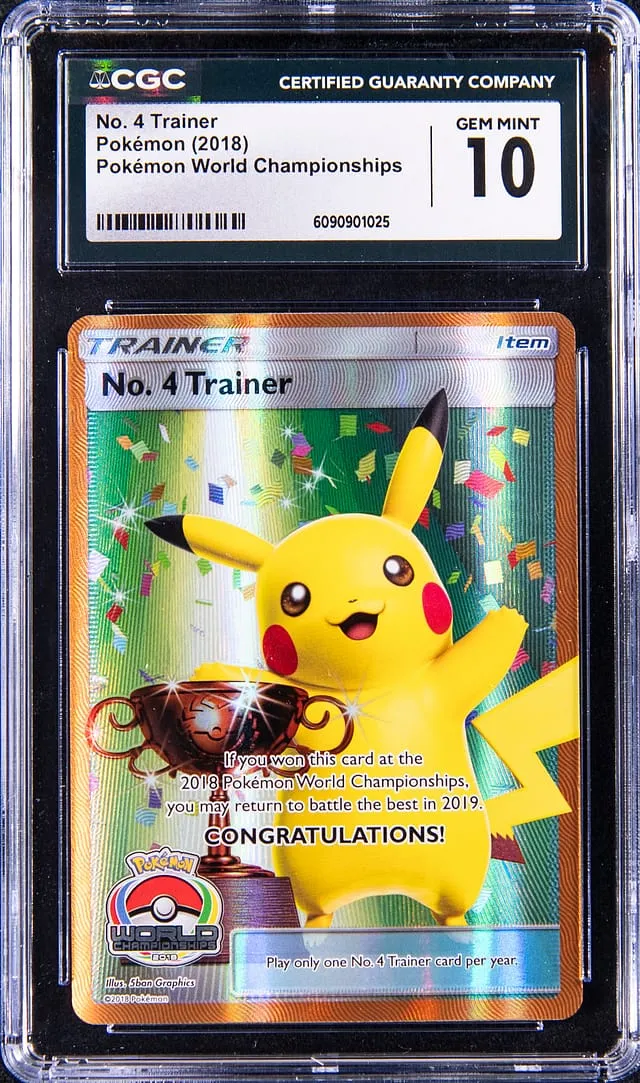
2018 No. 4 Trainer Pikachu Trophy CGC 10 Sells for $24K
Figoca looks at the $24,814 Goldin sale of a 2018 Pokémon World Championships No. 4 Trainer Pikachu Trophy Card CGC 10 and what it means for collectors.
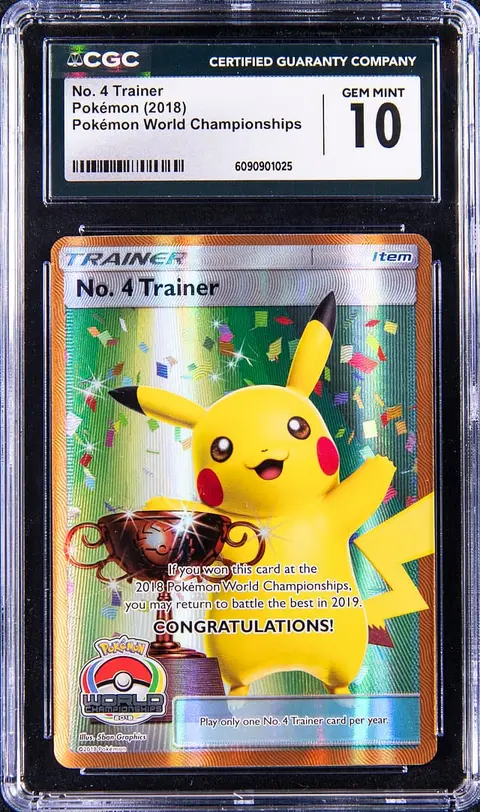
Sold Card
2018 Pokemon World Championships No. 4 Trainer Pikachu Trophy Card - CGC GEM MINT 10 - Pop 2
Sale Price
Platform
Goldin2018 Pokémon World Championships No. 4 Trainer Pikachu Trophy Card (CGC 10) Sells for $24,814
On February 16, 2026, Goldin sold a 2018 Pokémon World Championships No. 4 Trainer Pikachu Trophy Card graded CGC Gem Mint 10 for $24,814. For a niche, event‑only trophy card with only two copies at this grade level in the CGC population report, it’s an important data point for anyone tracking high‑end competitive Pokémon cards.
In this breakdown, we’ll walk through what this card actually is, why it matters to collectors, and how this sale fits into the broader market for World Championships trophy cards.
Card overview: what exactly sold at Goldin?
Card: 2018 Pokémon World Championships No. 4 Trainer Pikachu Trophy Card
Character: Pikachu (Trainer Trophy artwork)
Event: 2018 Pokémon World Championships
Year: 2018
Type: Trophy / prize card (not a standard pack‑pulled set card)
Grading company: CGC
Grade: Gem Mint 10
Population: Pop 2 at CGC in Gem Mint 10 (two copies known in this grade)
Sale price: $24,814 (hammer plus buyer’s premium, converted from reported cents)
Auction house: Goldin
Sale date (UTC): 2026‑02‑16
This is a trophy card – a prize issued to top finishers at the 2018 Pokémon World Championships, rather than something that was ever sold in booster packs. Trophy cards generally exist in very small quantities tied directly to a specific event and placement (e.g., Top 4, Finalist, Champion).
The card features a World Championships Pikachu artwork, part of a long‑running tradition where The Pokémon Company creates special Pikachu trophy designs for competitive events.
Why the 2018 World Championships Trainer Pikachu matters
1. Trophy card status and ultra‑low print runs
Trophy cards occupy a distinct lane in the Pokémon hobby. Instead of chase cards pulled from packs, they’re awarded to the very small number of players who place highly in a specific tournament.
For the 2018 World Championships Trainer Pikachu cards:
- They were distributed only to competitors who reached certain finishing positions.
- Each placement (such as No. 1, No. 2, No. 3, No. 4 Trainer) typically has its own version.
- Total copies per placement are usually in the single‑digit or very low double‑digit range.
Exact print runs for individual trophy cards are rarely published in full detail, but based on how Worlds events and prizing are structured, collectors treat these as extremely scarce compared with even the most desirable pack‑pulled secret rares.
2. Event‑linked history
World Championships trophy cards are essentially snapshots of organized play history:
- They document who was good enough at that time to reach the highest stages.
- They connect directly to a real‑world, date‑stamped event (here, the 2018 World Championships).
- They reflect The Pokémon Company’s long‑term commitment to competitive play.
Even if you don’t follow competitive Pokémon day‑to‑day, trophy cards represent the “top of the mountain” for the organized play ecosystem.
3. CGC Gem Mint 10 with Pop 2
This copy is graded CGC Gem Mint 10, the highest standard numerical grade for pack‑fresh condition under CGC’s scale.
A few key points:
- Gem Mint 10 generally signals a card that is extremely clean across corners, edges, centering, and surface.
- Pop 2 means CGC’s population report shows only two copies of this exact card in Gem Mint 10. Population (often shortened to “pop”) is the number of examples a grading company has encapsulated at each grade.
- Trophy cards are often handled, transported, and stored under non‑collector conditions at first (given to players at events, traveled with, etc.), so pristine examples are not guaranteed.
Because of the inherently small supply of raw copies and the difficulty of achieving perfect grades, a Pop 2 Gem Mint 10 for a Worlds trophy card is a meaningful datapoint even if there are also graded examples at PSA or BGS.
Market context: where does $24,814 fit in?
When collectors talk about comps (short for “comparables”), they mean recent sales of the same card or very similar items that help set realistic price expectations. For niche trophy cards, true comps can be sparse.
Recent and historical sale landscape
For the exact 2018 No. 4 Trainer Pikachu in CGC 10, there are very few publicly reported sales. Most recorded activity in the World Championships trophy lane tends to involve:
- Earlier‑era Pikachu trophies (late 1990s and 2000s), especially 1997–1999 cards, which sit in a different price tier.
- No. 1 and No. 2 placement cards from various years, which typically command premiums over lower placements like No. 3 and No. 4.
- PSA‑graded examples that have a longer track record in the market.
Within that context, the $24,814 result for this CGC 10 suggests a few things:
Healthy demand for modern trophy cards
While earlier Worlds and Japan‑only trophy Pikachu cards can sell for significantly higher amounts, a mid‑five‑figure USD result for a 2018 placement card is consistent with the idea that collectors and investors still view modern trophy Pikachu as important long‑term pieces.Premium for top‑grade, low‑pop slabs
Being one of only two CGC Gem Mint copies adds a layer of scarcity even on top of the already tiny total print. When you combine raw card scarcity with grade scarcity, it’s common to see a premium over any available lower‑grade results.Cross‑grader and cross‑placement comparisons are imperfect
Many older sales involve PSA‑graded examples or different placements (No. 1, No. 2, etc.), so direct one‑to‑one dollar comparisons need caution. Instead, it’s more useful to treat this sale as:- A modern benchmark for 2018 Worlds Pikachu trophies in top grade.
- A reference point within the broader band of modern trophy prices, rather than a hard template for every future sale.
Because publicly available data for this exact card and grade is thin, the $24,814 figure should be seen as one strong datapoint rather than a guaranteed “going rate.” Trophy cards often trade privately, and individual negotiation, provenance, and timing can all influence realized prices.
How this sale fits into the World Championships and trophy card market
1. Modern era, legacy design
2018 sits in what most collectors would call the modern to ultra‑modern era of Pokémon: after the explosive growth of the franchise, but still well before any sign of long‑term decline. By this point, The Pokémon Company had:
- Fully embraced regular World Championships events.
- Refined trophy card distribution and designs.
- Built a dedicated audience that follows competitive play and its prizes.
Modern trophy cards often walk a line between:
- Historical significance: they anchor specific Worlds seasons and formats.
- Contemporary relevance: they’re close enough to today that many current players remember the event.
2. Consolidation of high‑end Pokémon at major auction houses
This sale taking place at Goldin on February 16, 2026 reinforces an ongoing shift: high‑end Pokémon cards, especially graded trophies and grails, regularly appear at the same auction houses that handle blue‑chip sports and entertainment memorabilia.
For collectors, that means:
- Tournament prize cards are increasingly treated as long‑term cultural artifacts alongside sports rookies and key comics.
- Liquidity and visibility for rare Pokémon items are no longer confined to specialist platforms alone.
3. Grading diversification
While PSA still handles a major portion of vintage and modern Pokémon grading, CGC has built a substantial footprint, particularly among collectors who appreciate detailed subgrades and strong quality control.
For trophy cards, the presence of CGC Gem Mint copies alongside PSA and BGS examples has a few effects:
- It broadens the pool of high‑grade population data.
- It introduces more options for collectors who care about the label and grading philosophy.
- It can lead to cross‑over opportunities, where some owners may consider regrading between companies – another factor that can affect future population reports.
In this case, a CGC 10 Pop 2 sale north of $20,000 demonstrates that the market is comfortable assigning meaningful value to top‑grade CGC slabs in the high‑end Pokémon segment.
Takeaways for collectors and small sellers
Whether you’re just returning to the hobby or already active in high‑end Pokémon, here are some grounded observations from this sale:
Trophy cards are structurally different from pack‑pulled chase cards
Supply is fundamentally limited by event participation and placement, not print allocation across booster cases. Even as interest in certain sets ebbs and flows, the number of 2018 No. 4 Trainer Pikachu trophies can’t realistically increase.Condition matters more when supply is tiny
With very short‑run cards, each incremental grade step can have an outsized impact on price. A Gem Mint 10 in a population of two is a different proposition from a mass‑printed modern secret rare with hundreds of 10s on the pop report.Context is key for comps
For niche items, you may not find perfect sales comparisons. Instead of forcing direct dollar‑for‑dollar comparisons to earlier‑era trophies or different placements, it’s more useful to:- Look at a band of results for similar trophy Pikachu cards.
- Adjust based on grade, placement, and era.
- Remember that individual sales can be influenced by timing, collector goals, and how widely the listing was seen.
No guaranteed trajectory
This $24,814 result is an informative marker, not a promise that future sales will land higher or lower. Market conditions, collector preferences, and macro trends can all change.
Final thoughts
The $24,814 sale of the 2018 Pokémon World Championships No. 4 Trainer Pikachu Trophy Card in CGC Gem Mint 10 at Goldin on February 16, 2026 underscores how seriously the hobby now treats modern trophy cards.
For collectors, it’s another reminder that the story of Pokémon isn’t just told through pack‑pulled chase cards and booster boxes. It also lives in the small, carefully guarded group of cards that had to be earned the hard way – at the game table, under tournament pressure, on a specific weekend in 2018.
As more World Championships cards make their way into major auctions and population reports mature, collectors will have better data to work with. For now, this Pop 2 CGC 10 result stands as a strong point of reference in the evolving market for modern Pikachu trophy cards.