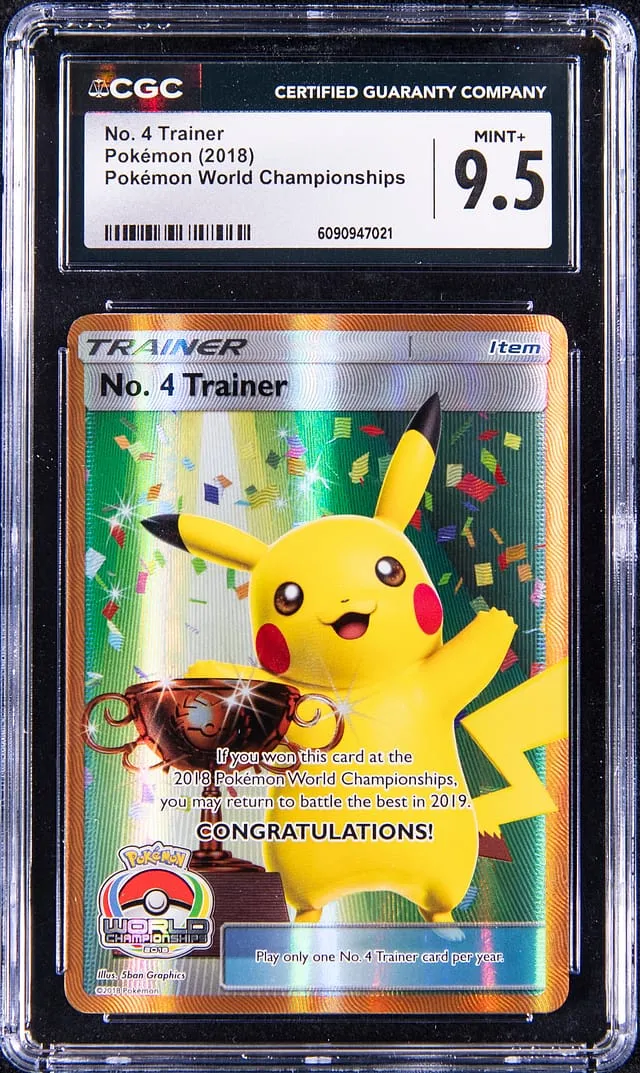
2018 No. 4 Trainer Pikachu Trophy Card Sells for $26K
Goldin sold a CGC 9.5 2018 Pokémon No. 4 Trainer Pikachu Worlds trophy card for $26,975. See why this scarce event prize matters to collectors.
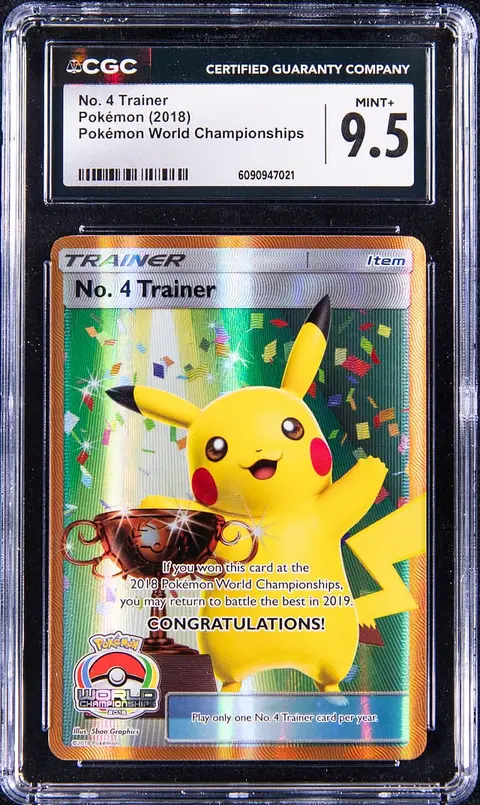
Sold Card
2018 Pokemon World Championships No. 4 Trainer Pikachu Trophy Card - CGC MINT+ 9.5
Sale Price
Platform
Goldin2018 Pokémon World Championships No. 4 Trainer Pikachu Trophy Card Sells for $26,975 (CGC 9.5)
On March 9, 2026, Goldin auctioned a 2018 Pokémon World Championships No. 4 Trainer Pikachu trophy card graded CGC MINT+ 9.5 for $26,975. For a niche event prize card, this is a meaningful result that helps clarify where modern Worlds-era trophies are currently trading.
Below, we’ll walk through what this card is, why it matters to collectors, and how this sale fits into the broader market for Pokémon trophy cards.
Card overview: what exactly sold?
Card: 2018 Pokémon World Championships – No. 4 Trainer Pikachu Trophy Card
Character: Pikachu (Worlds trophy artwork)
Year: 2018
Set / Issue: Pokémon World Championships prize card (not a standard booster set)
Variant: No. 4 Trainer
Type: Trophy card awarded at Worlds
Grading company: CGC Trading Cards
Grade: CGC MINT+ 9.5
This is not a pack-pulled card. It’s a trophy card, meaning it was awarded as a prize at an official Pokémon event – in this case, the 2018 Pokémon World Championships.
The “No. 4 Trainer” designation refers to a specific placement-tier trophy. Worlds trophies are typically given only to top finishers in age divisions (Juniors, Seniors, Masters) for both the Trading Card Game and sometimes related competitions. That structure naturally caps how many copies can exist.
While this is not a “rookie card” in the traditional sports sense, it’s a key issue within the lane of modern Worlds-era trophies: a Pikachu trophy from the most important annual Pokémon tournament.
Why the 2018 Worlds Pikachu trophies matter
1. Event-issued, ultra-low print
Trophy cards from the World Championships are among the lowest-print, most difficult-to-acquire pieces in the Pokémon hobby. Instead of being distributed through booster packs, they are handed directly to top competitors at a single event.
Public population data for exact 2018 Worlds trophy print runs is limited, but the structure of the event (few finalists, limited divisions) creates a hard ceiling on copies. Some winners hold onto their cards; others grade and sell them. That combination usually leads to:
- Very small grading population (low "pop" – shorthand for how many copies a grading company has encapsulated)
- Thin supply at public auction
- Wide price ranges depending on when a rare copy surfaces
2. Pikachu + Worlds = collecting lane crossover
Pikachu is the franchise mascot and a central focus for many character collectors. Worlds trophies bring together:
- Character collectors who chase every significant Pikachu issue
- Trophy collectors who specialize in event cards
- Competitive players who value the history of the World Championships
When a card lives at the intersection of several collecting lanes, you usually see deeper, more persistent demand.
3. Modern trophy era (not vintage, but established)
This card sits in the ultra-modern era (roughly 2017–present), but it’s far from a mass-printed chase card. Modern Worlds trophies have now had several years to establish a track record:
- Enough time has passed to see graded examples, resales, and early price history.
- They are still comparatively young compared to 1990s trophy issues, which tend to dominate all-time record lists.
For many collectors priced out of older, six-figure trophies, modern Worlds Pikachu cards represent a more accessible—though still very expensive—entry into the trophy space.
The grade: CGC MINT+ 9.5
CGC’s MINT+ 9.5 is a high-end grade, typically reflecting:
- Clean surfaces
- Strong corners and edges
- Centering very close to ideal
While CGC’s scale and subgrades differ from PSA and Beckett, a 9.5 generally sits in the high-tier, premium range in any grading ecosystem.
In the trophy lane, where total population is already low, the combination of:
- A scarce issue, and
- A top-end grade
creates a relatively small pool of comparable cards.
Market context: where does $26,975 sit?
This sale closed at $26,975 on Goldin on March 9, 2026.
Because public listings for the exact 2018 No. 4 Trainer Pikachu in CGC 9.5 are sparse, a clean, like-for-like "comps" list ("comps" = recent comparable sales) is hard to assemble. However, we can still frame this sale using known patterns and adjacent data points:
- Trophy cards tend to trade infrequently. It’s common to see gaps of many months—or even years—between public sales for a specific placement tier and grade.
- Earlier Worlds and older trophy Pikachu cards (e.g., mid-2000s and earlier) have often sold materially higher, reflecting their age, historical importance, and established collector lore.
- Modern Worlds tiers (No. 1 through No. 4 Trainer, depending on year and division) usually fall into a hierarchy where higher placements and older years command the strongest premiums.
Within that broader structure, a late-2010s Worlds Pikachu trophy in a top grade landing just under the $30,000 mark is consistent with the idea that:
- The card is recognized as a serious, high-end collectible.
- It still sits well below the most iconic, early trophy cards that can reach into much higher price brackets.
Because direct, grade-matched, year-matched comps are limited, this result should be read more as a reference point for the modern Worlds trophy market rather than an exact benchmark.
What this sale suggests for collectors
1. Continued depth in the trophy lane
High-end trophy cards remain a relatively small but committed corner of the Pokémon hobby. This sale reinforces several ongoing themes:
- Event-issued cards with genuine scarcity can draw strong bids, even without daily headlines.
- Collectors are still willing to differentiate between pull-based rarity (short prints and secret rares from packs) and structural rarity (cards you can only win).
2. Modern Worlds trophies are holding a defined tier
While the most famous 1990s and early-2000s trophies grab headlines with record-breaking numbers, modern Worlds Pikachu trophies like this one have been settling into their own tier:
- Price points that are high for almost any collector,
- But still noticeably below the earliest, most historically significant trophy issues.
This layering is typical as any hobby matures: top-tier grails, established but secondary keys, and then a long tail of chase cards.
3. Grade and grading company matter, but scarcity dominates
In mass-printed sets, collectors can compare dozens or hundreds of sales across PSA, CGC, and Beckett and see clear patterns. With trophies, the card itself often matters more than the label:
- A CGC 9.5 here is positioned as a premium example, and that surely helped.
- But the fundamental driver is the card’s event-issued scarcity and Pikachu Worlds artwork.
Over time, as more copies (if any) from the same placement tier are graded by different companies, the market may show clearer preferences. For now, each public sale is a data point more than a full pattern.
Takeaways for different types of collectors
Newcomers and returning collectors
- Trophies like this are at the top of the difficulty scale—both to find and to afford.
- Use sales like this to understand the structure of the market, even if you never plan to buy into this tier:
- Event-issued > pack-issued for rarity.
- Worlds Pikachu > many standard chase cards in terms of long-term collector attention.
Active hobbyists
- Track trophy auction results over time; even if you focus on regular booster cards, high-end trophy behavior often signals how serious collectors are in a given era.
- When looking at any trophy listing, pay close attention to:
- Year and event (e.g., 2018 Worlds vs. earlier Worlds or regional events).
- Placement tier (No. 1 vs. No. 4, etc.).
- Grading pop reports where available.
Small sellers
- Sales like this highlight the role of specialized auction houses such as Goldin, which often handle event-issued and ultra-rare pieces.
- For rarer items you may encounter—player promos, staff cards, or regional awards—it’s useful to study how auction houses describe trophy cards, including:
- Clear event context.
- Placement and distribution.
- Grading details.
Final thoughts
The $26,975 sale of a 2018 Pokémon World Championships No. 4 Trainer Pikachu trophy card in CGC MINT+ 9.5 at Goldin on March 9, 2026, is a solid data point for modern Worlds trophies.
It underlines three core realities of the Pokémon market:
- Event-issued, low-print cards occupy a different plane than pack-pulled chases.
- Pikachu trophy cards—especially tied to Worlds—continue to attract deep collector interest.
- Even within the ultra-modern era, competition prizes are carving out their own, clearly defined tier in the price landscape.
For most collectors, this card will always be more of a reference point than an achievable target—but understanding why it sold where it did helps make sense of the broader Pokémon ecosystem.