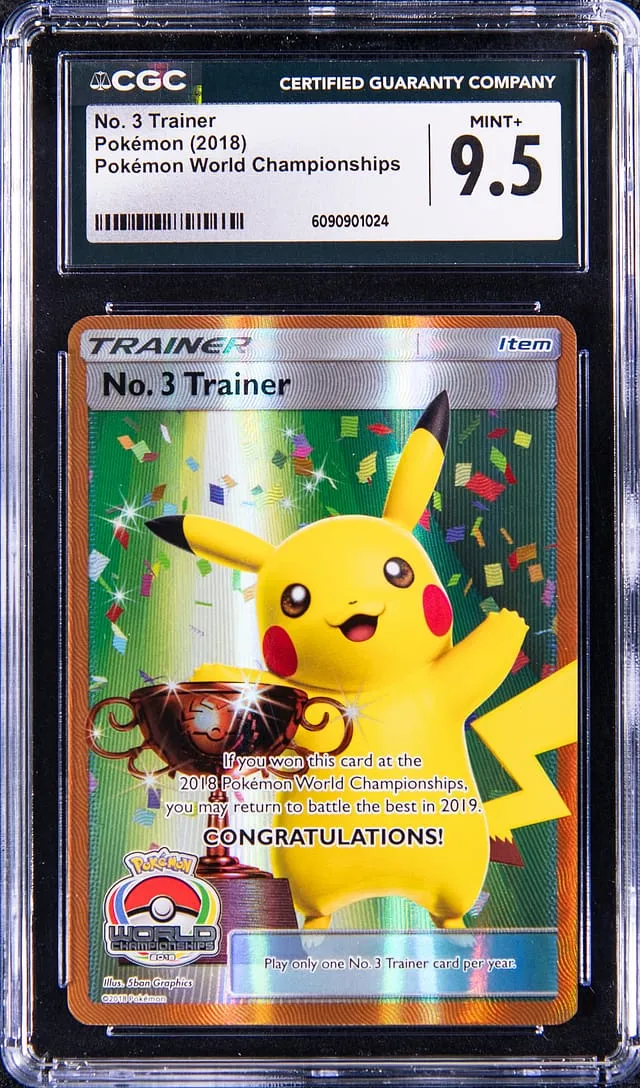
2018 No. 3 Trainer Pikachu Trophy Card Sells for $27K
A CGC 9.5 Pop 1 2018 No. 3 Trainer Pikachu World Championships trophy card sold for $27,555 at Goldin. Here’s what it means for collectors.
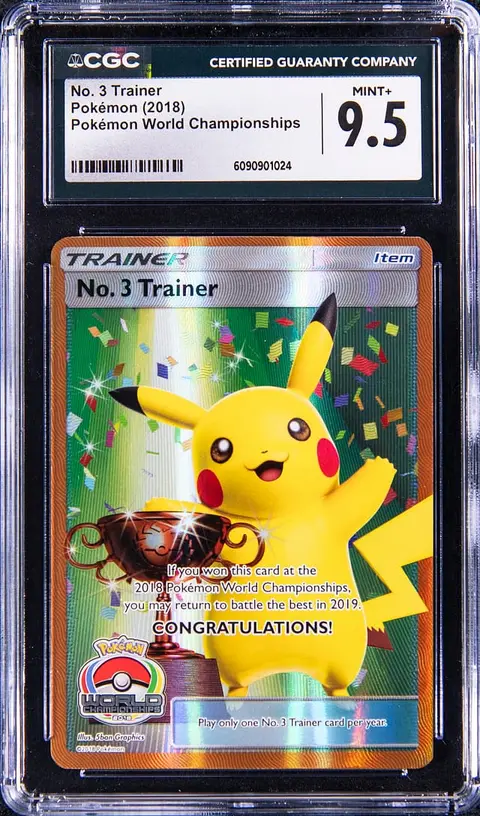
Sold Card
2018 Pokemon World Championships No. 3 Trainer Pikachu Trophy Card - CGC MINT+ 9.5 - Pop 1
Sale Price
Platform
Goldin2018 Pokémon World Championships No. 3 Trainer Pikachu Trophy Card Sells for $27,555
On February 16, 2026, Goldin auctioned a true niche grail from the competitive side of the Pokémon hobby: a 2018 Pokémon World Championships No. 3 Trainer Pikachu Trophy Card, graded CGC MINT+ 9.5, for $27,555.
For collectors who follow trophy cards and competitive history, this is an important data point. For newer or returning collectors, it’s a good case study in how rarity, provenance, and grading all intersect.
What exactly is this card?
Card details:
- Character: Pikachu (Trainer trophy artwork)
- Event: 2018 Pokémon World Championships
- Title: “No. 3 Trainer” trophy card
- Year: 2018 (ultra‑modern era)
- Category: Trophy/prize card, not a pack‑pulled release
- Distribution: Awarded to top finishers at the 2018 World Championships (extremely limited)
- Grading company: CGC
- Grade: CGC MINT+ 9.5
- Population: CGC Pop 1 at this grade at the time of sale
This is not a standard set Pikachu or a card you can open from booster packs. Trophy cards are awarded to high‑placing competitors at major events and typically have very low print runs and a direct connection to the competitive scene.
The “No. 3 Trainer” naming indicates a third‑place trophy level in its category at Worlds. Exact print quantities for modern Worlds trophies are not always publicly confirmed, but they are understood to be extremely small compared with regular releases.
Why collectors care about Pokémon World Championships trophy cards
World Championships trophy cards sit in a different lane than most chase cards:
- Event‑based provenance: These cards are tied to specific tournaments and placements, not retail products.
- Ultra‑low distribution: Only a handful of copies are awarded, often to players who may keep them for personal reasons.
- Historical continuity: Trophy Pikachu cards trace back to some of the earliest and most famous Pokémon trophy issues from the late 1990s.
From a collecting standpoint, this puts them closer to award medals or championship belts than to a normal “hit” from a pack. For some collectors, that competitive history is the main draw.
The grade: CGC MINT+ 9.5, Pop 1
Grading details matter a lot with niche, low‑population issues.
- CGC 9.5 MINT+: A very high grade, just below pristine tiers. Minor flaws only.
- Pop 1: “Pop report” is short for population report, which is the grading company’s count of how many copies they’ve graded at each grade. A Pop 1 at 9.5 means there was only one copy graded at that level with CGC at the time.
For modern trophy cards, even getting a single copy into a slab can be a hurdle because:
- Owners may be long‑time players rather than traditional collectors.
- Some copies remain ungraded for years.
So a high‑grade example like this, already encapsulated and documented, can attract attention simply because there are so few alternatives on the market.
Market context and price positioning
This Goldin sale closed at $27,555 on February 16, 2026.
When we look at price context for a card like this, there are a few challenges:
- Very thin sales history: Trophy cards do not trade as often as mass‑produced set cards. You might only see a few public auction results over several years, sometimes fewer, depending on the specific trophy.
- Differences by year and placement: Earlier Worlds and Japanese trophy cards, and higher placement levels (No. 1 vs No. 3), can see very different demand and pricing.
- Cross‑grading and mixed grading companies: Some copies sit in PSA holders, others in CGC or BGS, making direct comparisons trickier.
Because of these factors, the best we can do is compare this sale to:
- Reported prices for similar World Championships Pikachu trophies from nearby years.
- Comparable grades (high‑grade PSA, CGC, or BGS copies) when available.
Across the modern era, high‑grade Worlds trophy Pikachu cards have generally established themselves as five‑figure items, with asking prices and occasional public sales reflecting their niche but persistent demand. Within that context, $27,555 sits in line with what collectors might expect for a modern, ultra‑scarce, high‑grade World Championships Pikachu trophy, particularly a Pop 1 example with a premium grade.
Because confirmed public comps (short for comparables—recent similar sales) for this exact 2018 No. 3 Trainer in CGC 9.5 are very limited, it’s more accurate to say this sale helps define the range, rather than cleanly fitting into a long, established curve.
How this sale fits into trophy and Pikachu collecting
From a broader hobby view, this sale touches three active collector lanes:
Trophy and award card collectors
- Focused on World Championships, early Japanese trophies, and other prize issues.
- Sensitive to tiny differences in event, year, and placement.
Pikachu specialists
- Collectors who chase Pikachu cards across all sets and eras.
- Trophy Pikas often sit at the very top of those collections due to scarcity.
High‑end, low‑population modern
- Collectors who prefer ultra‑modern (roughly mid‑2010s onward) but still want genuinely scarce cards.
- For this segment, Worlds trophies serve as a counterweight to large‑print, widely graded chase cards.
This sale reinforces a pattern we’ve seen across the last several years:
- Tournament‑tied rarity continues to hold a distinct lane in the market, separate from mass‑opened modern product.
- High‑grade, documented copies of niche awards tend to draw attention when they surface, especially with clear population data.
What newcomers and small sellers can take away
If you’re newer to the hobby or just starting to sell, a trophy card like this can look mysterious. Here are a few practical takeaways:
Understand origin and distribution
When evaluating any card, ask: Was this pack‑pulled, a promo, or an award? Award and trophy cards often have much smaller print runs.Check population reports
Pop reports from grading companies can provide context on how many graded copies exist at each grade. For niche cards, even a small shift (e.g., a second 9.5 appearing) can matter.Use comps carefully
With ultra‑rare items, there may be very few comps. Instead of forcing a price comparison to a different year or placement, treat each sale as another piece of the puzzle.Separate nostalgia from narrative
Worlds trophy cards are historically important for competitive players, but that doesn’t guarantee specific price outcomes. Think of them as artifacts of the game’s history first, and only then as market assets.
Final thoughts
The February 16, 2026 Goldin sale of the 2018 Pokémon World Championships No. 3 Trainer Pikachu Trophy Card – CGC MINT+ 9.5 (Pop 1) at $27,555 adds a new, visible marker to the small but closely watched segment of Pokémon trophy cards.
It’s another reminder that within the broader modern Pokémon boom—where many cards are widely available and heavily graded—there is still a thin layer of truly scarce, competition‑tied pieces that move on their own timelines and with their own rules.
For collectors tracking the evolution of high‑end Pikachu and Worlds trophies, this is a sale worth bookmarking.