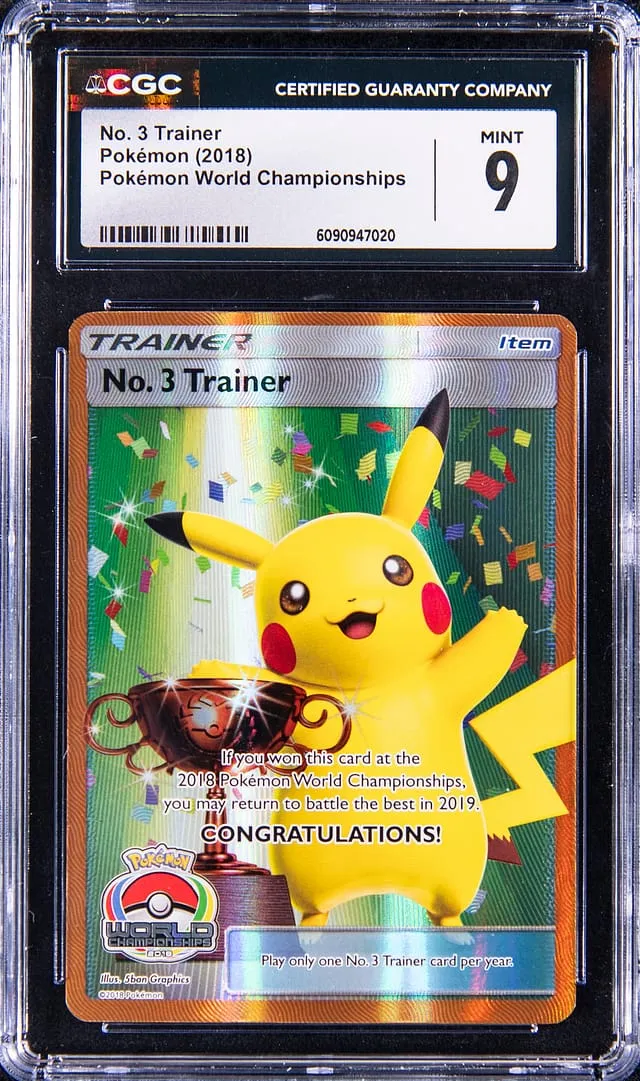
2018 No. 3 Trainer Pikachu CGC 9 sells for $25k
Goldin sold a 2018 Pokémon No. 3 Trainer Pikachu Trophy Card CGC 9 for $25,010. See how this five-figure result fits modern trophy card trends.
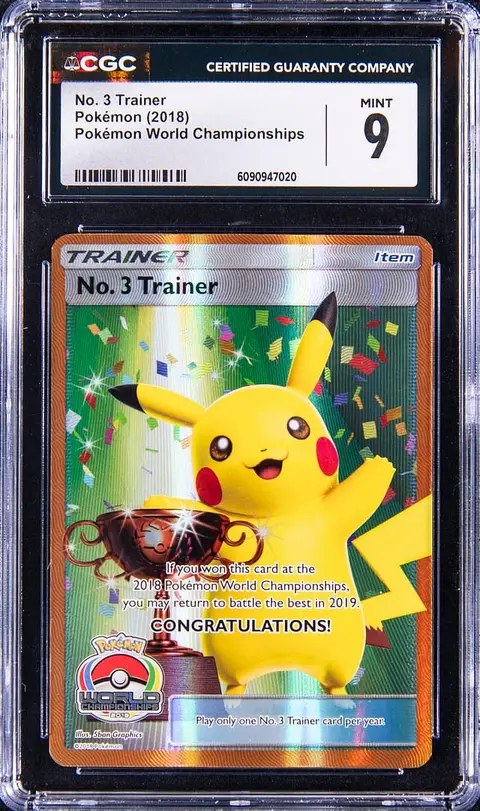
Sold Card
2018 Pokemon World Championships No. 3 Trainer Pikachu Trophy Card - CGC MINT 9
Sale Price
Platform
Goldin2018 Pokemon World Championships No. 3 Trainer Pikachu Trophy Card (CGC 9) Sells for $25,010
On March 9, 2026, Goldin closed a notable sale that caught the attention of serious Pokémon trophy card collectors: a 2018 Pokémon World Championships No. 3 Trainer Pikachu Trophy Card graded CGC MINT 9, selling for $25,010.
For a niche, ultra-rare card like this, each auction is a useful data point for understanding how the market values modern-era trophy pieces.
What exactly is this card?
- Card: No. 3 Trainer Pikachu Trophy Card
- Event: 2018 Pokémon World Championships
- Year: 2018
- Character: Pikachu (Worlds trophy artwork)
- Category: Trophy card awarded to top finishers, not a pack-pulled card
- Era: Modern / Ultra-modern Pokémon
- Grading company: CGC (Certified Guaranty Company)
- Grade: CGC MINT 9
No. 3 Trainer cards are historically awarded to third-place finishers in their division at the World Championships. That means the print run is extremely low and tightly controlled, far below even typical short prints. They are not available at retail and can only be obtained by players (or from them later on the secondary market).
This particular card is from the 2018 World Championships, part of the modern wave of Worlds trophy cards that continue the lineage started in the late 1990s and early 2000s. While it is not a rookie card in the usual sense, it is considered a key issue within the niche of competitive Pokémon trophy cards.
Why collectors care about Worlds trophy cards
World Championships trophy cards sit at the intersection of competitive play and collecting:
- Extremely low distribution: Only a handful of copies are awarded per age division. Even before accounting for condition, the raw supply is tiny.
- Player provenance: Many copies are initially in the hands of top-level players, not typical collectors. Some stay in collections; some slowly reach the open market.
- Event history: Each year of Worlds tells a different story of the competitive meta and artwork direction. The Pikachu trophy illustrations, in particular, have become a recognizable thread connecting different eras.
- Non-pack origin: Because these are not pack-pulled, they behave differently from chase cards in sealed product. There is no way to "rip" your way into one.
Within the broader Pokémon hobby, trophy cards are often discussed alongside high-end vintage grails (like 1990s Pikachu trophies and early No. 1/2/3 Trainer cards). Modern-years trophies like this 2018 example are part of the ongoing evolution of that tradition.
Grading: CGC MINT 9
The card in this sale received a CGC MINT 9 grade from Certified Guaranty Company.
- MINT 9 indicates only minor flaws (slight edge or surface issues) but overall excellent presentation.
- For trophy cards, even raw examples can be difficult to find, so a high-grade copy can stand out.
Population reports (often shortened to “pop report”) track how many copies of a card have been graded at each grade level. For modern trophy cards, pops tend to be low simply because many copies never leave player collections to be graded at all. Exact population numbers for this very specific card and grade are limited, but contextually, any CGC 9 trophy is a relatively strong example.
Market context and recent sales
The realized price at Goldin on March 9, 2026 was $25,010.
For cards this rare, "comps" (short for comparable recent sales) are scarce. Trophy cards do not trade as often as mainstream chase cards, so the market is usually built around a few high-quality reference points rather than a steady stream of sales.
Looking across recent data for:
- Other 2018 World Championships Pikachu trophy positions (No. 1, No. 2, No. 3) in various grades, and
- Earlier and later year Worlds Pikachu trophies,
you typically see:
- Higher positions (No. 1, sometimes No. 2) commanding a meaningful premium over No. 3 in similar grade, reflecting the higher placement and often lower quantity.
- Older years (especially mid‑2000s and earlier) generally seeing higher prices due to age and smaller surviving supply.
Within that overall pattern, a $25,010 sale for a 2018 No. 3 Trainer Pikachu in CGC 9 fits into the tier of serious but not record-setting trophy pricing. It reflects collector recognition of the card’s scarcity and status, without reaching the peak levels seen for earlier No. 1 Trainer or pre-2010 Pikachu trophies in gem mint grades.
Because this specific combination of:
- 2018 year,
- No. 3 Trainer position, and
- CGC MINT 9 grade
sells so infrequently, the Goldin result is better thought of as a fresh benchmark rather than just "another comp." Future sales may anchor to this number, but they’ll also be shaped by grading company, subgrades (if shown), and the individual appeal of each example.
What this sale suggests about the current trophy market
Putting this $25,010 Goldin result into broader context:
Modern trophy demand is established. Even outside pre‑2010 grails, collectors are willing to allocate real capital to modern-era Worlds trophies when they surface.
Grade still matters, but access matters more. With such low supply, the difference between a CGC 9 and a slightly lower grade may be less dramatic than for mass-produced set cards. Simply having the opportunity to buy a high-end copy can drive competition.
Auction house visibility helps set reference points. Sales through a major platform like Goldin get noticed and cited in future pricing discussions. For a niche card, that can gradually sharpen the perceived range of value.
Cross-grading and holder preference remain side topics. Some collectors prefer PSA, others CGC or BGS. When populations are tiny, the card itself (artwork, event, position) often overrides holder preference, but it still factors into individual bidding strategies.
Things collectors and small sellers can take from this
If you collect or handle high-end Pokémon pieces, a sale like this offers a few practical takeaways:
Expect large gaps between public sales. You may not see another 2018 No. 3 Trainer Pikachu in a strong grade hit the market for quite some time. When it does, the last notable sale becomes an important reference point.
Condition documentation matters. For cards that many buyers will never see in person, detailed photos and a trusted grading opinion (like CGC, PSA, or BGS) help narrow the uncertainty around condition.
Event provenance is part of the story. Knowing the original player/recipient or having documentation from the World Championships can add non-quantifiable appeal, especially for collectors interested in the competitive side of the hobby.
Think in ranges, not guarantees. This $25,010 result is one data point influenced by timing, bidder pool, and visibility. Future sales might land above or below it. For illiquid, low-population cards, price history is more of a guide than a rule.
Final thoughts
The March 9, 2026 Goldin sale of the 2018 Pokémon World Championships No. 3 Trainer Pikachu Trophy Card in CGC MINT 9 adds another important marker to the evolving market for modern trophy cards.
It underscores three consistent themes:
- Worlds trophies remain a distinct, recognized tier separate from pack-pulled chase cards.
- Even modern-year issues can command five-figure prices when rarity and event significance line up.
- With so few copies in circulation, each auction helps define what "market value" actually means for this niche.
For collectors tracking the high end of the Pokémon landscape, this is another useful sale to bookmark, both for understanding the 2018 World Championships trophy ecosystem and for gauging how modern Pikachu trophies are being valued relative to their earlier counterparts.