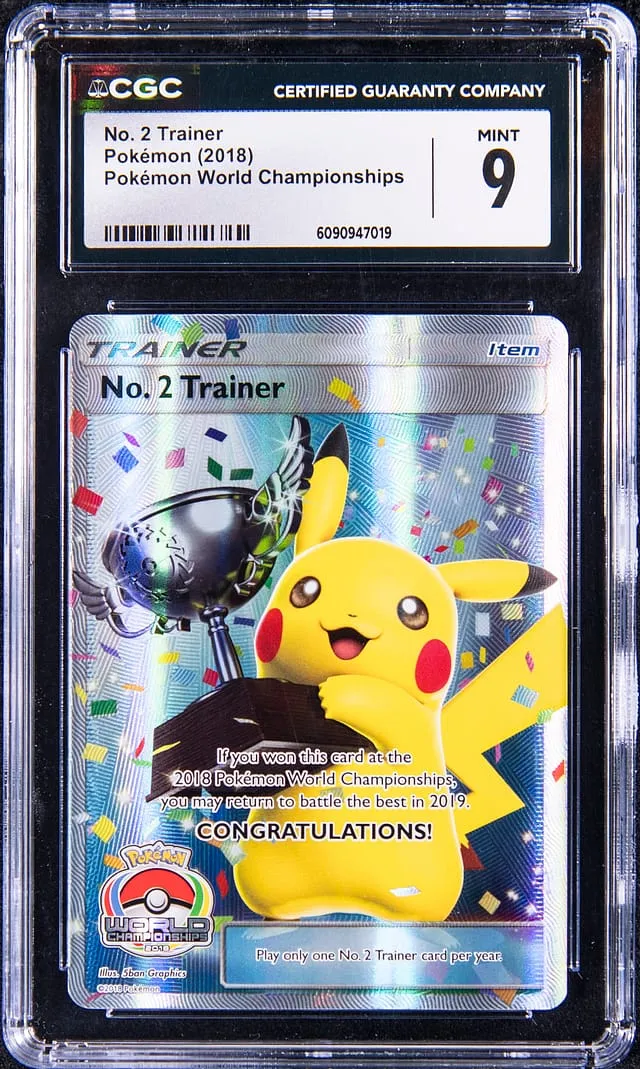
2018 No. 2 Trainer Pikachu Trophy CGC 9 Sells for $37K
Figoca review of the 2018 Pokemon No. 2 Trainer Pikachu trophy card, CGC 9 Pop 2, sold for $37,820 at Goldin on March 9, 2026.
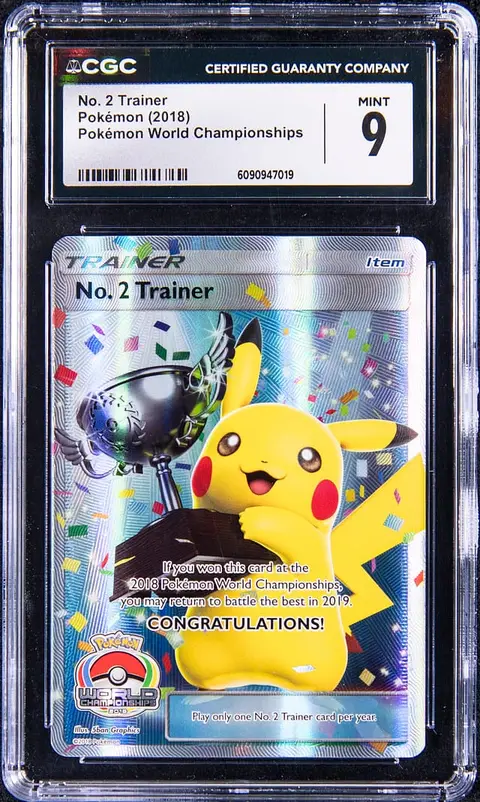
Sold Card
2018 Pokemon World Championships No. 2 Trainer Pikachu Trophy Card - CGC MINT 9 - Pop 2
Sale Price
Platform
Goldin2018 Pokemon World Championships No. 2 Trainer Pikachu Trophy Card – CGC 9 Sells for $37,820
On March 9, 2026, a major Pokemon trophy card quietly changed hands at Goldin: a 2018 Pokemon World Championships No. 2 Trainer Pikachu Trophy Card, graded CGC MINT 9, realized $37,820.
For most collectors, cards like this live more in lore than in personal collections. Let’s break down what sold, why it matters, and how this price fits into the broader Pokemon market.
What exactly is this card?
Card details
- Year: 2018
- Event/Set: Pokemon World Championships (trophy card, not a retail set card)
- Title: No. 2 Trainer (Pikachu Trophy Card)
- Character: Pikachu
- Type: Trophy / Prize card, awarded at the World Championships
- Rarity: Extremely limited, distributed only to top-placing competitors
- Era: Ultra-modern (mid‑2010s onward)
Unlike booster‑pull cards, World Championships “Trainer” trophy cards are awarded to finalists at the top competitive event of the year. They are effectively event‑used awards, not commercial products. That’s why you won’t find them in standard checklists or on big-box store shelves.
Grading and condition
- Grading company: CGC (Certified Guaranty Company)
- Grade: CGC MINT 9
- Population: Pop 2 in CGC 9 (two copies in this grade)
A “pop report” (population report) tells you how many copies of a card a grading company has seen at each grade. A Pop 2 in CGC 9 on a card that only exists in tiny numbers to begin with underlines how thin the market is: there simply are not many copies to trade hands.
Why collectors care about No. 2 Trainer Pikachu trophy cards
Trophy cards vs regular chase cards
In Pokemon, trophy cards sit at the top of the pyramid. While most collectors chase set cards, secret rares, and alternates, trophy cards are limited to a handful of copies for finalists and champions at events like Worlds.
The No. 2 Trainer is awarded to the second‑place finisher in a division. Historically, these cards feature:
- Unique artwork (often Pikachu in an event‑themed pose)
- Specific event text referencing the championship and placement
- Extremely low distribution numbers
Where a standard ultra‑modern chase might have print runs in the tens of thousands (or higher), a World Championships No. 2 Trainer can exist in single‑digit to low double‑digit quantities. Even before grading filters them further, that level of scarcity is on a completely different scale than pack‑pulled cards.
2018 World Championships context
The 2018 Pokemon World Championships were held in Nashville, continuing an unbroken tradition of Worlds trophy card releases that stretches back decades. Each year’s No. 1, No. 2, and No. 3 Trainer cards form a micro‑set of that event’s most coveted awards.
For collectors, the key points of significance are:
- Competitive history – This specific card was originally handed to a top competitor, not sold.
- Pikachu focus – Pikachu trophy artwork keeps demand broad, appealing to player‑collectors, art collectors, and Pikachu character collectors.
- Worlds continuity – Many high‑end collectors build runs of No. 1/2/3 Trainer cards across multiple years.
Within the trophy hierarchy, the No. 1 Trainer (champion) cards sit at the absolute top, but No. 2 Trainer copies are right behind them and frequently command strong prices when they surface.
Market context: how does $37,820 fit in?
Understanding the price
This copy realized $37,820 at Goldin on March 9, 2026 (UTC). For ultra‑scarce trophy cards, the idea of an exact “market price” is tricky: the number of recorded sales is small, and individual copies often trade privately.
Instead of thinking in terms of a stable price, it’s more accurate to think in terms of price ranges observed when copies actually surface, and how those ranges relate across:
- Different years of Worlds (earlier years vs more recent)
- Placement tiers (No. 1 vs No. 2 vs No. 3)
- Grades (e.g., BGS/PSA/CGC 9 vs 9.5 vs 8)
- Award divisions (Junior/Senior/Masters, when applicable)
Recent sales and comparisons
Public, verifiable sales data for this exact card, year, and grade is thin, which is normal for event‑only trophy pieces. When a card exists in very small numbers and has a pop of 2 in a top grade at one grading company, you simply don’t see monthly comps.
What can be said in context:
- Earlier Worlds trophy cards (especially early 2000s and mid‑2000s No. 1 Trainers and similar prizes) have achieved significantly higher prices in high grade, reflecting both their age and legendary status among trophy collectors.
- Later ultra‑modern trophies like this 2018 No. 2 Trainer Pikachu generally trade below the earliest grails but still sit well above typical ultra‑modern chase cards, because access is so restricted.
- Cross‑grade comparisons (PSA 9 vs CGC 9 vs BGS 9) can be noisy for trophy cards: with only a handful of graded copies worldwide, single sales often represent unique situations (collector consolidation, set building, or an owner finally deciding to sell after years).
Within that context, $37,820 for a CGC 9 Pop 2 lines up with how the market often treats:
- A later‑era, but still highly respected, Worlds trophy card; and
- A key mid‑tier placement (No. 2) that remains aspirational but sits under the true top‑end records reserved for older No. 1 trophies.
Instead of calling this a bargain or a peak, it is more accurate to say that this result is consistent with the premium that modern trophy cards command over even the most popular pack‑pulled ultra‑modern cards.
Why CGC 9 and population matter here
On most set cards, a CGC 9 is one of many options on the market. With trophy cards, each graded copy has outsized weight.
Key points for this sale:
- Pop 2 in CGC 9 – Only two copies in this grade in CGC’s registry. That doesn’t include PSA or BGS, but it highlights how scarce graded examples are.
- Limited total supply – Because there were only so many finalists at 2018 Worlds, the total number of genuine copies in existence is inherently small. The grading population will never resemble a typical mass‑printed card.
- Condition sensitivity – Trophy cards were handled as awards, transported, and sometimes displayed. They are not always treated like pack‑fresh singles, so high grades are not guaranteed.
For collectors building Worlds trophy runs, any high‑grade copy becomes a key target. When a Pop 2 card appears at a major auction house like Goldin, it can attract:
- Dedicated trophy specialists
- Pikachu character collectors
- High‑end Pokemon buyers who focus on historically important pieces
That overlapping demand is what supports results in this price range.
What this sale tells us about the Pokemon market
Trophy tier vs mainstream ultra‑modern
It’s easy to focus on modern alternate arts and special set releases, but sales like this reinforce that there is a separate, thinner, and often more stable lane for:
- Trophy and prize cards
- Event‑only promos
- Cards with competitive pedigree
Where standard ultra‑modern chase cards sometimes show more frequent price swings (driven by grading backlogs, new reprints, or waves of hype), trophy cards tend to:
- Trade less often
- Move more in response to collector demand than to short‑term speculation
- Be accumulated by long‑term collectors or set builders who hold them for years
Impact of grading diversity
This card is in a CGC holder, not PSA. Over the last few years, CGC has become a serious grading option for TCGs, and trophy collectors increasingly use multiple grading companies.
In practice, this means:
- Cross‑company pop reports matter – A serious buyer will often look at CGC, PSA, and BGS together to understand true supply.
- Holder preference can influence bidding – Some collectors are PSA‑only, others are CGC‑friendly, and some plan to cross‑grade. That mix can slightly shift where certain copies sell and for how much.
This result at Goldin suggests strong enough demand that a high‑grade CGC example is taken seriously as a centerpiece trophy card, even for collectors who may cross to another grading company later.
Takeaways for different types of collectors
If you’re new or returning to Pokemon
- Think of trophy cards as the championship hardware of the TCG world. They occupy a different lane than booster‑pulled cards.
- You don’t need a trophy card to enjoy the hobby, but understanding them helps you see how the very top end of the market behaves.
- When you see a five‑figure sale like this, remember you’re looking at a piece that was never widely available in packs.
If you’re an active hobbyist or small seller
- Use sales like this as market context, not price anchors for regular cards. A Worlds No. 2 Trainer has a fundamentally different supply profile than chase cards from standard sets.
- Pay attention to event‑linked promos and limited releases; while they’re not trophies, they often show more durable demand than high‑print‑run inserts.
- For rare items, be cautious about relying on a single comp. With ultra‑low‑supply cards, each sale can reflect unique collector situations.
If you’re a trophy or high‑end collector
- This Goldin result gives another data point for ultra‑modern World Championships trophies in strong grade.
- The price supports the idea that 2010s Worlds trophies, while below the earliest grails, occupy a solid tier that continues to attract serious bidders.
- For CGC‑graded trophies specifically, a Pop 2 CGC 9 pushing near $40,000 underscores that the market is comfortable recognizing high‑grade CGC examples in this space.
Final thoughts
The 2018 Pokemon World Championships No. 2 Trainer Pikachu Trophy Card – CGC MINT 9 (Pop 2) selling for $37,820 at Goldin on March 9, 2026 is another reminder that Pokemon’s competitive history holds real weight in the hobby.
While most collectors will never own a Worlds trophy, following these sales helps put the rest of the market in perspective. It shows how rarity, event prestige, condition, and character appeal combine to create a separate, quieter tier of collecting—one where even a single auction can meaningfully update our understanding of value.
For figoca users tracking high‑end Pokemon, this sale sits as a clear marker: modern Worlds trophies remain a distinct and firmly‑established category, with prices that reflect both their scarcity and their place in the game’s competitive story.