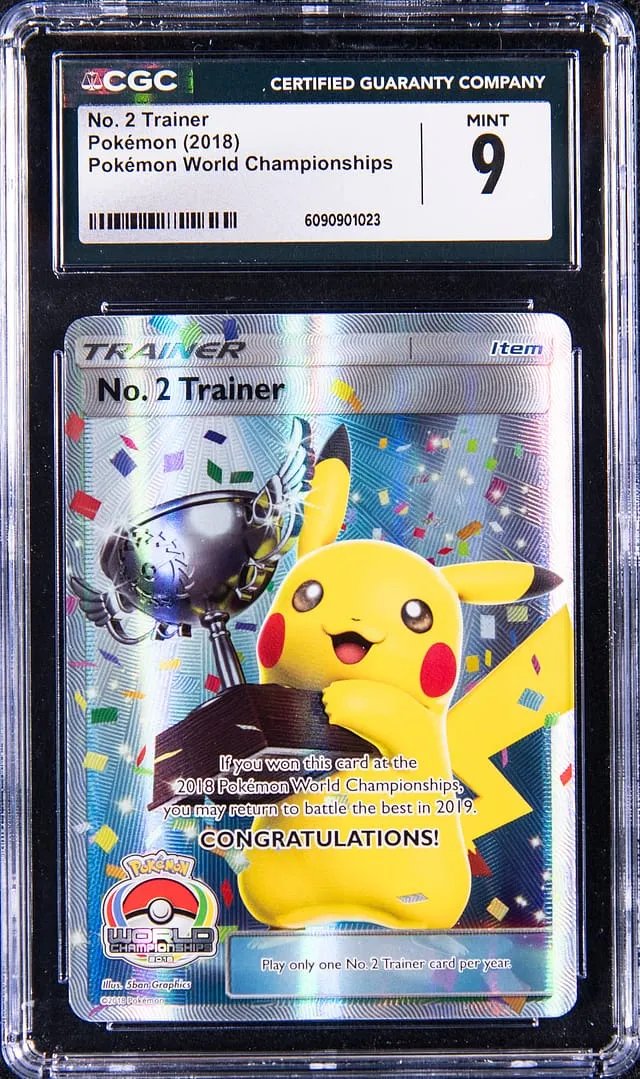
2018 No. 2 Trainer Pikachu Trophy CGC 9 Sells for $32K
Goldin sold a 2018 Pokémon World Championships No. 2 Trainer Pikachu CGC 9, Pop 2, for $32,874. See the key details and price context for this trophy card.
Sold Card
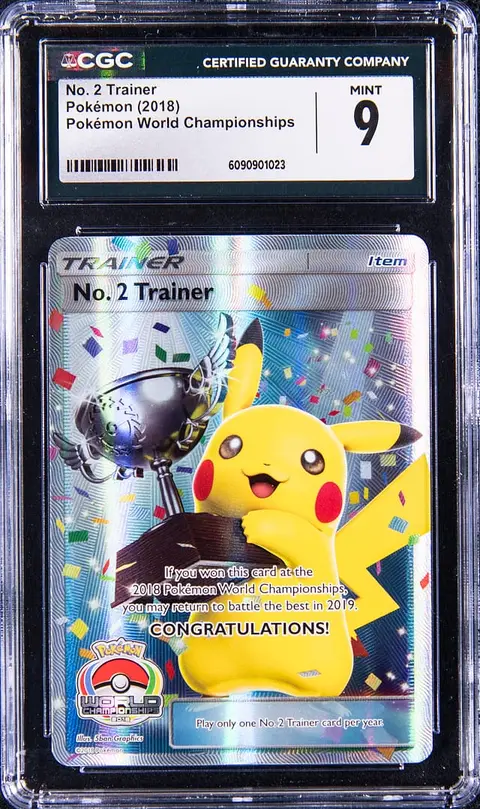
2018 Pokemon World Championships No. 2 Trainer Pikachu Trophy Card - CGC MINT 9 - Pop 2
Sale Price
Platform
Goldin2018 Pokemon World Championships No. 2 Trainer Pikachu Trophy Card Sells for $32,874 (CGC 9)
On February 16, 2026, Goldin closed a notable high-end Pokémon sale: a 2018 Pokémon World Championships No. 2 Trainer Pikachu Trophy Card graded CGC MINT 9, realizing $32,874.
For such a niche, invitation-only card, this result offers a useful reference point for collectors tracking the upper end of the competitive Pokémon trophy market.
What exactly is this card?
- Card: 2018 Pokémon World Championships No. 2 Trainer Trophy Card (Pikachu artwork)
- Event: 2018 Pokémon World Championships
- Placement: Awarded to 2nd-place finishers
- Character: Pikachu (Worlds trophy illustration)
- Type: Trophy / prize card (not a standard pack-pulled card)
- Era: Ultra-modern competitive trophy
- Grading company: CGC
- Grade: CGC MINT 9
- Population note: CGC pop report shows Pop 2 in CGC 9 at the time of this sale
Unlike set cards that are pulled from booster packs, this No. 2 Trainer Pikachu was awarded directly at the World Championships to top-placing competitors. That makes it a true event trophy, tied to a specific year and result.
Why the 2018 No. 2 Trainer matters to collectors
Trophy history and scarcity
“Trophy cards” in Pokémon are cards given as prizes at high-level events (often the World Championships). They are typically produced in very low quantities compared to normal set releases. For this 2018 No. 2 Trainer Pikachu:
- Each age division (Juniors, Seniors, Masters) at Worlds awards its own Top 4 trophy cards.
- That means only a small, fixed number of authentic copies exist globally.
- Some copies remain in personal collections and may never be graded or sold.
Because of this structure, collectors often treat each World Championship year as its own micro-set of Top 4 trainer trophies, with the No. 1, No. 2, No. 3 (and sometimes additional placements) forming a small hierarchy.
Pikachu and the Worlds connection
Pikachu-based trophy cards have a long track record of collector interest. They combine:
- The franchise mascot (Pikachu) with
- The highest-level competition (World Championships) and
- A dated snapshot of the game’s history (2018 season).
This makes the card both a character collectible and an esport/TCG history piece. For some collectors, the year and division matter; for others, any authentic Worlds Pikachu trophy significantly above participation level is the focus.
Understanding the grade and pop report
This copy received a CGC MINT 9 grade.
- MINT 9 typically indicates very light flaws (minor corner/edge wear or surface issues) but excellent overall presentation.
- Pop 2 (population 2) means that, according to CGC’s public population report at the time of the sale, only two copies have received the CGC 9 grade.
For ultra-low-print trophy cards, population reports can be misleading if taken as the full story. Some copies may never be submitted for grading, and a portion of awarded cards can remain raw for years. Still, pop data helps frame how many graded examples are likely to appear in public auctions.
Market context and recent sales
Auction data for this exact card and year is limited because so few copies surface.
When looking at “comps” (short for comparables—recent sales of the same or closely related items), collectors have generally had to use:
- Other 2018 Worlds trophy placements (No. 1, No. 3) in similar grades,
- Other World Championship years’ No. 2 Trainer trophies, and
- Trophy sales graded by different companies (e.g., PSA, BGS vs. CGC).
Across major auction houses and marketplaces over the last few years, high-end Worlds Pikachu trophies have frequently:
- Sold in the mid–five-figure range, with strong results for higher placements and top grades.
- Shown wide variability based on year, placement (No. 1 vs. No. 2 vs. No. 3), language, and grading company.
Within that context, the $32,874 result at Goldin for this CGC 9 No. 2 Trainer Pikachu sits in a range that is consistent with other modern Worlds trophy sales of similar tier—neither an obvious outlier record nor a clear discount. It functions as a solid data point rather than a shock to the market.
Because auction appearances are sparse, each sale effectively “refreshes” the price reference for that card and year.
Comparing to related trophies
Even when exact comps are thin, collectors often compare:
- By placement: No. 1 Trainer typically carries a premium over No. 2, with No. 3 trailing.
- By year: Earlier- or historically significant Worlds (in terms of metagame or location) can be more sought after.
- By grade: High-end grades (PSA 9/10, BGS 9.5, CGC 9/9.5) command noticeable premiums over mid-grade copies.
For 2018 and surrounding years, the general pattern has held: higher placement + higher grade + strong grading label visibility tends to result in the higher realized prices. This CGC 9 No. 2 Trainer slots into that matrix as a premium but not top-tier (relative to a GEM MINT or No. 1 Trainer) example.
Why this sale matters for the broader market
1. Trophy visibility
Every time a Worlds trophy crosses a major platform like Goldin, it:
- Reminds newer collectors that the competitive side of Pokémon generates its own class of grail-level cards.
- Provides a public benchmark in a segment where private deals are common.
2. CGC representation in high-end Pokémon
Seeing a CGC-graded Pokémon trophy achieve a substantial five-figure result helps:
- Show that multiple grading companies are active in the trophy space.
- Provide pricing references that aren’t exclusively PSA-based.
Collectors who focus on trophy cards often look across grading labels, but realized auction prices still help them decide whether to cross grades, hold, or buy in a particular holder.
3. Ultra-modern trophy pricing stability
Ultra-modern (roughly mid-2010s onward) Pokémon has experienced strong swings in enthusiasm, especially around 2020–2022. Trophy cards, however, have generally held a separate path from mass-produced set hits.
Sales like this:
- Reinforce that prize-only, low-print cards behave differently from standard booster box chase cards.
- Suggest that demand is driven more by long-term scarcity and competitive significance than by short-term hype cycles.
Takeaways for different types of collectors
New or returning collectors
- This card is not something you’ll find in a pack or most online singles shops.
- Trophy cards live in a different tier of rarity and price than standard set cards.
- Understanding these sales can help you recognize why some cards with simple artwork sell for far more than flashy set pulls.
Active hobbyists
- The $32,874 Goldin sale on February 16, 2026, is a useful anchor point for 2018 Worlds trophy valuations, especially CGC-graded examples.
- If you track trophy markets, log this sale alongside other Worlds Pikachu and No. 2 Trainer results by year and grading company.
Small sellers
- While you’re unlikely to handle a Worlds trophy regularly, following these auctions can sharpen your sense of true scarcity vs. perceived scarcity.
- When evaluating rare promos or event cards, consider how distribution method (pack vs. prize) and fixed print quantity can affect value over time.
Final thoughts
The 2018 Pokémon World Championships No. 2 Trainer Pikachu Trophy Card in CGC MINT 9, Pop 2, achieving $32,874 at Goldin on February 16, 2026, is a measured but important data point for high-end Pokémon collectors.
It confirms ongoing respect for Worlds trophy history, highlights CGC’s role in the space, and helps map out the evolving price landscape for ultra-modern Pikachu trophies. For anyone serious about understanding the top end of the Pokémon TCG, this is a sale worth noting in your records—even if it’s a tier of collecting you only watch from afar.