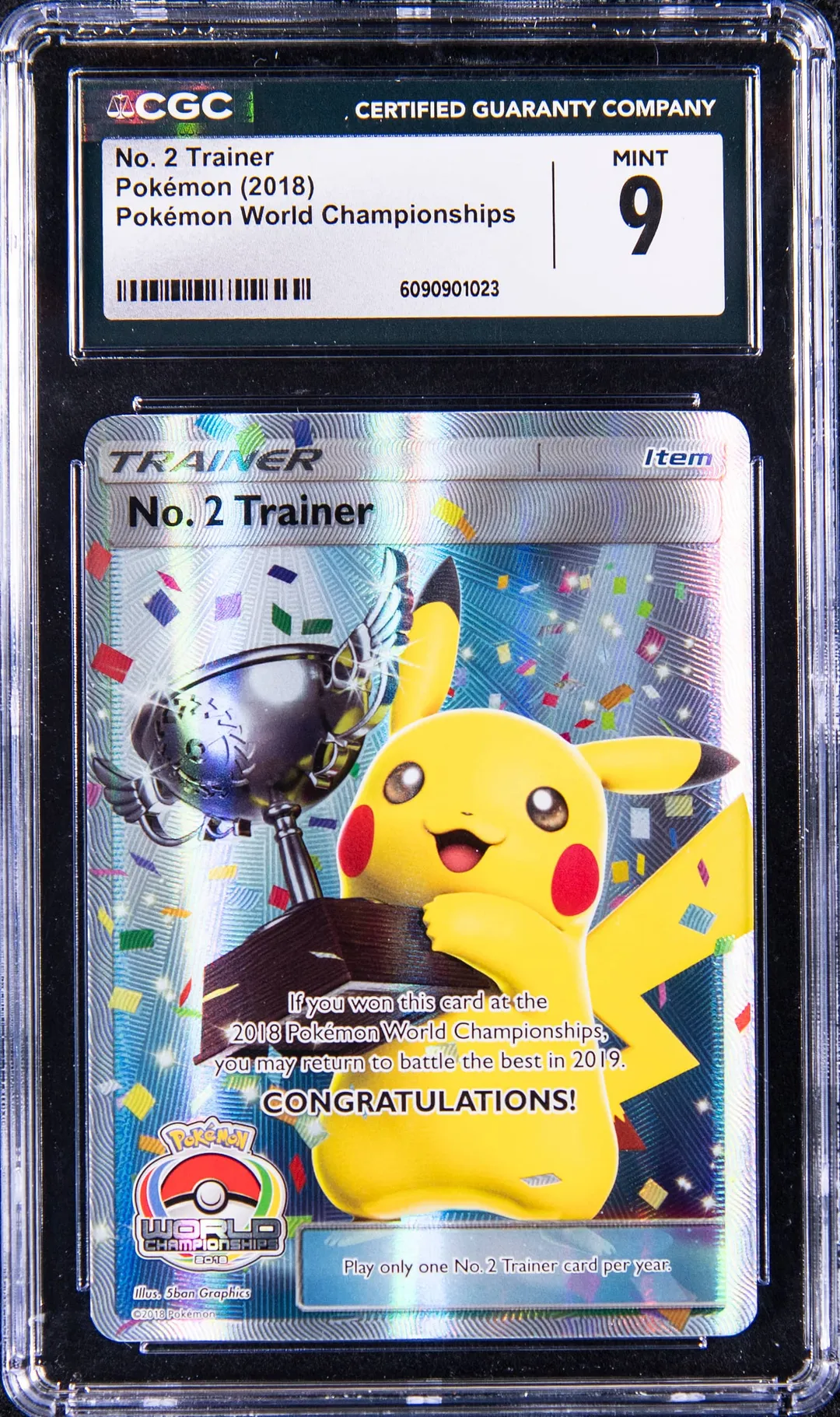
2018 No. 2 Trainer Pikachu Trophy Card Sells for $32K
Figoca looks at the $32,874 Goldin sale of a CGC Mint 9 2018 No. 2 Trainer Pikachu World Championships trophy card and what it means for collectors.
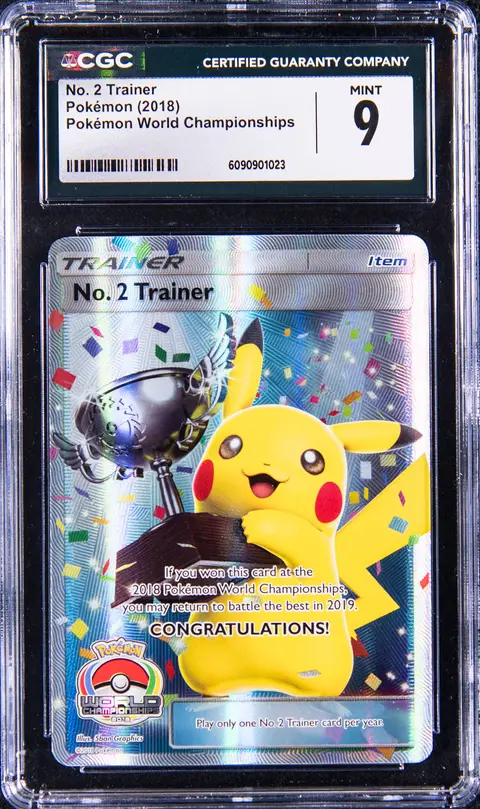
Sold Card
2018 Pokemon World Championships No. 2 Trainer Pikachu Trophy Card - CGC MINT 9 - Pop 2
Sale Price
Platform
GoldinThe 2018 Pokémon World Championships No. 2 Trainer Pikachu trophy card sits in a very small, very serious corner of the hobby. A recent sale through Goldin on 2/16/26 put one of these cards—graded CGC Mint 9 and labeled as a population 2 example—into new hands at $32,874.
For newer collectors, this is not a standard pack-pulled Pikachu. It’s a high-level tournament trophy, awarded only to a top finisher at the 2018 Pokémon World Championships. That combination of competitive history, Pikachu artwork, and extreme scarcity is what makes this card stand out.
What exactly is the 2018 No. 2 Trainer Pikachu trophy card?
Key details:
- Character: Pikachu (Trainer trophy artwork)
- Event: 2018 Pokémon World Championships
- Card type: No. 2 Trainer trophy card
- Year: 2018
- Category: Ultra-modern era Pokémon (2017–present)
- Distribution: Awarded to a top-placing competitor at Worlds, not sold in packs
- Grading: CGC Mint 9
- Population: Pop 2 in CGC’s census (only two copies graded Mint 9 by CGC at the time of this sale)
Trainer trophy cards from the World Championships are among the most limited and historically important Pokémon cards produced in any given year. They’re tied directly to the game’s highest competitive stage and exist in quantities closer to awards or medals than to normal trading cards.
Why collectors care about Pokémon World Championship trophy cards
Worlds trophy cards occupy a special lane:
- Ultra-low print runs: Unlike set cards that can exist in tens of thousands of copies, Worlds trophies are typically produced in very small numbers, aligned with podium placements and staff awards.
- Competitive provenance: These cards are tied to the actual World Championship event and its finalists. That gives them a form of built-in narrative and prestige.
- Pikachu as a mascot: When the artwork features Pikachu—the face of the franchise—that usually increases interest among both character collectors and high-end Pokémon specialists.
- Historical continuity: Since the late 1990s, trainer trophies have been some of the most coveted Pokémon cards. That lineage from early No. 1/2/3 Trainers through modern Worlds trophies helps support long-term collector interest.
Within that context, a 2018 No. 2 Trainer Pikachu is not a rookie card or a mass-market key issue. It is a niche but elite piece of competitive Pokémon history.
Understanding the CGC Mint 9 grade and population
This copy received a CGC Mint 9 grade from Certified Guaranty Company (CGC), one of the major grading services in the hobby alongside PSA and Beckett.
A quick breakdown:
- Mint 9 usually indicates sharp corners, clean edges, and strong surface quality with only minor, hard-to-see imperfections.
- Pop 2 (short for population 2) means that only two examples have received this grade in CGC’s population report—a public tally of how many copies of a card have been graded at each grade level.
Because World Championships trophies exist in such low quantities to begin with, population reports tend to stay thin. However, different grading companies (PSA, BGS, CGC) each maintain their own population data. So the complete picture comes from looking across all three, not just one.
Market context and recent sales
For a card this scarce, there are usually very few direct “comps.” In the hobby, comps (comparable sales) are previous realized prices for the same or very similar items, used to understand current price ranges.
With World Championship trophy cards, and especially a specific placing (No. 2), artwork, and year (2018), direct public sales are often limited. Many transactions happen privately or are infrequent enough that each auction creates its own new reference point.
From what’s visible in public records leading into early 2026:
- Sales of earlier-era No. 1 and No. 2 Trainer trophies (particularly from the late 1990s and early 2000s) have set very high benchmarks, often far above equivalent modern-era pieces. Those earlier cards are more historically significant and even scarcer in some cases.
- Modern Worlds trophies (2010s onward) tend to occupy a tier below the earliest trophies but are still firmly positioned as high-end collectibles. Prices scale with factors like year, artwork, grade, and the specific placing (No. 1 vs No. 2 vs No. 3).
- Within that band, the 2018 event sits in what many collectors consider a strong modern competitive period, with healthy player bases and active organized play.
Against that backdrop, the $32,874 Goldin result on 2/16/26 is a meaningful data point:
- It reinforces that modern Worlds trophies can still command strong five-figure prices when graded well and presented on a major platform.
- It provides a new, clear public reference price for a high-grade 2018 No. 2 Trainer Pikachu.
Because of the thin sales history, it’s difficult to call this sale definitively high, low, or “fair” in the traditional sense. Instead, it becomes one of the anchor data points that future buyers and sellers will look back on when they talk about 2018 trophies.
How this sale fits into the broader Pokémon market
The Pokémon market across 2023–2025 has been defined by a few themes:
- Normalization after the 2020–2021 surge: Prices for many mass-produced cards cooled off from their peak, while genuinely rare and historically important items generally held more stable.
- Separation of tiers: The gap widened between high-end, low-supply cards (trophies, early promos, core grails) and accessible set cards or modern chase cards.
- Growing respect for competitive history: As more collectors return to the hobby or discover it as adults, there has been increasing appreciation for tournament-linked items.
The 2018 No. 2 Trainer sale fits comfortably into the high-end tier:
- It’s not part of the everyday graded Pikachu or Charizard market.
- It belongs to a category (Worlds trophies) that is understood to be fundamentally supply-constrained.
- Its realized price continues the pattern of strong demand for true rarity with a clear story attached.
Key takeaways for collectors and small sellers
If you’re newer to trophy cards or considering moving up the ladder, a few practical points from this sale:
Scarcity is structural, not speculative. Trophy cards like this 2018 No. 2 Trainer Pikachu were never widely available. They started rare and will stay rare because they were created as awards, not as product.
Grading matters, but the card itself matters more. A CGC Mint 9 on a 2018 Worlds trophy is significant, especially with a pop 2 designation. That said, the card’s nature as a Worlds trophy is the real driver, not the difference between, say, 8.5 and 9 in isolation.
Comps will always be imperfect at this level. For ultra-low population items, each auction is part market check, part discovery. Collectors and small sellers should think of results like this Goldin sale as useful context rather than as a rigid price rule.
Provenance and documentation add value. For cards that come from championship events, being able to show a chain of ownership (original winner, early collectors, grading, notable auctions) helps buyers feel more confident.
Different grading companies can segment demand. Some buyers prefer PSA, others CGC or BGS. With population spread across multiple services, thin data in any one report doesn’t mean the card is overlooked; it may simply be sitting in another slab or in ungraded collections.
Where does the 2018 No. 2 Trainer Pikachu go from here?
Trophy markets tend to move in steps rather than gradual slopes. A new record or strong public sale often redefines expectations, then the market can remain quiet for months or years until another example appears.
For the 2018 No. 2 Trainer Pikachu in CGC Mint 9 (pop 2), the $32,874 Goldin sale on 2/16/26 now becomes a reference point collectors can point to when:
- Evaluating private offers
- Comparing other trophy years and placings
- Thinking about crossovers between grading companies
As always, the most sustainable approach is to treat these numbers as part of a broader picture: the card’s history, the health of competitive play, and your own collecting priorities.
For collectors who focus on story, scarcity, and competitive pedigree, this sale is another reminder that Worlds trophies remain a distinct and enduring segment of the Pokémon market—separate from short-term hype and anchored by the game’s highest stage.