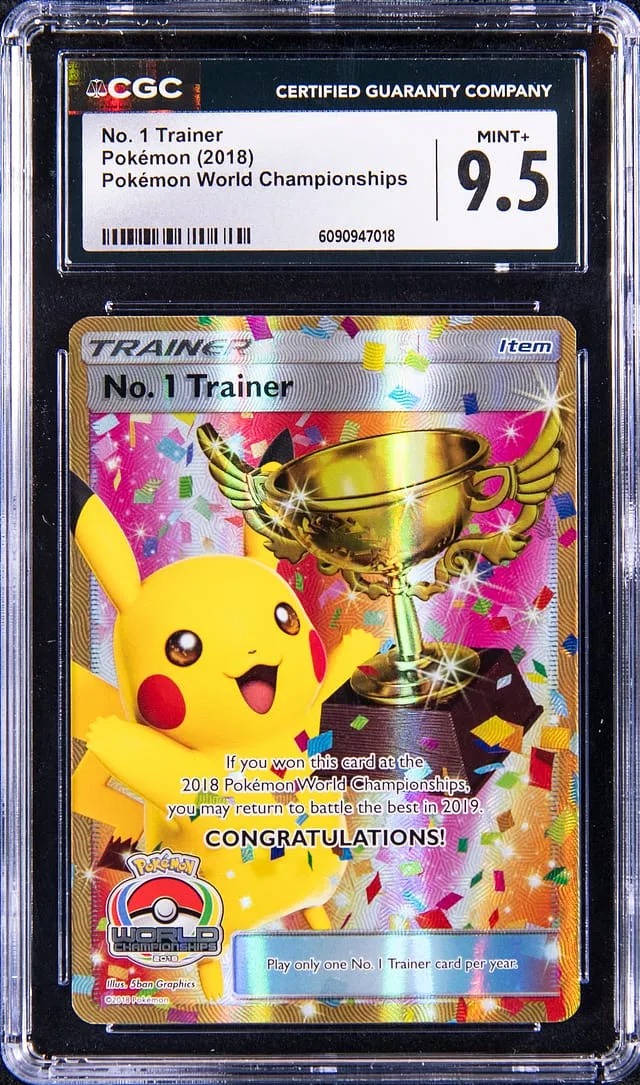
2018 No.1 Trainer Pikachu Trophy CGC 9.5 Sale
A CGC 9.5 2018 Pokémon World Championships No.1 Trainer Pikachu trophy card sold for $74,432 at Goldin. Here’s what that means for collectors.
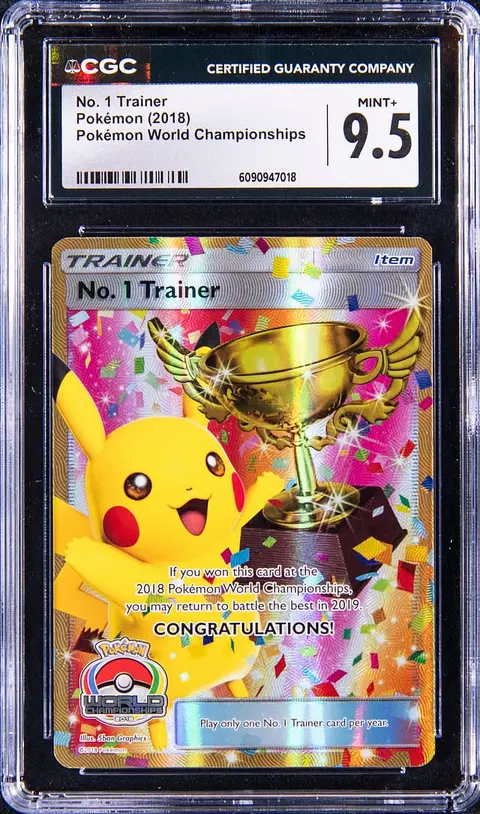
Sold Card
2018 Pokemon World Championships No.1 Trainer Pikachu Trophy Card - CGC MINT+ 9.5
Sale Price
Platform
Goldin2018 Pokémon World Championships No.1 Trainer Pikachu Trophy Card (CGC 9.5) Sells for $74,432
On March 9, 2026, a 2018 Pokémon World Championships No.1 Trainer Pikachu Trophy Card, graded CGC MINT+ 9.5, closed at $74,432 via Goldin. For a niche but highly respected corner of the Pokémon market—Worlds trophy cards—this is a meaningful data point that helps clarify how collectors are currently valuing newer-era prize cards.
What exactly is this card?
Let’s break down the basics:
- Character: Pikachu (World Championships “No.1 Trainer” artwork)
- Year: 2018
- Event/Set: Pokémon World Championships Trophy/Prize card, not a standard booster set release
- Card Type: No.1 Trainer trophy card (awarded to top finishers at Worlds)
- Era: Ultra-modern (Sun & Moon-era Worlds)
- Grading Company: CGC
- Grade: CGC MINT+ 9.5
- Autograph/Serial/Relic: Typically non-serial, no patch or autograph; the rarity comes from distribution, not print numbering
These No.1 Trainer trophy cards are not pulled from packs. They are event prizes given to top-ranking competitors at the Pokémon World Championships. That structure means the total number of copies is very low from the start, and many remain in players’ personal collections or tied to the history of specific competitors.
Why Worlds trophy cards matter to collectors
World Championships trophy cards occupy a different lane from chase cards pulled from booster boxes:
- True scarcity by design: Prize cards are issued only to winners or top finishers at Worlds events. Even if the exact print run isn’t always public, the upper bound is dictated by the tournament structure, not mass retail.
- Historical weight: Each trophy card is tied to a specific year of Worlds, giving it built-in historical context. Collectors who follow high-level competitive play see these as mementos of that year’s metagame and champions.
- Pikachu as a flagship character: Many trophy issues use Pikachu, the franchise mascot. That keeps the appeal broader than competitive-only collectors.
- Niche but serious demand: Trophy cards usually attract long-term, research-heavy collectors who care about print history, provenance, and condition more than short-term hype.
The 2018 No.1 Trainer Pikachu sits within this tradition. It is part of the ultra-modern era of Worlds, where awareness of trophy cards among collectors has grown thanks to online coverage and auction house marketing.
Grading, condition, and CGC’s role
This copy received a CGC MINT+ 9.5, which signals:
- Near-gem condition with only minor flaws under close inspection
- Strong eye appeal suitable for high-end collections
CGC has built a notable presence in the Pokémon space, especially among collectors who appreciate consistent subgrades and detailed grading standards. While PSA has historically commanded the largest price premiums for some Pokémon grails, CGC high grades are now widely accepted as serious condition benchmarks.
For a card as scarce as a Worlds trophy, the absolute number of graded copies—regardless of grading company—is typically low. Population reports (or “pop reports,” which show how many of each card/grade a grading company has seen) for individual trophy cards often show only a handful of examples in any high grade.
Market context and recent sales
Because this is a niche, low-population card, there are usually very few public “comps” (comparable recent sales) to reference, especially in the same grade and grading company.
Patterns collectors generally see with Worlds trophy cards:
- Sparse auction history: Months or even years can pass between public appearances of specific years or placements (No.1 vs No.2, etc.).
- Wide price ranges: With so few data points, prices can vary significantly from sale to sale depending on timing, buyer interest, and broader Pokémon sentiment.
- Grade sensitivity: A jump from a strong near-mint or mint grade into the 9.5/10 tier can materially affect realized prices, because the total population is already tiny.
In that context, the $74,432 realized price at Goldin places this particular 2018 No.1 Trainer Pikachu firmly in the high-end but still accessible range of modern trophy pieces, especially when compared to older, historically important trophy cards that have crossed six-figure thresholds.
This result suggests:
- Collectors are continuing to differentiate between vintage-era trophies (early 2000s) and ultra-modern trophies (2010s and newer), with the former still often commanding the highest premiums.
- There is consistent willingness to pay strong numbers for documented, high-grade, graded examples of more recent Worlds trophy issues.
Because public data on this exact grade and year is limited, it’s more precise to say that this sale reinforces the existing perception of 2018 Worlds trophies as serious high-end items, rather than setting a clearly defined new benchmark across the board.
How this sale fits into the broader Pokémon market
A few broader hobby dynamics frame this result:
Maturity of the ultra-modern segment
The 2018 World Championships fall into the ultra-modern era, a period where Pokémon collecting has become more organized and data-driven. Newer trophy issues now enter a hobby that already understands rarity tiers, grading, pop reports, and long-term collecting goals.Separation from mass-printed chase cards
While set-based chase cards (e.g., alt-art illustrations, rainbow rares) can be graded in large numbers, trophy cards start and stay rare. That scarcity cushions them somewhat from the ebbs and flows that can affect cards with thousands of graded copies.Continued interest in competitive history
As coverage of Worlds expands, more collectors see the competitive scene as part of the brand’s story, not a side note. That narrative—linking a card to a specific Worlds year and placement—adds a layer of appeal beyond artwork alone.Auction house visibility
A sale at Goldin on March 9, 2026, ensures this card’s price point is part of the public record. High-visibility auctions often become anchor points for future negotiations between buyers and sellers when private offers arise.
What this means for different types of collectors
This sale won’t affect every corner of the Pokémon market the same way, but it does offer some useful takeaways.
For newcomers and returning collectors
- Trophy cards are not an entry-level chase. Their rarity, price, and limited availability make them advanced targets.
- However, understanding them can help you better interpret the overall Pokémon hierarchy of rarity and prestige.
- If you’re just starting out, it can be helpful to think of Worlds trophies as the “historical artifacts” of the competitive scene—more like museum pieces than everyday collection goals.
For active hobbyists
- This Goldin sale is a useful data point when you evaluate other high-end event cards, prize cards, or ultra-rare promos.
- When public comps are thin, contextual anchors like this—or earlier sales of adjacent years and placements—help you think in ranges rather than single reference prices.
- If you track trophy cards, it’s worth noting the grade, grading company, date, and auction house when logging comparables.
For small sellers
- Trophy cards may never pass through your inventory, but the same principles apply to lower-tier promos and event cards:
- Document provenance when you can.
- Note whether a card has grading upside (condition, centering, surface).
- Keep records of public auction results for similar items.
- As buyers become more educated, clear documentation and accurate descriptions—year, event, distribution method—matter more.
Key details collectors will want to remember
- Card: 2018 Pokémon World Championships No.1 Trainer Pikachu Trophy Card
- Grade: CGC MINT+ 9.5
- Result: $74,432
- Auction House: Goldin
- Sale Date (UTC): March 9, 2026
For now, this sale stands as one of the more recent reference points for ultra-modern Worlds trophy cards in high CGC grade. It reinforces the status of 2010s-era Pikachu trophies as serious, historically connected collectibles without drifting into speculative territory.
As more examples surface across different auction houses and grades, the picture will become clearer. Until then, this Goldin result offers a grounded, public marker for how the market currently views the 2018 No.1 Trainer Pikachu in CGC 9.5.