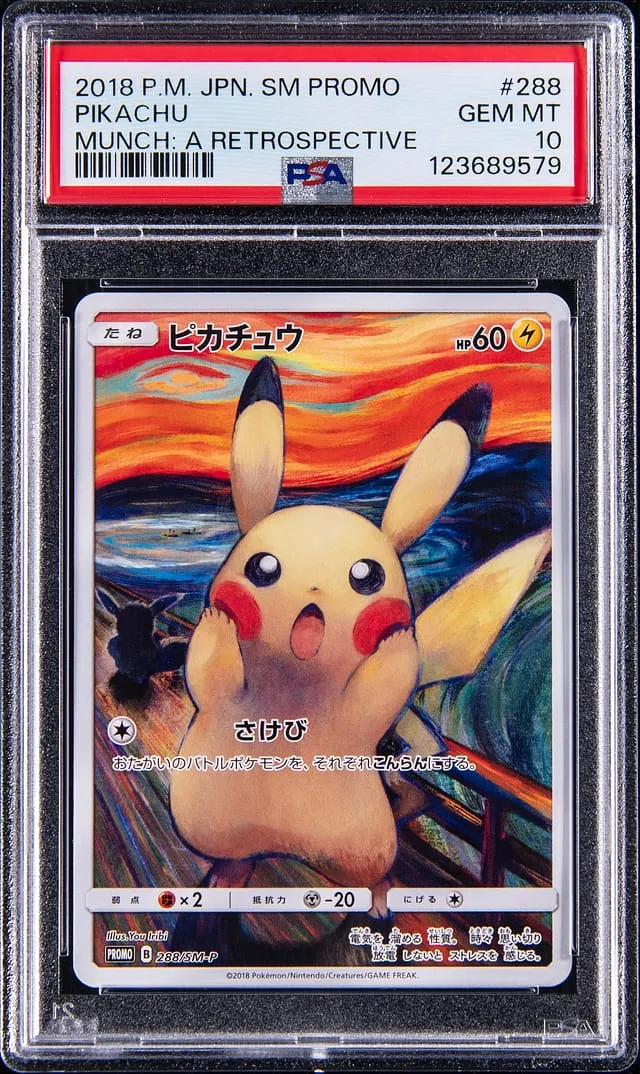
2018 Munch Pikachu PSA 10 sells for $14,640 at Goldin
A PSA 10 2018 Japanese Munch Pikachu promo sold for $14,640 at Goldin. See the sales context, collector demand, and market insights for this key promo.
Sold Card
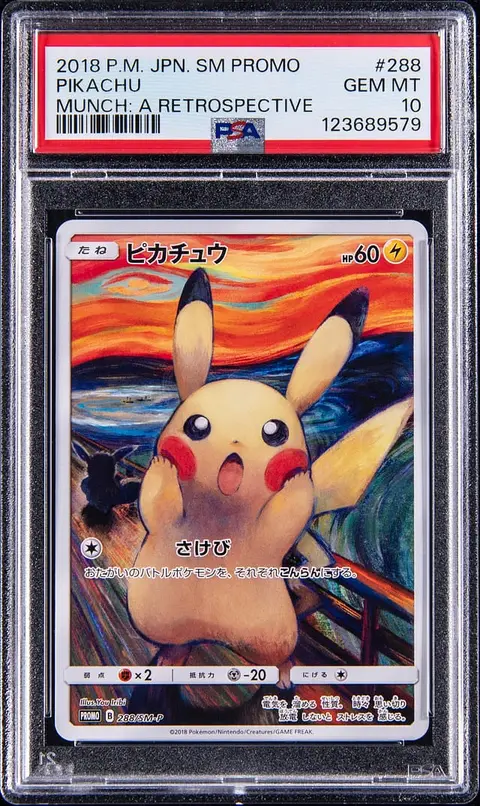
2018 Pokemon Japanese Sun & Moon Promo Munch: A Retrospective #288 Pikachu - PSA GEM MT 10
Sale Price
Platform
Goldin2018 Pokémon Munch Pikachu PSA 10 Sells for $14,640: What It Means for Collectors
On March 9, 2026, a 2018 Pokémon Japanese Sun & Moon Promo “Munch: A Retrospective” #288 Pikachu in a PSA GEM MT 10 holder sold at Goldin for $14,640. For a modern-era Pokémon promo, that’s a meaningful result—and it fits into a larger story about one of the hobby’s most recognizable art cards.
In this breakdown, we’ll look at what this card is, why collectors care about it, and how this latest sale fits into the current market picture.
The card at a glance
- Card: 2018 Pokémon Japanese Sun & Moon Promo – Munch: A Retrospective Pikachu
- Card number: 288/SM-P (often shortened to #288)
- Character: Pikachu
- Language/Region: Japanese, Pokémon Center promo (Japan)
- Issue type: Special art promo, not a standard set card
- Series/era: Sun & Moon era, considered “ultra-modern” by hobby standards
- Grading company: PSA (Professional Sports Authenticator)
- Grade: GEM MT 10 (PSA’s highest standard grade)
This Pikachu is part of the well-known “Munch: A Retrospective” promo run issued in Japan to tie in with a museum exhibition inspired by Edvard Munch’s painting The Scream. The cards in the mini-run feature iconic Pokémon illustrated in the style of that painting.
Key points about this Pikachu promo:
- It is not a rookie card (Pokémon doesn’t really have rookies in the sports sense), but it is considered a key modern Pikachu art card.
- It was distributed as a limited promotional item through museum and/or Pokémon Center tie-ins in Japan, not through booster packs.
- The art and distribution method give it a crossover appeal between traditional Pokémon collectors, art-focused hobbyists, and people who collect Pikachu specifically.
Why “Munch Pikachu” matters to collectors
Among modern Pokémon promos, the Munch series has become one of the most talked-about art-driven releases of the last decade. The Pikachu is often treated as the centerpiece for several reasons:
Pikachu focus – Pikachu is the face of the Pokémon brand, so many collectors build Pikachu-only collections. Any limited, visually distinctive Pikachu automatically has a wide audience.
Art crossover – The card directly references The Scream, one of the most recognizable artworks in the world. That gives it appeal beyond just the TCG, similar to how some collectors chase cards that reference major cultural or art moments.
Promo distribution – Being a promo means it wasn’t available in standard packs. Promos like this can be harder to source in clean condition because they were distributed loosely and handled more casually than pack-fresh cards.
Ultra-modern with a defined story – In an era where many modern releases can feel repetitive, the Munch series stands out with a clear theme and a finite, non-reprinted run. That narrative helps it hold attention with collectors.
Within the 2018–present ultra-modern window, this Pikachu sits alongside other major Pikachu promos (like certain full-art or illustration contest cards) as one of the “prime targets” for character-focused collections.
Grading and population context
A GEM MT 10 from PSA indicates a card with sharp corners, clean surfaces, strong centering, and no visible flaws at standard inspection. For modern Pokémon, it’s common to see a decent number of PSA 10s, but not all promos are equal.
While exact population figures change constantly, the overall trend for this card has been:
- A steady build-up of total graded copies as raw (ungraded) Munch Pikachus surface from collections and inventory in Japan.
- A meaningful, but not unlimited, PSA 10 population, partly because:
- Distribution wasn’t from sealed booster boxes opened and sorted in bulk.
- Surface and edge wear from loose handling can knock cards down to PSA 9 or lower.
That combination—good overall supply but real condition hurdles—helps create a tiered market where PSA 10 premium over PSA 9 is significant.
When collectors talk about “pop reports”, they’re referring to the grading company’s population report: the number of copies graded at each grade level. For a card like this, pop reports help explain why PSA 10s command a noticeably higher price than lower grades.
Market context: how does $14,640 fit in?
This Goldin result came in at $14,640, which we get by taking the reported 1,464,000 cents and dividing by 100.
To understand this number, collectors usually look at “comps”—recent comparable sales of the same card, ideally in the same grade and condition. While exact numbers evolve quickly, the general trend for the 2018 Munch Pikachu in PSA 10 over the past few years has looked something like:
- Early adoption phase with relatively lower prices when the promo was still new and not fully appreciated outside Japan.
- A significant run-up once the Munch series gained global attention and English-language collectors started pursuing the Pikachu and its companion promos.
- A more mature phase where:
- High-grade copies settled into a recognizable price range.
- Occasional outlier sales at major auction houses stood above standard marketplace results due to eye appeal, timing, or auction-specific demand.
While exact recent PSA 10 comp numbers can vary by platform and auction, the Goldin sale sits in the upper tier of the historical range for this card in GEM MT 10. It does not appear wildly disconnected from prior high-end results, but it does reinforce that:
- Demand for top-grade Munch Pikachu remains strong among serious Pikachu and promo collectors.
- Major auction houses can still draw focused bidding for iconic modern promos with clear stories and cross-collector appeal.
Lower grades of this card (PSA 9 and below) typically trade at substantially lower levels than PSA 10, showing a classic modern-card pattern: heavy premium for the top grade, with a wider base of more affordable copies in lower conditions.
Historical significance within modern Pokémon
Compared to true vintage staples like 1990s Japanese promos or 1st Edition Base Set holos, the 2018 Munch Pikachu is still relatively new. However, within the modern and ultra-modern promo era, it has already carved out a defined place:
- It’s frequently referenced in discussions of “the best modern Pikachu cards.”
- It appears consistently in high-end Pokémon auctions alongside more traditional grails.
- It is part of a themed mini-set (the broader Munch promo group), which encourages collectors to chase the full run.
Because this card doesn’t tie to a competitive milestone or in-game achievement, its significance is almost entirely art- and culture-driven. That’s a useful reminder that in Pokémon, not every key card is defined by tournament play—some are defined by art, story, or limited distribution.
Reading this sale as a collector or small seller
For collectors or small sellers, here are a few grounded observations from this $14,640 sale at Goldin on March 9, 2026:
Art promos can be long-term pillars of modern collections. The Munch Pikachu shows that carefully designed, story-rich promos can sustain real demand several years after release.
Top grades continue to separate from the field. The gap between PSA 10 and lower grades here is large. For anyone submitting raw copies, condition inspection and understanding grading standards matter a lot.
Auction house venue can influence realized prices. Strong results at a major house like Goldin don’t automatically reset prices everywhere, but they do help define expectations for high-end copies.
Data context beats headlines. This sale is notable, but it fits into a broader pattern of solid performance for the card rather than an out-of-nowhere spike. Looking at several months of comps gives a more accurate picture than any single auction.
Where this leaves the Munch Pikachu
The 2018 Japanese Sun & Moon Promo Munch Pikachu has moved from “interesting art promo” to “established modern key” in a relatively short span. This $14,640 PSA 10 sale through Goldin on March 9, 2026, adds another data point to that story:
- It reinforces the card’s status among serious Pikachu and promo collectors.
- It shows that, even in a crowded modern landscape, a clear narrative and distinctive art can support premium pricing.
For collectors considering this card—whether in gem mint or more budget-friendly grades—the main takeaways are:
- Understand the promo’s history and distribution.
- Pay close attention to condition and grading trends.
- Use recent, grade-matched comps as reference points rather than relying on a single standout sale.
As with all trading cards, outcomes can and do change over time, but this Goldin result underlines one thing clearly: the Munch Pikachu is no longer just a niche art curiosity. It’s an established part of the modern Pokémon conversation.