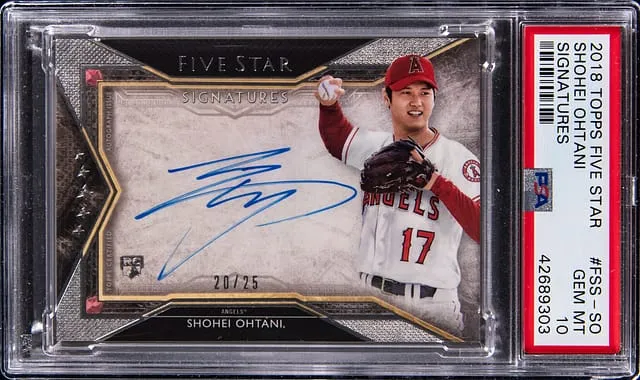
2018 Five Star Shohei Ohtani Auto /25 PSA 10 Sale
Goldin sold a 2018 Topps Five Star Shohei Ohtani rookie auto /25 PSA 10 (pop 3) for $29,282 on April 12, 2026. figoca breaks down the sale and context.
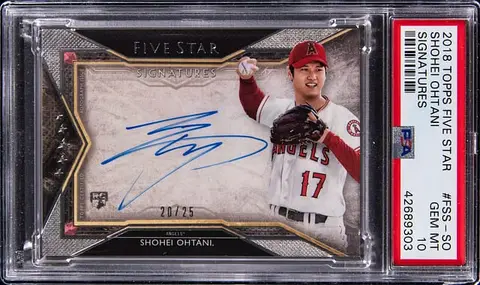
Sold Card
2018 Topps Five Star Signatures #FSS-SO Shohei Ohtani Signed Rookie Card (#20/25) - PSA GEM MT 10 - Pop 3
Sale Price
Platform
Goldin2018 Topps Five Star Shohei Ohtani Auto /25 PSA 10 Sells for $29,282
On April 12, 2026, Goldin sold a key early Shohei Ohtani autograph: a 2018 Topps Five Star Signatures #FSS-SO Shohei Ohtani Signed Rookie Card, serial-numbered 20/25, graded PSA GEM MT 10. The final price was $29,282.
For collectors tracking Ohtani’s high-end rookies and the modern baseball market, this sale offers a useful datapoint on where premium, low-serial, on-card autographs are settling.
Card breakdown: what exactly sold?
Let’s start by identifying the card clearly:
- Year: 2018
- Product: Topps Five Star Baseball
- Subset: Five Star Signatures
- Card number: #FSS-SO
- Player: Shohei Ohtani
- Team: Los Angeles Angels (rookie season)
- Type: Signed rookie card (on-card autograph)
- Serial numbering: 20/25 (only 25 copies produced)
- Grading company: PSA (Professional Sports Authenticator)
- Grade: GEM MT 10 (their highest standard grade)
- Population: PSA pop 3 in GEM MT 10
Because it’s from 2018, this is an ultra-modern card from Ohtani’s official rookie year. Five Star is a higher-end, all-autograph product: every card in the product is signed, printed on thick, premium card stock. The Five Star Signatures cards are generally considered a key autographed insert for top players in that checklist.
This particular copy is:
- An on-card autograph (the player signed directly on the card surface, not on a sticker).
- Limited to just 25 copies.
- One of only three PSA 10s ever graded, according to PSA’s population report (often shortened to “pop report”).
In other words, even before grading, this is a scarce, premium rookie-year auto. In a PSA 10 holder, it sits at the top of the grading ladder for this specific issue.
Price and basic context
- Sale price: $29,282 (hammer plus buyer’s premium, as reported)
- Auction house: Goldin
- Sale date (UTC): April 12, 2026
When we talk about “comps” (short for comparables), we mean other recent sales of the same or very similar cards, usually pulled from auction houses and major marketplaces. They help frame a realistic range of what collectors have actually been willing to pay.
Market context: how this sale fits in
Ultra-premium Ohtani rookies have been some of the most actively watched cards in the modern baseball hobby. While individual prices can swing with performance and news cycles, several themes show up consistently:
Rookie-year on-card autos matter most
- Ohtani has many rookie cards across 2018 products (Topps, Bowman, Panini), but his on-card (hand-signed directly on the card) rookie autographs from licensed MLB sets are a core focus for serious collectors.
- Five Star is in that mix of respected, mid-to-high-end autograph products, alongside things like Topps Triple Threads, Museum Collection, and others.
Low serial numbering adds a scarcity premium
- A print run of 25 is considered a low serial number in modern baseball. That kind of scarcity can materially separate a card from more commonly available rookie autos numbered /99, /150, or higher.
PSA 10 population is extremely thin
- With only three PSA GEM MT 10 copies reported, this is not a card a collector can simply decide to go buy in top grade on any given day.
- On thicker, premium card stock like Five Star, gem-mint grades are harder to achieve, which often supports a stronger price gap between PSA 9 and PSA 10.
What recent comps generally tell us
Direct, identical comps for this exact card—2018 Topps Five Star Signatures #FSS-SO /25, PSA 10—tend to be sparse, simply because so few copies exist and even fewer come to public auction.
When identical comps are limited, collectors usually look at:
- The same card in lower grades (PSA 9, BGS 9/9.5, raw).
- Neighboring parallels or similar rookie autos from the same year (for example, Five Star Ohtani autos with different numbering, or 2018 on-card autos from adjacent premium products).
- A broader basket of high-end Ohtani rookies to see where this card might reasonably sit.
Across those areas, recent public sales have generally shown:
- Strong premiums for low-serial, on-card Ohtani rookie autos in PSA 10 compared to PSA 9 or raw.
- A wide but consistently high range for his top-tier rookies, influenced by performance, injuries, and media cycles.
Against that backdrop, $29,282 for a /25 PSA 10 Five Star Signatures fits comfortably into the tier of serious, high-end Ohtani rookie pieces. It’s not at the record-setting level of his most famous cards (like logo patches, 1/1s, or flagship ultra-chase rookies), but it clearly sits above the more accessible, higher-print-run autos.
Why this card matters to collectors
Several factors make this a noteworthy card in Ohtani’s market:
Rookie-year autograph from a respected brand
- 2018 is Ohtani’s MLB rookie season, and collectors often differentiate sharply between rookie-year autos and later issues.
- Five Star is known for premium, autograph-only checklists, which helps its rookie autos hold a place in many long-term PC (personal collection) builds.
On-card signature
- Many collectors strongly prefer on-card autos over sticker autos because they feel more personal and visually clean.
- For international star players like Ohtani—who already carries a large global fanbase—high-quality on-card signatures are especially chased.
Low print run: /25
- With just 25 copies, this card is scarce by design.
- Once a few copies are locked away in long-term collections, the actual supply on the open market can drop to near-zero for long stretches.
Top-grade scarcity: PSA 10, pop 3
- Population 3 in GEM MT 10 signals that very few examples reached PSA’s highest grade.
- On thicker cards, issues like edge chipping and corner wear are common, which makes pristine copies notably harder to find.
Ohtani’s ongoing significance
- As a two-way superstar, Ohtani has re-shaped expectations of what a modern player can do.
- Awards, milestones, and team changes have historically moved his market, sometimes quickly.
- For many collectors, owning a true rookie-year, on-card auto in a premium PSA 10 slab is one of the most direct ways to participate in his long-term hobby story.
What this sale might signal (without speculating)
Rather than predicting future prices, it’s more useful to treat this sale as a datapoint:
- It reinforces that serious buyers are still stepping up for low-serial, on-card rookie autos of elite modern players.
- It confirms that scarcity plus top-grade condition still command a meaningful premium over more plentiful rookie issues.
- It suggests that Five Star remains a respected lane for collectors who want high-end autographs without necessarily chasing only the absolute top 1/1 or logo patch tiers.
If you’re collecting or selling cards like this
For collectors considering similar Ohtani rookies:
- Look at multiple recent comps, not just one: Check completed sales for the same card in different grades and for comparable autos from 2018.
- Pay attention to population reports: Lower pop at high grades can explain why pricing sits where it does compared to raw or mid-grade copies.
- Factor in set reputation: Five Star, along with a handful of other 2018 products, forms the backbone of Ohtani’s premium rookie auto portfolio.
For small sellers and flippers:
- Auction vs. fixed price: Premium, low-pop cards like this often surface at major auction houses (like Goldin) because they reach a global audience of advanced collectors.
- Timing matters: Because performance and news can move ultra-modern markets, looking at sale dates alongside prices helps you understand why comps differ.
Summary
Goldin’s April 12, 2026 sale of the 2018 Topps Five Star Signatures #FSS-SO Shohei Ohtani Signed Rookie Card (#20/25) in PSA GEM MT 10, pop 3, at $29,282, is a clear marker of how the market currently values scarce, on-card, rookie-year autographs for one of the game’s defining modern stars.
It’s not the highest-tier Ohtani card in existence, but within its lane—premium, low-serial, autograph-only product, top grade, tiny population—it stands as a significant piece, and a useful reference point for anyone tracking the intersection of modern star power and high-end baseball cardboard.