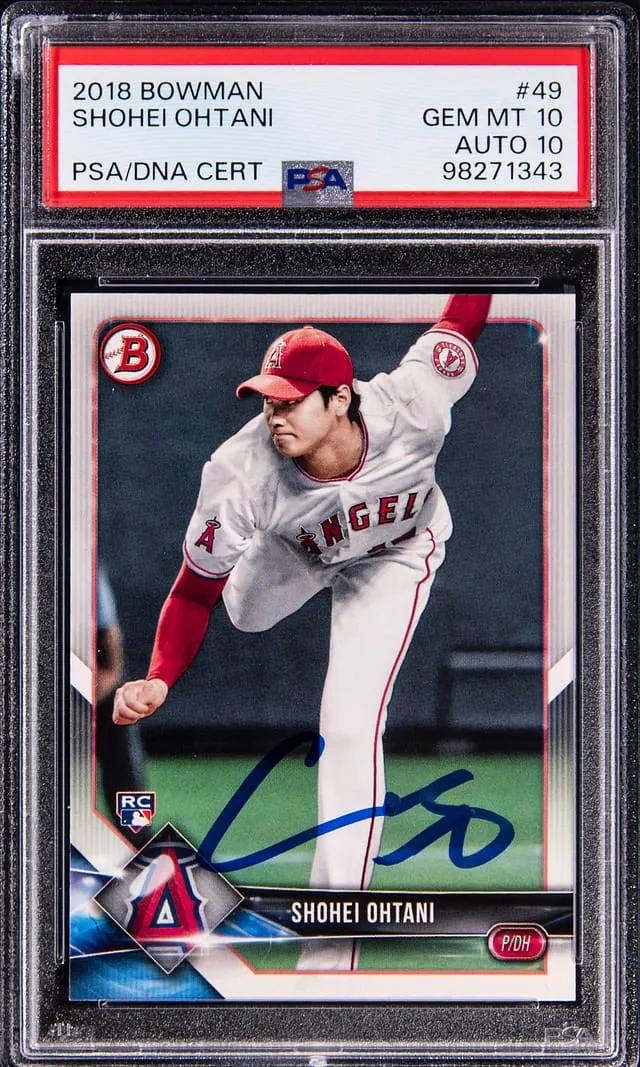
2018 Bowman Shohei Ohtani Auto PSA 10/10 Sells High
Goldin sold a 2018 Bowman #49 Shohei Ohtani signed rookie, PSA 10 with PSA/DNA 10 auto (Pop 2), for $34,526. Here’s what it means for collectors.
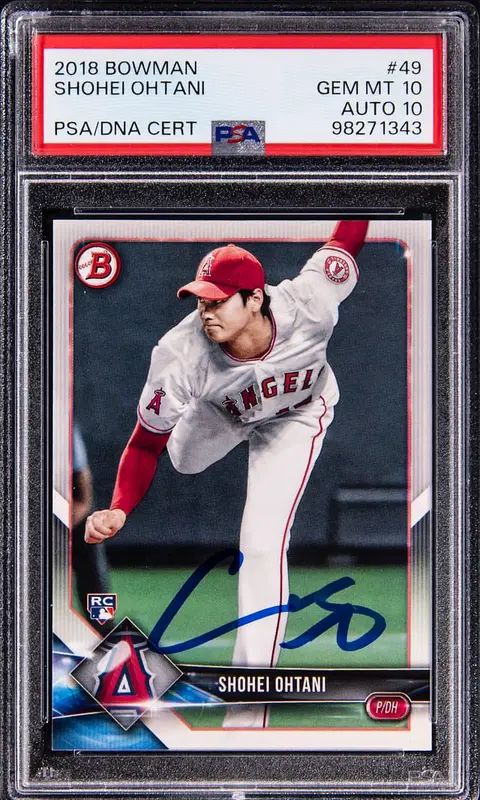
Sold Card
2018 Bowman #49 Shohei Ohtani Signed Rookie Card - PSA GEM MT 10, PSA/DNA GEM MT 10 - Pop 2
Sale Price
Platform
Goldin2018 Bowman Shohei Ohtani Auto Rookie in PSA 10/10 Sells for $34,526
On March 15, 2026, Goldin closed a notable modern baseball auction: a 2018 Bowman #49 Shohei Ohtani signed rookie card, graded PSA GEM MT 10 with a PSA/DNA GEM MT 10 autograph, sold for $34,526.
For a card that isn’t a numbered parallel or a chrome rookie, this is a meaningful data point for both Ohtani collectors and anyone tracking the high end of modern baseball.
The card at a glance
- Player: Shohei Ohtani
- Team: Los Angeles Angels
- Year / Set: 2018 Bowman Baseball
- Card number: #49
- Type: Rookie card featuring a certified on‑card autograph
- Grading company: PSA
- Card grade: PSA GEM MT 10 (Gem Mint)
- Autograph grade: PSA/DNA GEM MT 10 (Gem Mint auto)
- Population: Pop 2 in this dual 10 configuration (card 10 + auto 10)
- Sale: Goldin auction, March 15, 2026
- Price: $34,526
This is not a serial‑numbered refractor or a Superfractor; it’s the base Bowman Ohtani with an on‑card signature, but locked in at the hobby’s top grade combination: 10/10.
Why 2018 Bowman matters for Ohtani
In modern baseball, “Bowman” is often treated as the prospect pipeline, while “Bowman Chrome 1st” is the true prospect flagship. By 2018, Shohei Ohtani already had enormous attention as a two‑way star arriving from NPB.
Key reasons collectors care about this specific issue:
Rookie year ink:
This is a 2018 rookie‑year autograph. While Ohtani’s most chased prospect autos are his earlier Bowman Chrome 1st cards, 2018 Bowman gives collectors a mainstream MLB‑licensed rookie card with an on‑card signature.On‑card autograph:
The autograph is signed directly on the card instead of on a sticker. Collectors generally prefer on‑card autos for aesthetics and long‑term desirability.Dual GEM MT 10 / 10:
Achieving a PSA 10 on the card and a PSA/DNA 10 on the auto simultaneously is tough. Surface, corners, centering, and autograph quality all need to be near perfect. At pop 2, this is one of the finest known examples of this exact card/auto pairing in PSA’s database.Ultra‑modern anchor:
2018 sits firmly in the “ultra modern” era. Print runs are larger than vintage, but the chase has shifted toward condition rarity (high grades) and configuration rarity (perfect grades plus auto grades) rather than raw scarcity alone.
Population and scarcity
When collectors talk about a “pop report,” they mean the grading company’s census of how many copies of a card exist at each grade. For this card:
- PSA reports only 2 copies at PSA 10 with a PSA/DNA 10 auto (Pop 2).
- Lower grades (PSA 9 with 10 auto, PSA 8, etc.) are more common, but still not overwhelming compared to base, unsigned rookies.
In ultra‑modern cards, scarcity often comes from:
- Perfect grade combinations (10 card / 10 auto).
- Centering and surface issues that limit how many raw copies can realistically reach PSA 10.
- The fact that not every raw card is submitted for grading, especially years later.
So while the underlying 2018 Bowman print run is healthy, the number of dual‑gem copies is genuinely tight.
Market context: how does $34,526 fit in?
Because this is a specific configuration (2018 Bowman #49, signed, PSA 10 with PSA/DNA 10, pop 2), there are relatively few direct “comps.” In hobby language, “comps” are recent comparable sales that collectors use as a reference for price.
Looking across the broader Ohtani market, some consistent patterns emerge:
- Bowman Chrome 1st autos (earlier prospect issues) in BGS/PSA 9.5/10 or 10/10 tend to sit at the very top of Ohtani’s card market. Those cards can reach well into six figures depending on parallel and grade.
- Flagship rookies from 2018 (Topps Chrome, Topps Series 2, Bowman Chrome Rookie autos) typically occupy the next tier down, with premium prices attached to low‑serial parallels and perfect grades.
- Non‑numbered, rookie‑year on‑card autos like this 2018 Bowman #49 usually sit below his most coveted 1st Bowman issues, but still command strong attention when paired with elite grades.
Against that backdrop, a $34,526 result:
- Positions this card as a clear high‑end but not top‑tier Ohtani piece. It’s meaningful, but still below his most famous prospect autos and rare refractors.
- Aligns with the idea that collectors now assign a real premium to dual 10 grades. A raw or lower‑grade copy of this card would likely sell for a noticeably lower amount, depending on condition and eye appeal.
Without a long history of sales for this exact pop‑2 configuration, it’s hard to call this result definitively high or low; instead, it functions as an anchor point for future auctions of the same card and grade.
Ohtani’s current hobby backdrop
Even without exact real‑time stats, a few stable truths help explain the sustained interest in his cards:
- Two‑way uniqueness: Ohtani’s combination of elite pitching and elite hitting remains historically unusual. Collectors often frame him alongside Babe Ruth in terms of role, which keeps his market in focus even when performance fluctuates.
- Awards and milestones: MVP seasons, home run titles, and postseason narratives typically provide waves of renewed attention. Each key award season tends to leave a “step up” footprint in his high‑end sales.
- Team and media exposure: Moving from the Angels to a larger‑market team (and the ongoing global attention from Japan and the U.S.) keeps his cards visible well beyond the typical star.
This sale sits inside that wider story: Ohtani is one of the handful of ultra‑modern players whose rookie and prospect cards regularly clear five figures in public auctions.
How this sale might matter to collectors
This Goldin result is useful in a few ways, whether you’re a new collector or already deep into Ohtani PCs (personal collections):
1. A reference point for non‑chromes
The highest numbers in the Ohtani market usually come from Bowman Chrome 1st or rare refractors. Seeing a non‑numbered Bowman paper‑style rookie auto reach $34,526 in dual GEM form reinforces that:
- Not only the Chrome 1st cards have meaningful upside in the Ohtani ecosystem.
- Condition and autograph quality can be just as important as the specific parallel when you move into five‑figure territory.
2. Grade separation is real
If you track this card across different grades, you’ll usually notice large gaps between:
- Ungraded or raw signed copies.
- PSA 9 card / 10 auto.
- PSA 10 card / 9 auto.
- The top of the pyramid: PSA 10 card / 10 auto.
This sale underlines how sharp those jumps can be for modern superstars. For collectors, it’s a reminder to:
- Look closely at centering, corners, and surface before submitting a card for grading.
- Consider whether the autograph quality (streaking, fading, smudges) will support a top auto grade.
3. Pop 2 doesn’t automatically mean unlimited upside
A population of 2 in a top grade sounds extremely scarce, and it is in grading terms. But:
- The base card itself was produced in significant quantities.
- More copies could, in theory, be graded into 10/10 territory over time, though that tends to slow as the product ages and the best raw examples are already slabbed.
For newer collectors, this is a good example of the difference between true scarcity (like a card that is serial‑numbered /10 from the factory) and conditional scarcity (only a few examples reach a perfect grade).
Takeaways for different types of collectors
If you’re an Ohtani collector:
This sale confirms that high‑end demand runs deeper than just Chrome 1st and low‑serial refractors. A well‑centered, clean 2018 Bowman rookie auto in a strong slab can be a meaningful long‑term anchor in an Ohtani PC.
If you’re a general modern baseball collector:
Use this sale as a benchmark for how ultra‑modern rookie autos of MVP‑caliber players can behave over time. Notice how:
- The combination of rookie status, on‑card signature, and elite grading drives the result.
- The card doesn’t need to be serial‑numbered to reach the five‑figure range when the player is at the very top of the sport.
If you’re a small seller or part‑time flipper:
This result highlights the value of grading discipline. The gap between “nice raw auto” and “pop 2 dual 10” is massive. Being selective about what you submit and to whom (PSA vs. other graders) can materially change outcomes.
Final thoughts
The 2018 Bowman #49 Shohei Ohtani signed rookie card that sold at Goldin on March 15, 2026, is a clean case study in modern card dynamics:
- A globally followed superstar.
- A rookie‑year, on‑card autograph.
- The highest available grade pairing, with a population of just 2.
- A realized price of $34,526 that slots comfortably into the upper tier of Ohtani’s rookie‑year market while still below his most iconic prospect issues.
For collectors tracking Ohtani or the broader ultra‑modern segment, this sale is less about a single headline number and more about what it says regarding where condition, autograph quality, and player reputation intersect in 2026.
figoca will continue to log and analyze these types of results so you can compare across sets, grades, and eras without guesswork—and build a collection that fits your own goals and comfort level with risk.