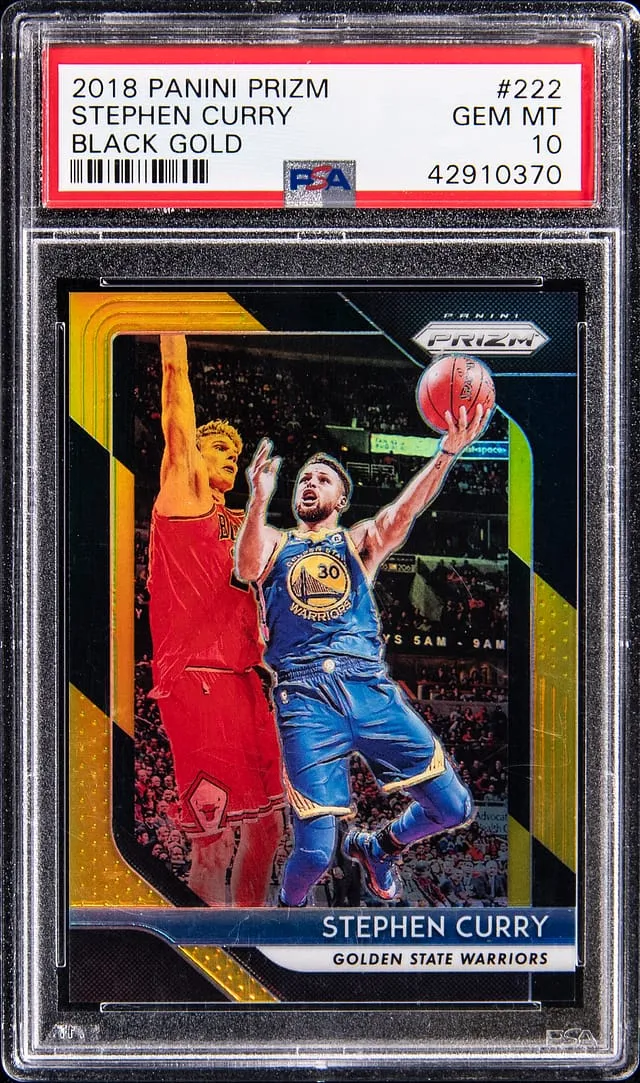
2018-19 Prizm Black Gold Steph Curry PSA 10 Sells
Deep dive into the $30,622 sale of the 2018-19 Prizm Black Gold /5 Stephen Curry PSA 10 Pop 1 at Goldin on May 10, 2026, and what it means for collectors.
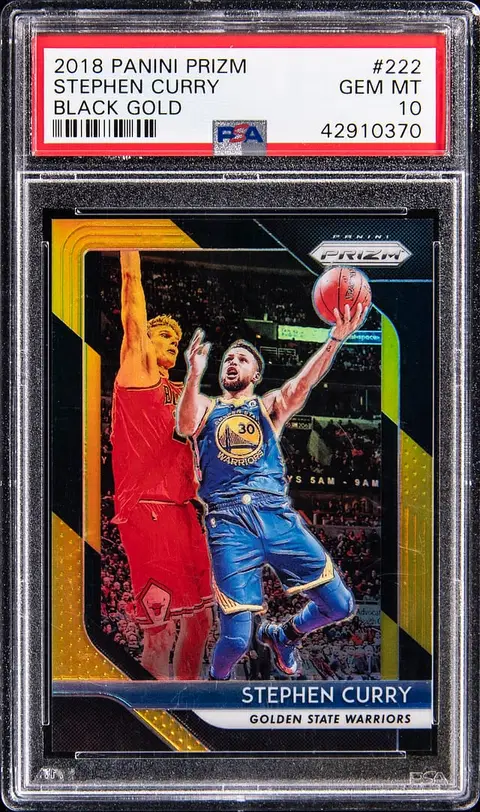
Sold Card
2018-19 Panini Prizm Black Gold Prizm #222 Stephen Curry (#1/5) - PSA GEM MT 10 - Pop 1
Sale Price
Platform
Goldin2018-19 Prizm Black Gold Stephen Curry /5 Sells for $30,622
On May 10, 2026, Goldin sold a major modern Stephen Curry card that quietly says a lot about how collectors view ultra-rare Prizm parallels and true gem grades.
The card at a glance
- Player: Stephen Curry (Golden State Warriors)
- Year / Product: 2018-19 Panini Prizm Basketball
- Card: #222 Stephen Curry
- Parallel: Black Gold Prizm, serial numbered 1/5
- Grading: PSA GEM MT 10 (PSA’s highest standard numeric grade)
- Population: PSA Pop 1 (only one copy graded PSA 10 at the time of sale)
- Result: Sold for $30,622 at Goldin on May 10, 2026 (UTC)
This is not a rookie card (Curry’s rookie year is 2009-10), but it is a flagship chromium parallel from Panini’s core NBA brand, Prizm. Within Prizm, Black Gold is one of the most coveted low-numbered parallels, traditionally numbered to just 5 copies.
Why this specific Curry matters
1. Ultra-rare Prizm color of an all-time great
Prizm has become the modern “flagship” chromium set for basketball. When collectors say “flagship,” they usually mean the main, broadly collected set for a sport and era.
Within 2018-19 Prizm, the Black Gold Prizm /5 is a premium color match-style parallel: bold black with gold accents that pairs nicely with Golden State’s colors. Being numbered to 5 already makes it a scarce card, but this copy is also stamped 1/5, the first serial number in the run, which some collectors quietly prefer.
Steph Curry is firmly in “inner circle” territory for many hobbyists: multiple championships, revolutionized the three-point shot, and still active. As the years pass, low-serial, visually striking Prizm parallels like this have increasingly become long-term “trophy cards” for dedicated Curry collectors.
2. PSA 10 and Pop 1 scarcity
PSA graded this card GEM MT 10, which is their highest standard grade, indicating sharp corners, clean edges, strong centering, and essentially pack-fresh appearance.
This copy is a Pop 1 at PSA, meaning:
- Only one example has ever received a PSA 10 grade
- Any other graded copies (if they exist) are in lower grades or at other grading companies
For ultra-rare parallels (numbered to 5), grading population (“pop report”) becomes more than a trivia number—it defines the entire graded landscape. If five cards exist and only one has reached PSA 10, that example becomes the default “top of the pyramid” for registry-focused collectors and high-end player PCs (personal collections).
Market context: where does $30,622 fit?
This Goldin result of $30,622 should be viewed in the context of three overlapping markets:
- High-end Stephen Curry cards
- Premium Prizm color for star veterans
- Ultra-modern, low-serial parallels in gem grade
Comparing to related Curry cards
Direct, identical comps for a 2018-19 Prizm Black Gold #222 Curry PSA 10 are naturally limited—there are only five copies in existence, and this is the only known PSA 10. However, we can look at nearby markets for context:
- Other Curry Black Golds /5 from different years tend to surface rarely and usually in mixed grades or raw (ungraded). When they do appear, prices have historically depended heavily on design, centering, and timing relative to playoff runs.
- Higher-tier parallels like Prizm Black 1/1 or Gold /10 of star players have often led major auctions, setting the tone for color hierarchy. Black Gold tends to slot narrowly behind true Black and sometimes on par with Gold, depending on aesthetics and serial numbering.
Given those patterns, $30,622 for a non-rookie, non-auto, but ultra-rare Prizm parallel of Curry in a Pop 1 PSA 10 sits in a range that:
- Recognizes his status as an all-time great
- Prices in the scarcity of both the /5 print run and the lone PSA 10
- Remains below the tier of true rookie grails, logo-man patches, or 1/1s, which can reach significantly higher levels
Because this is a Pop 1 and a card that doesn’t trade often, there is no deep sales history to say this is definitively high or low—for now, it functions more as a reference point than an established market average.
What this sale suggests about the market
1. Non-rookie, high-end parallels still command serious attention
Collectors sometimes focus almost exclusively on rookies, but this sale is a reminder that:
- Prime-era star cards with premium parallels (especially /10 and below) can act as centerpieces in a collection.
- Not every major result has to be a rookie; for some collectors, the combination of design and rarity in a peak-performance year matters more than the RC label.
2. Condition still matters even when a card is already rare
With only 5 copies printed, every 2018-19 Curry Black Gold /5 is special. But the one that earns a PSA 10 and stands alone as a Pop 1 adds a second dimension of scarcity:
- Print scarcity: Only 5 exist
- Condition scarcity: Only 1 is PSA 10
This is a pattern seen across modern high-end cards: collectors are willing to pay a meaningful premium for the top-graded example, even when every copy is already numerically rare.
3. Prizm color remains a key language of modern value
The hierarchy of Prizm parallels—Silver, numbered color like Blue and Red, then Gold /10, Black Gold /5, and Black 1/1—still shapes how many collectors think about modern basketball cards.
This sale reinforces that:
- Numbered color is still one of the clearest, most widely understood ways to signal long-term importance for modern cards.
- Parallel scarcity plus a proven superstar remains a formula that the market understands and responds to.
Player and hobby backdrop
As of the May 10, 2026 sale date:
- Stephen Curry has long been recognized as one of the greatest shooters and guards in NBA history.
- His championships and impact on pace-and-space offenses have been absorbed into long-term hobby sentiment, rather than short-lived hype.
In other words, this sale is less about a sudden news spike and more about how collectors are gradually pricing in Curry’s sustained legacy.
Takeaways for collectors and small sellers
For newer and returning collectors, this card offers a few clear lessons:
Know your parallels. Within any set, especially Prizm, learn the parallel ladder (Silver, numbered colors, Gold, Black Gold, Black). It helps you understand why similar-looking cards can be priced drastically differently.
Population matters more when print runs are low. For mass-produced cards, a Pop 1 can just mean “rarely graded.” For a card serial numbered to 5, a Pop 1 PSA 10 is a tight bottleneck for anyone who wants the best-graded copy.
Not all key cards are rookies or autos. Flagship, low-serial parallels of established stars can become important hobby pieces in their own right, especially when they sit at the intersection of a beloved player, a popular set, and very small print runs.
Use single results as data points, not guarantees. This $30,622 sale at Goldin on May 10, 2026 is a helpful benchmark, but not a promise that future sales will match or exceed it. A thin market with only a few copies means each auction can land differently depending on timing and bidders.
Final thoughts
The 2018-19 Panini Prizm Black Gold Prizm #222 Stephen Curry (#1/5) in PSA GEM MT 10 (Pop 1) is a textbook example of how modern basketball “grail” cards are defined:
- A cornerstone set (Prizm)
- A legendary, still-active player
- A very low serial number
- The top available grade with documented population scarcity
For collectors following high-end Curry cards, this Goldin sale at $30,622 on May 10, 2026 will stand as an important reference point the next time a Black Gold, Gold /10, or even a 1/1 Curry from this era appears at auction.
If you track rare parallels and population reports, sales like this are worth bookmarking. They help anchor expectations, even when the card itself may not appear again for years.