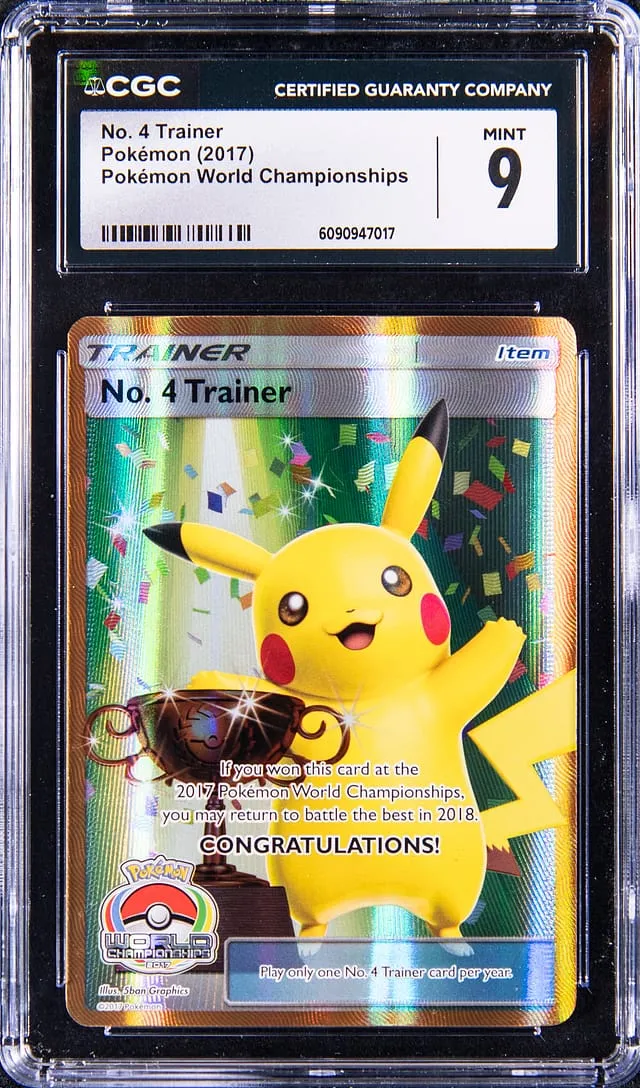
2017 Trophy Pikachu No. 4 Trainer CGC 9 Sells for $18K
Figoca breaks down the $18,300 Goldin sale of the 2017 Pokémon World Championships No. 4 Trainer Trophy Pikachu CGC 9 and what it means for collectors.
Sold Card
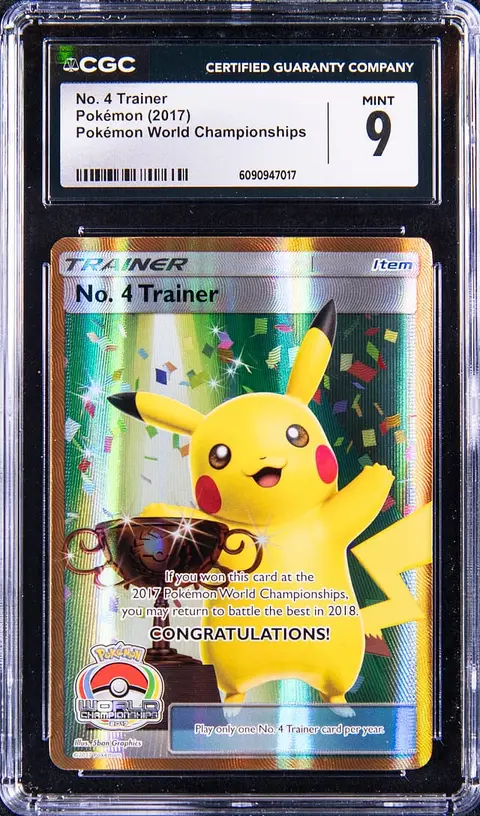
2017 Pokemon World Championships No. 4 Trainer Trophy Pikachu - CGC MINT 9
Sale Price
Platform
Goldin2017 Pokémon World Championships No. 4 Trainer Trophy Pikachu CGC 9 Sells for $18,300 at Goldin
High-end Pokémon doesn’t just live in booster boxes and chase Charizards. Sometimes it shows up in the form of a card most collectors will only ever see in photos: a World Championships Trophy card.
On April 6, 2026 (UTC), Goldin sold a 2017 Pokémon World Championships No. 4 Trainer Trophy Pikachu graded CGC MINT 9 for $18,300. For collectors who like understanding the “why” behind big results, this sale offers a clear look at how rarity, event history, and grade scarcity come together in the modern Pokémon market.
Card overview: what exactly sold?
- Card: 2017 Pokémon World Championships No. 4 Trainer Trophy Pikachu
- Character: Pikachu (Trophy "Trainer" Pikachu artwork)
- Event: 2017 Pokémon TCG World Championships
- Placement level: No. 4 Trainer (awarded to a top finisher; not a pack-pulled card)
- Era: Ultra-modern (mid‑2010s)
- Grading company: CGC Trading Cards
- Grade: CGC MINT 9
This is a Worlds Trophy card – a prize card awarded to high‑placing competitors at the official Pokémon World Championships. These are not retail products, not part of a normal numbered set, and not obtainable from booster packs. They were distributed in extremely small quantities directly to competitors.
Because of that, this card functions more like a scarce award or medal than a typical collectible card.
Why this card matters to collectors
1. True scarcity from the source
Worlds Trophy cards, including the 2017 No. 4 Trainer Pikachu, are widely understood in the Pokémon community to have very low original print runs. While exact print numbers are not publicly and precisely documented, the general structure of Worlds prizing means only a handful of copies go to top finishers in each age division in any given year.
For collectors, that matters more than a stamped “1/25” on a serial-numbered modern chase card. This is functional scarcity: very few were made, and even fewer are likely to enter the open market because many stay with the original recipients.
2. World Championships lineage
The Pokémon World Championships occupy a special place in the hobby. They are:
- The highest‑level official tournament for the game
- An annual snapshot of competitive history
- A recurring source of unique, event‑only promos
Worlds Trophy Pikachu cards tie directly to that history. Each year’s art and language version tells part of the ongoing story of competitive Pokémon. For many high‑end collectors, these cards sit alongside early Japanese promos, trophy Kangaskhan, and Illustrator‑era cards as some of the hobby’s most important non‑set issues.
3. Trophy Pikachu as a prestige lane
Within the world of rare Pokémon, “Trophy Pikachu” is almost its own sub‑category. Collectors tend to group together:
- The 1990s Japanese trophy cards (like the early No. 1/2/3 Trainer issues)
- Later Worlds trophy cards like this 2017 piece
- Other invitation/prize‑only Pikachu promos
That continuity makes cards like the 2017 No. 4 Trainer particularly attractive to advanced collectors who build long‑term, event‑focused or Pikachu‑focused collections.
4. Ultra‑modern, but not mass‑produced
Even though 2017 sits firmly in the ultra‑modern era (mid‑2010s onward, when print runs for regular sets expanded), this card avoids the usual ultra‑modern risk of oversupply. Instead of being printed by the hundreds of thousands like a standard English set card, it starts out rare.
The result: the card behaves in the market more like an older, niche, low‑supply Japanese promo than like a typical 2017 booster card.
Market context: where does $18,300 fit?
In hobby language, “comps” are comparable recent sales that help provide price context. Trophy cards, however, don’t trade often enough to create a smooth price chart.
For this specific 2017 No. 4 Trainer Trophy Pikachu in CGC 9, recent public sales are thin. When looking at available information from major auction houses and large marketplaces:
- Exact‑match sales (same card, same year, same placement, CGC 9) appear infrequent, with no dense, month‑by‑month history to reference.
- Close comparisons (same card in different grades or grading companies, or other 2017 Worlds trophy placements) tend to show wide price ranges, reflecting:
- Very small populations (few graded copies exist)
- Individual consignor needs (some sellers are patient, others accept earlier bids)
- The impact of timing (which larger high‑end Pokémon cards are selling in the same season)
Given that limited data, the $18,300 Goldin result on April 6, 2026 looks like:
- A solid mid‑five‑figure‑adjacent outcome that fits within the broader pattern of mid‑ to high‑five‑figure pricing for modern Worlds trophy placements, with the exact level influenced by year, placement (No. 1 vs No. 4), condition, and grading label preference.
- Not obviously out of line with how the market has generally treated mid‑tier placements from the 2010s, especially in strong grades.
Without a dense trail of public comps for this exact card and grade, it’s more accurate to describe this as consistent with the established prestige tier of modern Worlds Trophies rather than call it a clear “record” or a discount.
The role of grading: CGC MINT 9
Grading companies evaluate a card’s condition on a 1–10 scale. A CGC MINT 9 generally indicates:
- Very clean surfaces
- Strong centering
- Only minor wear visible under close inspection
For scarce trophies, the population report (often shortened to “pop report”, meaning how many of a given card a grading company has recorded at each grade) tends to be extremely small across all companies.
While different segments of the market may have preferences among PSA, BGS, and CGC, for Worlds Trophy cards the existence of a high‑grade, authenticated copy is usually more important than the specific label color. Many advanced collectors will consider cross‑grading (submitting to another grading company) if they feel it suits their collection or target registry.
What this sale signals for the market
A single auction doesn’t define a market, but results like this do provide some useful signals:
Event‑tied rarity still commands attention. In a period where many mass‑printed ultra‑modern cards have softened, event‑only cards like Worlds trophies have generally held their status as long‑term centerpieces.
2010s trophy cards are gaining historical weight. As time passes, the 2017 Worlds no longer feels “new.” The players who competed that year are already part of the game’s competitive history, and their prize cards increasingly look like fixed markers of that era.
Cross‑grading and label preferences matter, but don’t dominate. The fact that a CGC 9 trophy can draw a strong five‑figure result at a major house like Goldin underlines that, in the truly scarce tier, collectors focus first on the card and the condition, and only second on the plastic around it.
What collectors can take away
For newcomers, returning collectors, and small sellers, this 2017 Trophy Pikachu sale offers a few practical lessons:
Not all ultra‑modern is created equal. Print‑to‑demand main sets and tightly controlled prize cards behave very differently in the market. Knowing the difference is important.
Rarity isn’t just about serial numbers. Worlds trophies and early promos can be rarer than many numbered cards, even if there’s no “/25” on the label.
Research each niche. With low‑pop cards like this, a handful of results can swing averages. Instead of relying on a single comp, look at:
- Multiple years of sales where available
- Parallel or related trophy cards (e.g., higher placements from the same year)
- Cross‑grading patterns and how different labels perform
Market context changes over time. Player news, broader Pokémon sentiment, and macroeconomic shifts can all influence what people are comfortable spending on high‑end cards. Instead of treating any single auction as a guarantee of future value, it’s more helpful to view it as one data point on a longer line.
Final thoughts
The April 6, 2026 Goldin sale of the 2017 Pokémon World Championships No. 4 Trainer Trophy Pikachu in CGC MINT 9 at $18,300 reinforces how strongly the hobby continues to value true scarcity and event history.
For collectors who appreciate the competitive side of Pokémon, cards like this represent more than a line item on a pop report – they are physical proof that, for at least one weekend in 2017, a small group of players reached the very top of the game.
As always, this information is best used as context, not prediction. Whether you’re building a long‑term trophy collection or just learning how high‑end Pokémon works, anchoring your decisions in transparent sales data, print‑run realities, and your own collecting goals will serve you better than any single headline result.