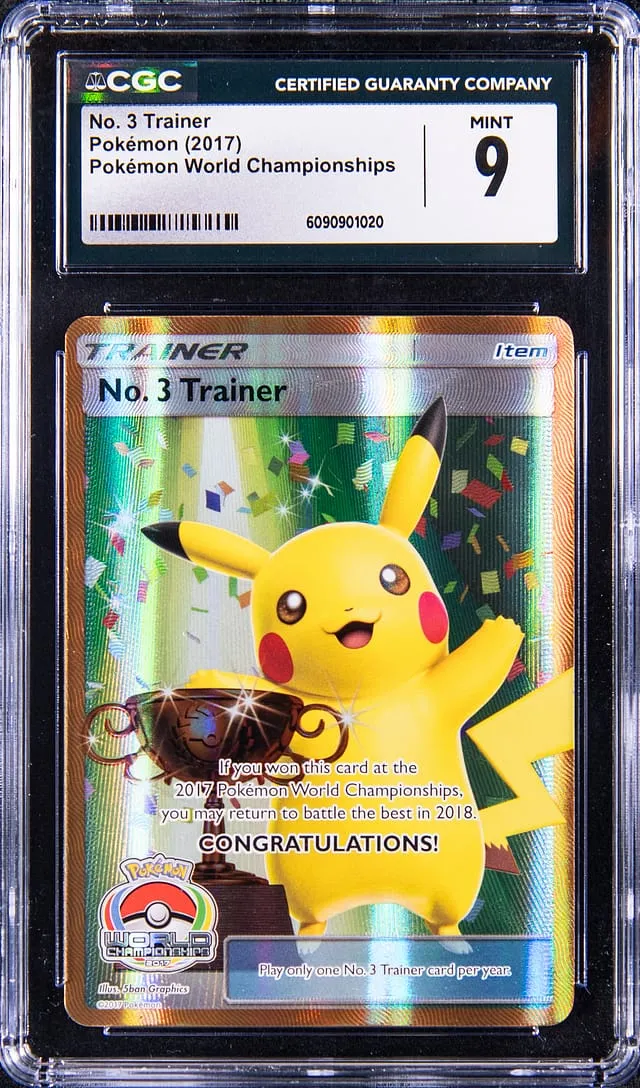
2017 No. 3 Trainer Pikachu Trophy CGC 9 Sells for $30K
Goldin sold a 2017 Pokémon World Championships No. 3 Trainer Pikachu CGC 9, pop 1, for $30,814. See what this means for high-end Pokémon trophy cards.
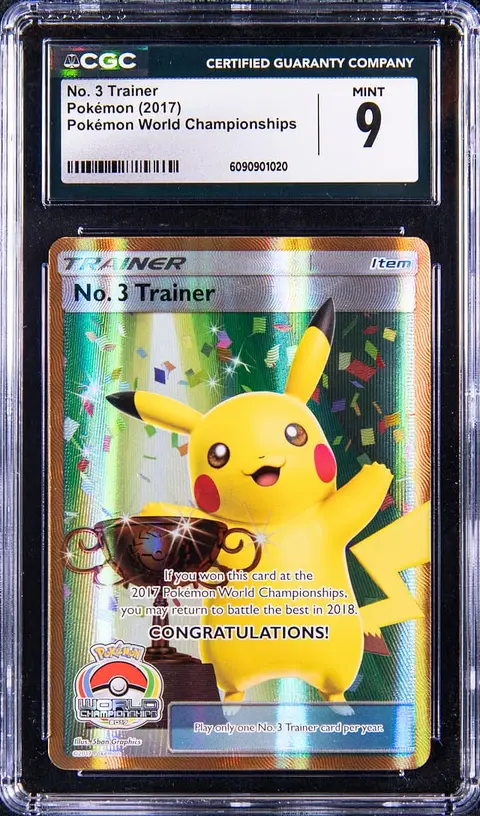
Sold Card
2017 Pokemon World Championships No. 3 Trainer Pikachu Trophy Card - CGC MINT 9 - Pop 1
Sale Price
Platform
Goldin2017 Pokémon World Championships No. 3 Trainer Pikachu Trophy Card (CGC 9) Sells for $30,814
On February 16, 2026, Goldin auctioned a true niche grail from the competitive Pokémon world: a 2017 Pokémon World Championships No. 3 Trainer Pikachu trophy card, graded CGC MINT 9, for $30,814.
For a card that never appeared in booster packs and was only awarded to top World Championships competitors, this is an important data point for anyone tracking high‑end Pokémon trophy cards.
What exactly is this card?
Card ID
- Character: Pikachu (illustrated as a World Championships “Trainer” trophy card)
- Year: 2017
- Event/Set: 2017 Pokémon World Championships Trophy (not a standard set release)
- Title: No. 3 Trainer
- Type: Trophy prize card, not a pack‑pulled card
- Era: Ultra‑modern competitive era
The No. 3 Trainer cards are historically awarded to third‑place finishers in their divisions at the Pokémon World Championships. They are printed in extremely small numbers and distributed only to top competitors, which is why collectors group them with the rarest items in the Pokémon TCG.
This specific copy is:
- Grading company: CGC
- Grade: CGC MINT 9
- Population: Pop 1 in CGC’s census at the time of listing (only one graded CGC 9, and no higher within CGC for this label)
- Attributes: Trophy card, extremely low overall print run, event‑only distribution
There is no autograph, patch, or serial number on the card; its importance comes from competitive provenance and controlled distribution, not from a manufactured parallel.
Why trophy Pikachu cards matter to collectors
Trophy cards occupy a different lane than pack‑pulled chase cards:
- Event‑only distribution: Cards like the No. 1/2/3 Trainer Pikachu are given to World Championships finalists. They never enter normal circulation through packs, boxes, or retail products.
- Ultra low print runs: Exact print quantities are rarely public, but they are generally understood to be in the single digits or very low double digits per year and division.
- Historical significance: These cards document the competitive history of the game, not just the commercial releases. For many collectors, they represent peak rarity and prestige in the Pokémon hobby.
Within this lane, Pikachu trophy cards are particularly important because Pikachu is the franchise mascot. When you combine Pikachu artwork, Worlds branding, and a top‑finish trophy title, you get a card that sits at the intersection of character popularity and event history.
Understanding the $30,814 sale
- Final price: $30,814
- Auction house: Goldin
- Sale date (UTC): 2026‑02‑16
For context, trophy cards tend to trade privately as often as they do at public auction, so the public sales we see usually represent only a slice of the real activity. Still, they give us useful reference points.
Market context and related sales
Because the exact 2017 No. 3 Trainer Pikachu in CGC 9 is a population‑1 item, direct “apple‑to‑apple” comparisons are limited. The most relevant benchmarks come from:
- Other years’ No. 3 Trainer Pikachu cards (PSA‑ or BGS‑graded)
- 2017 No. 1 and No. 2 Trainer variants where public sales exist
- Other Worlds Pikachu trophy cards from adjacent years
Recent public data around Worlds Pikachu trophies indicates:
- Lower‑grade copies and less prominent years generally transact lower.
- Top grades and earlier trophy issues regularly command strong premiums because of scarcity and historical cachet.
Seen against those ranges, a $30k+ result for a 2017 CGC MINT 9, pop‑1 lands in what looks like a healthy zone for an ultra‑scarce, newer‑era trophy Pikachu—strong but not out of step with how the market has treated Worlds trophies more broadly.
Because CGC’s presence in high‑end Pokémon has continued to grow, this sale also adds another data point for high‑grade CGC trophy cards sitting alongside PSA and BGS examples.
Grade, population, and why they matter here
When collectors talk about a grading company’s pop report (population report), they mean the official count of how many copies of a specific card have received each grade.
Key points for this sale:
- CGC MINT 9 is premium territory. On a modern or ultra‑modern card, 9s and 9.5s tend to capture a significant share of collector demand, especially when 10s are rare or nonexistent.
- Pop 1 at CGC. Being the only CGC 9 (with no mention of any higher grade in this listing) increases its standing among collectors who prefer CGC slabs or are building CGC‑only registries.
- Effective scarcity. Trophy cards already start at a much smaller supply base than pack‑pulled chase cards. Once you layer in grading and condition, the number of high‑grade, publicly selling examples can be very small.
In practice, this means each confirmed high‑grade sale has an outsized influence on how collectors think about values and replacement cost for similar pieces.
How this sale fits the broader Pokémon market
A few broader hobby trends help frame this result:
- Trophy vs. pack‑pulled: While the hobby has seen large swings in interest for modern booster‑box product and pack‑pulled hits, true trophy items have tended to move on a slower, more collector‑driven cycle.
- Ultra‑modern focus: 2017 sits in the ultra‑modern era, where print runs for standard sets are high, but trophy and event cards remain exceptionally scarce. That contrast often pushes serious collectors toward event pieces like this when they want scarcity rooted in distribution, not just stamp or serial‑number design.
- Grading diversification: With CGC, PSA, and BGS all active in Pokémon, collectors now compare across grading companies more often. Strong CGC results, particularly on rare items, reinforce that high‑end Pokémon is no longer PSA‑only territory.
Takeaways for collectors and small sellers
Some grounded observations from this Goldin sale on February 16, 2026:
- Documented public sale for a pop‑1 CGC trophy. For anyone holding a 2017 World Championships Pikachu trophy or a comparable year, this transaction becomes a reference point when discussing value, insurance, or potential sale decisions.
- Event‑only scarcity still commands a premium. Even in a market that has cooled from peak speculation, cards with real‑world competitive provenance continue to attract committed bidders.
- Grading pathway matters. Seeing a CGC MINT 9 achieve a strong five‑figure price suggests that, for ultra‑scarce cards, buyers will focus on the card and the competition around it rather than limiting themselves to a single grading label.
As more Worlds trophy cards surface at major auction houses, we’ll get additional data to refine ranges and understand how different years, divisions, and grades relate to each other. For now, this $30,814 result at Goldin reinforces the enduring appeal of Pikachu trophy cards at the very top end of the Pokémon TCG market.