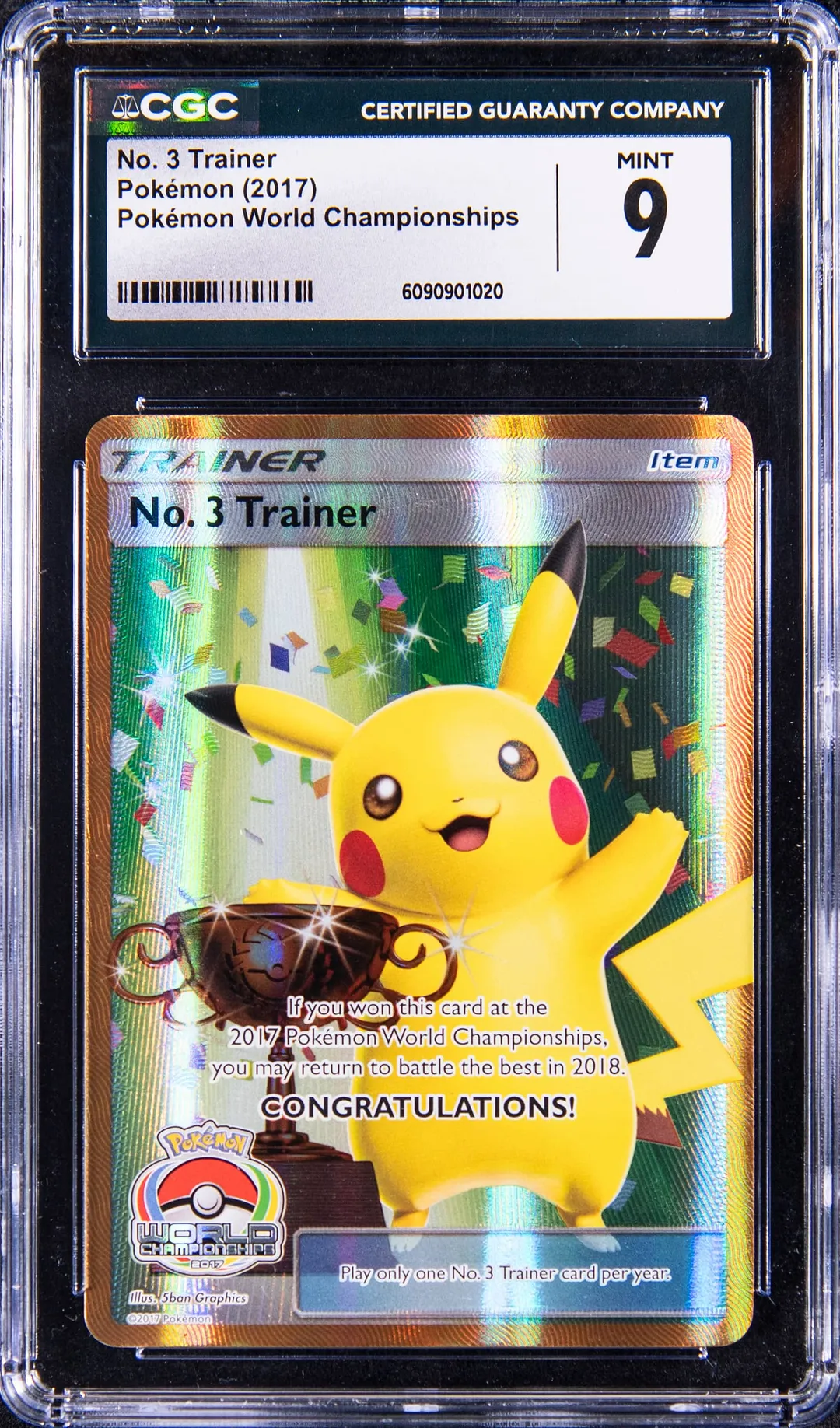
2017 No. 3 Trainer Pikachu CGC 9 Sells for $30.8K
Goldin sold a CGC Mint 9 2017 Pokémon Worlds No. 3 Trainer Pikachu trophy card for $30,814. See the context, scarcity, and market takeaways.
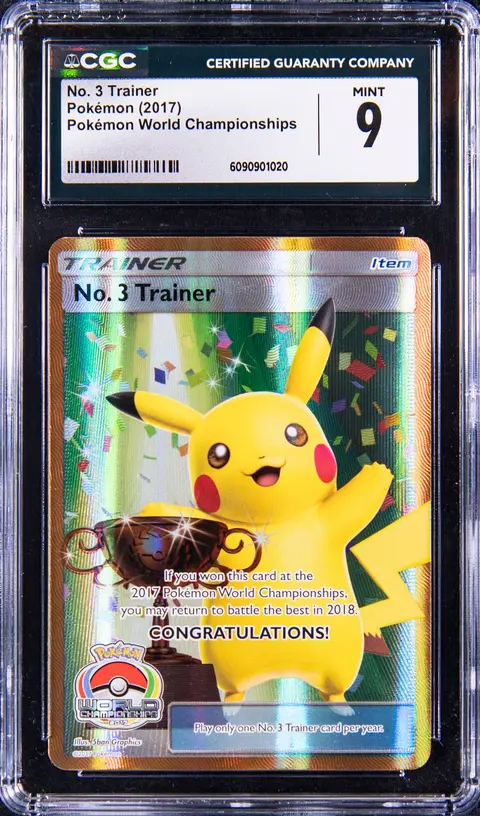
Sold Card
2017 Pokemon World Championships No. 3 Trainer Pikachu Trophy Card - CGC MINT 9 - Pop 1
Sale Price
Platform
Goldin2017 Pokémon World Championships No. 3 Trainer Pikachu Trophy Card (CGC 9, Pop 1) Sells for $30,814
On February 16, 2026, Goldin auctioned one of the most elusive modern Pokémon trophy cards: a 2017 Pokémon World Championships No. 3 Trainer Pikachu card, graded CGC Mint 9, for $30,814.
For collectors who watch the high-end trophy market, this sale offers a useful data point on a card that rarely surfaces and sits at the intersection of competitive history, scarcity, and the growing recognition of CGC-graded Pokémon.
Card overview
Card: 2017 Pokémon World Championships – No. 3 Trainer Pikachu Trophy Card
Event: 2017 Pokémon TCG World Championships
Character: Pikachu (event trophy artwork)
Type: Trophy card awarded to top finishers (No. 3) at Worlds
Era: Ultra-modern competitive trophy
Grading company: CGC
Grade: Mint 9
Population: Pop 1 in CGC Mint 9 at time of sale
Auction house: Goldin
Sale date (UTC): 2026-02-16
Sale price: $30,814 (hammer + buyer’s premium, per Goldin’s realized price)
Trophy cards like this are not pulled from booster packs. They are printed in extremely small numbers and handed directly to top-placing players at the Pokémon TCG World Championships. The "No. 3 Trainer" designation indicates a third-place finish in a specific division (for example, Junior, Senior, or Masters) in that year’s World Championships.
While set checklists and serial numbering are not the focus here, the defining traits are:
- Event-issued, not pack-issued
- Very low print run (only enough for finalists and possibly a few spares)
- Competitive provenance (tied to a specific Worlds event and placing)
This particular copy receiving a CGC Mint 9 and registering as population 1 (the only CGC 9 at the time of sale) adds grading scarcity on top of already severe organic rarity.
Why this card matters to collectors
World Championships trophy lineage
Worlds trophy cards sit in a small category of items that tell the story of the Pokémon TCG as a competitive game, not just a collectible product. Since the late 1990s, top finishers at Worlds and predecessor events (e.g., the original Japanese trophy cards like Pikachu Trophies and the No. 1/2/3 Trainer cards) have received unique prize cards that:
- Were never sold at retail
- Exist in single- or low-double-digit quantities
- Are directly tied to the best players of a given era
The 2017 No. 3 Trainer Pikachu is a continuation of that tradition. It may not have the same era-defining status as the earliest 1990s and early-2000s Japanese trophies, but it belongs to the same functional family: tournament prizes that are fundamentally scarce.
Ultra-modern trophy, real scarcity
In modern and ultra-modern Pokémon, there is a big difference between:
- Mass-produced chase cards (for example, alternate-art chase cards in main sets), and
- Event-only trophies like Worlds Trainer Pikachu cards.
The 2017 No. 3 Trainer Pikachu falls in the second category. Even though it is from the ultra-modern era, its distribution is closer to the earliest trophy cards than to regular pack-pulled cards. That makes it interesting for collectors who:
- Focus on competitive history
- Build trophy/tournament-only collections
- Prefer cards whose supply is constrained by event results rather than print runs
CGC’s role in the high-end Pokémon market
This copy is graded CGC Mint 9. CGC has grown quickly in the Pokémon space, particularly for modern and ultra-modern cards. For some segments of the market, PSA still commands a premium, especially for headline sales, but high-end CGC results are becoming more common and are worth tracking.
The fact that this is a CGC pop 1 in 9 suggests either:
- Very few 2017 No. 3 Trainer Pikachu cards have been graded overall, or
- Most existing copies have gone to other grading companies, or are still in original owners’ hands.
Either way, it underlines the small pool of graded examples available to public buyers.
Market context and recent sales
Because this is a niche, event-issued trophy card, it does not trade with the same frequency as set-based chase cards. That means we don’t have a dense price history, but we can still frame this $30,814 sale.
Comps and related sales
In the trophy segment, “comps” (short for comparables) are recent sales of the same card or very closely related cards, used to gauge price context. For the 2017 No. 3 Trainer Pikachu:
- Public auction appearances are sparse. When they do surface, they are often in different grades, different grading holders, or as part of private deals that aren’t fully disclosed.
- Trophy buyers frequently transact privately, which limits publicly verifiable data.
More broadly, looking at closely related trophy cards helps:
- Earlier Worlds No. 1/2/3 Trainer Pikachu trophies (from early-2010s) have historically traded in a wide range, largely driven by grade, auction venue, and timing in the broader Pokémon price cycle.
- Top-end vintage trophies (for example, 1997–1999 Japanese Pikachu Trophies and early No. 1/2/3 Trainers) have sold publicly in the five- and six-figure ranges, but those represent a different era and scarcity profile.
Within that context, $30,814 for a 2017 No. 3 Trainer in CGC Mint 9 is notable but not out of step with the idea that later-era World Championship trophies sit below the earliest Japanese trophies, while still commanding a clear premium over most pack-issued ultra-modern chase cards.
How this result fits
Given limited public sales history for this exact 2017 card, it’s more accurate to treat this auction as a fresh reference point than as a clear continuation of a long-established price trend.
What this sale suggests:
- Confirmed demand: There is active, paying interest for post-2010 Worlds trophy Pikachu cards at five-figure levels.
- Grade and holder acceptance: A CGC Mint 9, even without a long comp history, was able to find a buyer at a strong price in a major auction house.
- Market segmentation: Many collectors still draw a line between vintage Japanese trophies and modern Worlds trophies, but this result shows modern examples occupy their own tier, not a budget afterthought.
Because public comps for this precise card and grade are thin, it’s difficult to label the sale definitively as high, low, or exactly typical. Instead, it’s best read as:
- A data point near the current market’s willingness to pay for an ultra-modern Worlds No. 3 Trainer Pikachu trophy in a top-tier grade.
- A baseline for future sellers and buyers to reference when similar copies surface.
Scarcity and population
When collectors talk about a “pop report” (population report), they mean the grading company’s count of how many copies of a card exist in each grade.
For this card:
- CGC lists this copy as population 1 in Mint 9 at the time of sale.
- Total graded population (across all companies) is not centralized, but given the limited original award count, the total number of slabbed 2017 No. 3 Trainer Pikachu cards is likely very low.
In practice, that means:
- If you are building a Worlds trophy run, you will not see this card come up often.
- Collectors may have to accept small compromises (different grader, slightly lower grade, or waiting a long time) if they want a copy.
What this sale may signal
Without predicting future prices, this Goldin sale on February 16, 2026, hints at a few broader trends:
Sustained interest in trophy provenance
The premium on event-issued cards tied to real tournament finishes appears intact. Even as set-based prices fluctuate, trophies with documented competitive history continue to attract focused bidders.Growing comfort with newer-era trophies
While the earliest Japanese trophies still command the headlines, later Worlds cards like this 2017 No. 3 Trainer Pikachu are carving out a stable niche of their own.Multi-grader high-end ecosystem
A strong result in CGC Mint 9 suggests that, at least for some buyers, card quality and provenance can matter as much as the specific label on top, especially in categories where supply is extremely thin.
Takeaways for different types of collectors
New or returning collectors: This sale is a reminder that not all Pokémon grails live in regular booster sets. Event-only and trophy cards are a separate lane, with different supply and price behavior. If you’re just entering the space, it’s worth learning the history of Worlds trophies before making decisions.
Active hobbyists: If you track ultra-modern Pokémon but mostly focus on pack-pulled chase cards, keep an eye on how modern trophies like this one compare. They may move on a different timeline than the broader market because available copies are so limited.
Small sellers: It’s unlikely you’ll randomly run into a 2017 No. 3 Trainer Pikachu in a collection buy. But this sale can still inform how you evaluate tournament or promo items: event provenance and clear scarcity can push certain pieces well beyond what set-based pricing might suggest.
As always, this result is one point in time—not a guarantee of where prices will go next. For trophy cards in particular, each auction tends to be its own negotiation between a tiny group of informed buyers. For anyone interested in this slice of the market, bookmarking the Goldin February 16, 2026 sale of the CGC Mint 9, pop 1 2017 Pokémon World Championships No. 3 Trainer Pikachu trophy card is a useful reference for future comparisons.