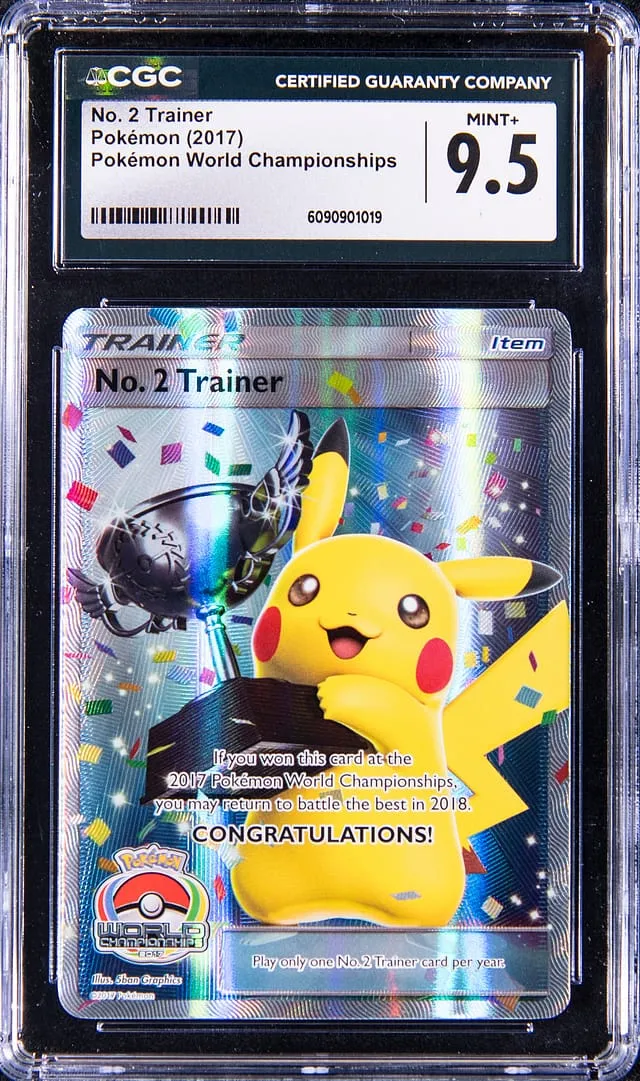
2017 No. 2 Trainer Pikachu Trophy CGC 9.5 Sale
Figoca looks at the $35,354 Goldin sale of a 2017 Pokémon World Championships No. 2 Trainer Pikachu trophy card graded CGC MINT+ 9.5 pop 1.
Sold Card
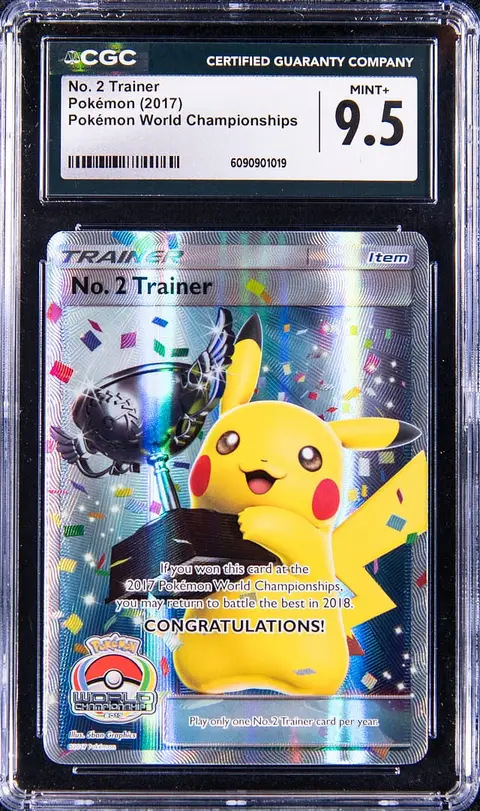
2017 Pokemon World Championships No. 2 Trainer Pikachu Trophy Card - CGC MINT+ 9.5 - Pop 1
Sale Price
Platform
Goldin2017 Pokemon World Championships No. 2 Trainer Pikachu Trophy Card – CGC 9.5 Pop 1 Market Breakdown
On February 16, 2026, Goldin closed a notable ultra‑modern Pokémon auction: a 2017 Pokémon World Championships No. 2 Trainer Pikachu Trophy Card graded CGC MINT+ 9.5 realized $35,354.
For a niche, event‑only trophy card with a pop 1 (population of one) in this grade, the sale offers a useful data point for collectors tracking the top end of the competitive‑play Pokémon market.
What exactly is this card?
- Character: Pikachu (illustrated as a World Championships trophy card mascot)
- Year: 2017
- Event / Set: Pokémon World Championships 2017 – No. 2 Trainer trophy card
- Card type: Prize / trophy card awarded at the World Championships, not a pack‑pulled set card
- Variant: “No. 2 Trainer” version (typically awarded to second‑place finishers in a division)
- Era: Ultra‑modern competitive trophy (not a standard set Pikachu)
- Grading company: CGC Trading Cards
- Grade: CGC MINT+ 9.5
- Population: Pop 1 in CGC’s census at this grade at the time of cataloging
Unlike mass‑released Pikachu cards, this World Championships No. 2 Trainer card was produced in extremely low quantities for high‑place finishers at the 2017 World Championships. That combination—Pikachu, trophy status, and ultra‑low print—places it in the same broad lane as other prestigious Pokémon trophy issues, even if each year and placing has its own small print run and unique art.
Why collectors care about World Championships trophy cards
Worlds trophy cards sit in a small but important corner of the Pokémon market:
- Not pack‑pulled: These cards are awarded to top competitors at the Pokémon World Championships. That makes them part of competitive Pokémon history rather than retail product.
- Tiny print runs: Exact numbers often aren’t officially published, but by design they line up with very few winners per age division. That typically means only a handful of copies exist for each year/placing.
- Pikachu focus: Many Worlds trophies feature Pikachu, which already has strong character collecting demand on its own.
- Competitive provenance: Collectors who care about the history of the game’s highest‑level play often prioritize Worlds‑linked pieces.
Within this context, a 2017 No. 2 Trainer Pikachu trophy card is best thought of as a niche, high‑scarcity item that appeals to:
- Dedicated Pikachu character collectors
- Trophy and prize card specialists
- Collectors of World Championships memorabilia
- High‑end Pokémon set builders looking for historically significant items beyond regular releases
Grade, pop report, and what “Pop 1” means
The card is graded CGC MINT+ 9.5 by CGC Trading Cards. In grading terms:
- MINT+ 9.5 usually signals near‑flawless surface, corners, and centering with only very minor, often hard‑to‑see imperfections.
- Pop report (population report): A grading company’s census of how many copies of a card they’ve graded at each grade level.
- Pop 1: At the time of the sale, this is the only card CGC had graded at 9.5. In other words, there are no other CGC 9.5s recorded.
Because Worlds trophies are thinly submitted and thinly traded, population numbers for any grading company are typically very low across all grades. A pop 1 top‑grade example doesn’t mean it is the only copy in existence, but it does underscore how few have both surfaced and been graded.
Market context and recent sales
This Goldin result of $35,354 sits in a section of the market where sales are infrequent and often individualized. That makes strict “comps” (short for comparables—recent, similar sales used as reference points) harder to establish than for, say, a mainstream Pikachu from a base set.
Based on available public information and typical trophy‑card patterns:
- Exact recent public sales of this specific 2017 No. 2 Trainer Pikachu in CGC 9.5 are scarce to non‑existent, which is common for pop‑1 trophy pieces.
- Related items that sometimes inform context include:
- Other Worlds Pikachu trophy cards from nearby years (e.g., 2016, 2018) in high‑end PSA, BGS, or CGC grades
- Different placings from 2017 (No. 1 and No. 3 Trainer), where available
- Earlier, historically important trophy cards that set broader expectations for the tier this type of piece occupies
Across those broader trophies:
- Prices tend to be sale‑specific. Factors such as year, artwork, division, provenance, and grade can swing realized prices significantly, even between structurally similar cards.
- Thin supply magnifies each auction. With so few copies and even fewer coming to market, each appearance can look like an outlier if viewed in isolation.
Within that context, $35,354 for a 2017 Pikachu Worlds trophy in pop‑1 CGC 9.5 territory fits the pattern of high‑end, niche Pokémon pieces: serious money, but grounded in scarcity and event history rather than broad, mass‑market popularity alone.
How this sale fits the broader Pokémon trophy market
While every trophy card is its own case, a few general trends help frame this sale:
Event‑driven demand: Trophy cards are closely tied to competitive history. Collectors who care about the Worlds narrative—locations, champions, year‑by‑year progression—are often the ones setting price levels.
Era differences: Earlier trophies (especially late‑1990s and early‑2000s cards) often get extra attention as foundational pieces from Pokémon’s early competitive era. A 2017 trophy is more recent, but still benefits from the maturation of Worlds as a major annual event.
Character premium: Pikachu continues to anchor a large part of the market. Even among niche items, a Pikachu illustration can draw in collectors who might not usually chase tournament prizes.
Grading mix: Trophy collectors spread their submissions across PSA, BGS, and CGC. That means each company’s pop report tells only part of the story. A CGC pop 1 9.5 may coexist with high‑grade examples in other holders.
When you combine those points with the fact that few 2017 No. 2 Trainer cards surface publicly, this Goldin result becomes a practical reference point rather than an absolute benchmark.
What this might signal to collectors
Without making predictions, a few grounded observations are reasonable:
- Visibility matters: A public sale on a major platform like Goldin on February 16, 2026, puts a concrete dollar figure next to a card that many collectors may never have seen in person.
- Grade scarcity supports premiums: For event‑only cards where raw copies are already scarce, a top‑grade pop 1 example often commands a noticeable premium over lower grades or ungraded copies.
- Trophy niches remain active: Even as broader Pokémon prices move through their own cycles, competitive and trophy‑focused segments continue to attract dedicated buyers willing to pay for scarcity plus story.
Key takeaways if you’re new to trophy cards
For collectors just starting to explore the trophy lane, this sale highlights a few practical points:
Do not assume “comps” will be abundant. Thin transaction history means you might be working from just one or two public data points over several years.
Focus on provenance and documentation. When cards are this scarce, knowing how a copy moved from original winner to current owner can matter.
Understand grading differences. Compare across CGC, PSA, and BGS, and remember that pop reports are company‑specific.
Separate nostalgia from scarcity. A favorite character or year may be personally important, while the market often prices in print run, event significance, and how often copies appear.
How this sale fits into a collector’s toolkit
You can treat the $35,354 Goldin sale on February 16, 2026 as:
- A reference point if you encounter other 2017 Worlds No. 2 Trainer cards in different grades or slabs
- A signal of active interest in ultra‑modern trophy Pikachu cards
- A reminder that Worlds‑linked items sit on a different curve than mass‑produced chase cards
As always, the most useful approach is to stack multiple data points—auction results, private‑sale chatter where verifiable, pop reports, and your own collecting priorities—rather than relying on any single sale as a standalone answer.
For now, this CGC MINT+ 9.5 pop‑1 copy stands as a clean, documented example of what serious collectors have recently been willing to pay for a 2017 Pokémon World Championships No. 2 Trainer Pikachu trophy card.
Goldin sale details
- Card: 2017 Pokémon World Championships No. 2 Trainer Pikachu Trophy Card
- Grade: CGC MINT+ 9.5 (pop 1)
- Auction house: Goldin
- Sale date (UTC): February 16, 2026
- Price: $35,354