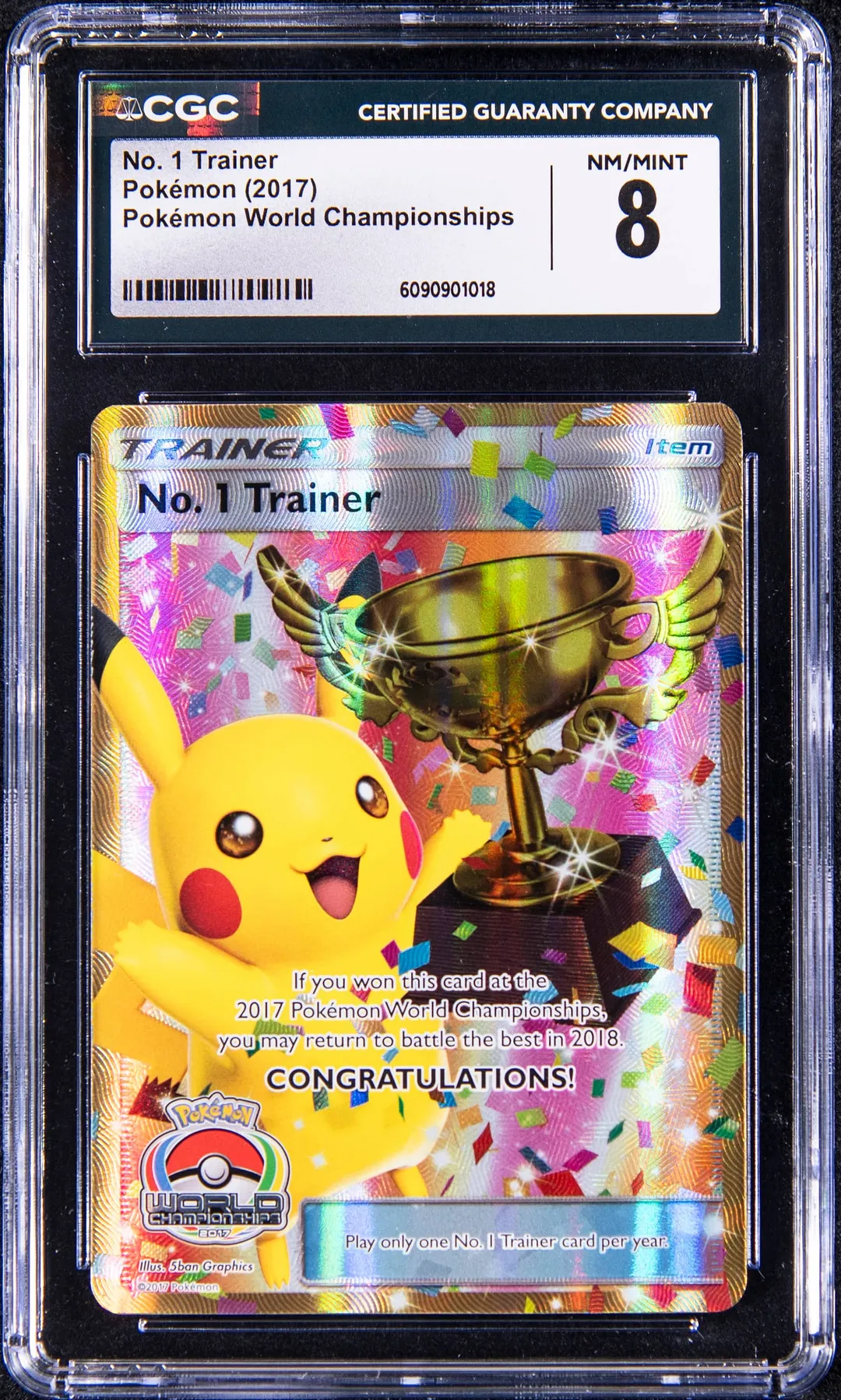
2017 No. 1 Trainer Pikachu Trophy CGC 8 Sells for $57K
A 2017 Pokémon World Championships No. 1 Trainer Pikachu CGC 8 (Pop 1) sold for $57,044 at Goldin on Feb 16, 2026. Here’s the collector context.
Sold Card
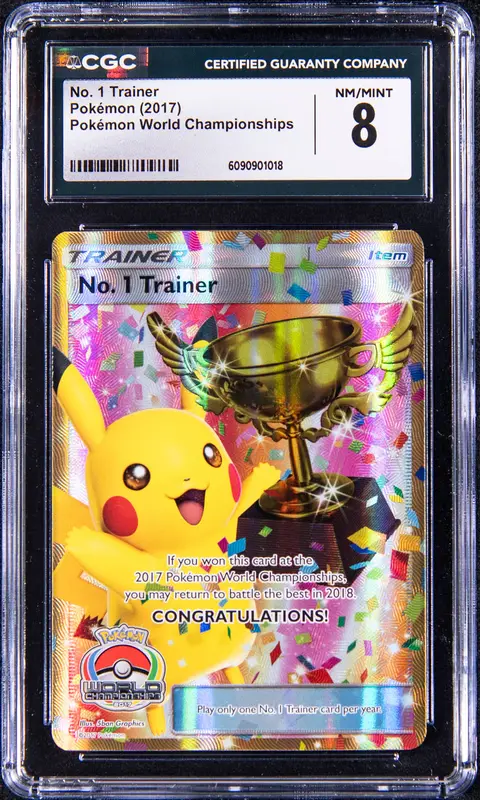
2017 Pokemon World Championships No. 1 Trainer Pikachu Trophy Card - CGC NM-MT 8 - Pop 1
Sale Price
Platform
Goldin2017 Pokémon World Championships No. 1 Trainer Pikachu Trophy Card Sells for $57,044
On February 16, 2026, Goldin closed a notable high-end Pokémon auction: a 2017 Pokémon World Championships No. 1 Trainer Pikachu trophy card graded CGC NM-MT 8, selling for $57,044. For collectors who follow rare trophy pieces, this is a meaningful data point in a niche but closely watched corner of the market.
The Card: 2017 No. 1 Trainer Pikachu Trophy
Card: 2017 Pokémon World Championships No. 1 Trainer (Pikachu Trophy Card)
Event: Pokémon World Championships 2017
Character: Pikachu (event trophy artwork)
Type: Trophy / prize card, not from a regular booster set
Era: Ultra-modern (Sun & Moon era)
Grading: CGC NM-MT 8 (Near Mint–Mint)
Population: Reported as Pop 1 in this grade at CGC at the time of sale
The No. 1 Trainer cards are not pack-pulled. They are prize cards awarded to top finishers at official Pokémon tournaments—often to champions of specific age divisions or events. This 2017 version ties directly to the World Championships, which is the highest level of competitive play for the game.
Because they are event-issued, the print runs are extremely low and tied to the number of winners, not to mass distribution. That structure is why trophy cards are widely viewed as some of the rarest and most historically important Pokémon cards of the modern and ultra-modern eras.
Why This Card Matters to Collectors
Several factors give this card outsized importance relative to its age:
True trophy status
Trophy cards are awarded at the event and are not available in regular packs or products. For collectors, that makes them closer to sports award memorabilia than to a standard trading card release.World Championships connection
The World Championships are Pokémon’s premier competition. Cards tied to Worlds tend to be seen as representative of peak-level play and community history.Pikachu as the face of the brand
Pikachu remains the franchise mascot and a central character in Pokémon’s visual identity. When a trophy card features Pikachu, it usually commands extra attention compared to non-mascot designs.Ultra-low supply and grading numbers
The card in this sale is listed as a CGC population 1 in NM-MT 8. "Pop" (population) refers to how many examples of a specific card-and-grade combination a grading company has recorded. While there may be raw (ungraded) or PSA/BGS-graded copies in the market, any trophy card with a population in the single digits at a major grading company signals meaningful scarcity.Event-issued condition challenges
Trophy cards are often handed directly to players and not originally treated as collectibles. They may be transported, displayed, or handled in less-than-ideal conditions for long-term preservation. That can make higher-grade examples (even an 8 in this context) challenging to find.
Market Context and Price Positioning
This sale closed at $57,044 on Goldin on February 16, 2026 (UTC).
When we talk about "comps" (comparable sales), we’re looking at recent auction and marketplace results for the same card—or, when direct matches are thin, for very closely related variants and grades.
For trophy cards like this, true comps are often limited because:
- The cards are awarded in tiny numbers to begin with.
- Many winners keep them long-term, reducing turnover.
- When they do surface, they may appear in different grading holders, grades, or languages.
Within that context, recent market behavior for Worlds-era No. 1 Trainer trophies (across various years, languages, and grading companies) has shown:
- Wide price dispersion: Condition, provenance, and specific event year can all materially affect closing prices.
- Irregular sale schedule: These cards may go years between public auctions for a specific year/variant.
Because of that thin data, it’s more accurate to frame this Goldin result as a current reference point for a 2017 No. 1 Trainer Pikachu trophy in CGC 8 rather than as a clean average or benchmark. It registers in the same general tier as other significant modern and ultra-modern Pokémon trophy pieces but should not be read as a firm number for every copy.
CGC 8 and Population: How to Read It
A CGC NM-MT 8 grade indicates a card that presents strongly overall but may show:
- Noticeable (but not severe) edge or corner wear under close inspection
- Minor surface marks or print defects
- Slight centering issues, depending on CGC’s subgrade structure if present
For mass-produced, pack-issued ultra-modern cards, collectors often focus on 9.5s and 10s. Trophy cards are a different conversation. With tiny print runs and event handling, a CGC 8 or PSA 8 can be considered very respectable and may sit near the top end of the total surviving population.
The Pop 1 note at CGC underscores that, at least in that grading ecosystem, there is only one example at this grade. There may be higher or lower grades, or parallel records at other grading companies, but a Pop 1 in an important trophy line typically strengthens the card’s perceived uniqueness.
How This Fits into the Broader Trophy Card Market
The trophy card lane remains a small but influential niche:
- Collector profile: Many buyers are long-term-focused collectors, advanced hobbyists, or institutions rather than short-term flippers.
- Market visibility: Sales often happen at major auction houses like Goldin, Heritage, and others, or privately. That can lead to less frequent public data but higher average lot values when cards do surface.
- Volatility patterns: Prices can move significantly sale to sale because sample sizes are so small. A card might not appear publicly for several years, and then the next sale may reflect shifts in broader Pokémon sentiment and overall high-end collectible liquidity.
In that sense, this $57,044 result serves more as a marker of current demand than a stable price chart line. For collectors tracking the space, it helps:
- Anchor expectations for modern Worlds Pikachu trophies in strong mid–high grades.
- Illustrate that even relatively recent (2010s) trophy issues can command five-figure results when they surface.
- Reinforce the idea that event-issued scarcity and competitive history can sometimes outweigh age in the Pokémon hierarchy.
Takeaways for Different Types of Collectors
New or returning collectors
You don’t need to chase trophy cards to enjoy the hobby. But understanding them gives context to why some auction headlines feature numbers that seem out of line with everyday pack cards. Trophy pieces sit at the intersection of competition history, low supply, and brand significance.
Active hobbyists
If you’re already familiar with grading and pop reports, this sale is a useful datapoint when you’re gauging how modern Pikachu-linked prize pieces compare to vintage grails and other modern high-end cards. The CGC 8, Pop 1 combination is a reminder that grade distribution for trophy issues can look very different from typical modern sets.
Small sellers and market watchers
While most inventory won’t mirror this card’s scarcity, tracking trophy results helps you:
- Understand where the top of the market is currently clearing.
- See how buyers are valuing branded events (Worlds) and key characters (Pikachu).
- Recognize that event-issued promos and limited-run cards tied to organized play may deserve closer attention than their age alone suggests.
Final Thoughts
The February 16, 2026 Goldin sale of the 2017 Pokémon World Championships No. 1 Trainer Pikachu Trophy Card, CGC NM-MT 8 (Pop 1), at $57,044 is another reminder that ultra-modern Pokémon can carry substantial long-term interest when design, rarity, and event history line up.
For collectors, it’s a clean, recent example of how the market currently prices a modern Worlds Pikachu trophy in a solid grade. As always with this tier of card, actual supply is thin, public data points are limited, and each future sale will need to be read in its own context rather than as a guaranteed trend line.