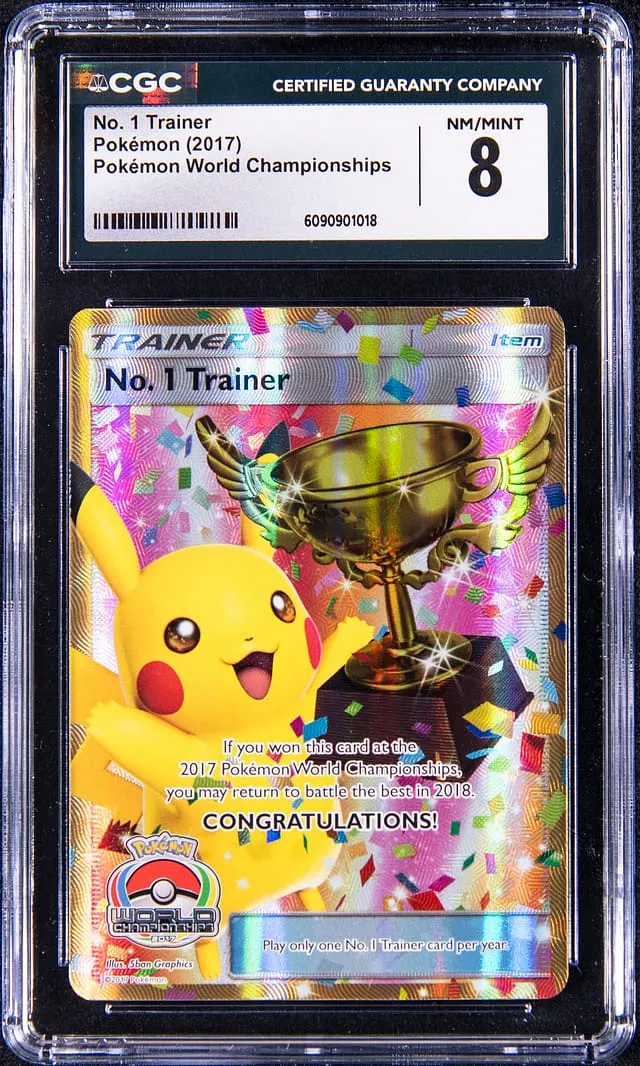
2017 No. 1 Trainer Pikachu Trophy CGC 8 Sells
Goldin sold a 2017 Pokémon No. 1 Trainer Pikachu Trophy Card, CGC 8 pop 1, for $57,044 on Feb 16, 2026. Here’s what it means for trophy card collectors.
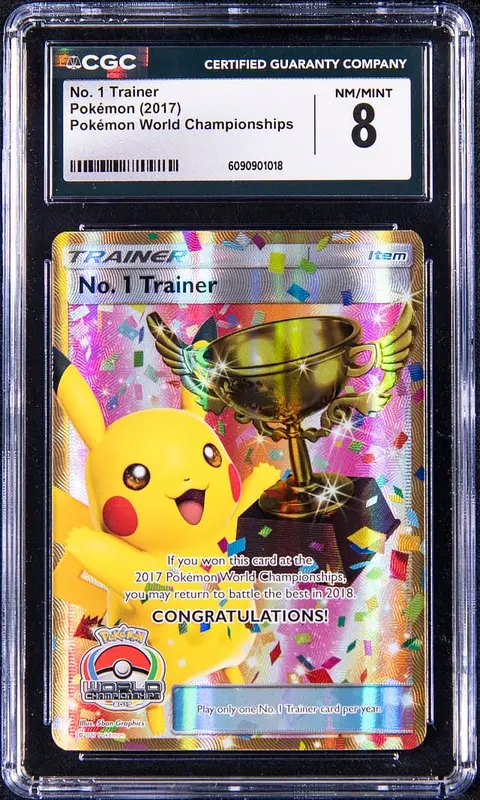
Sold Card
2017 Pokemon World Championships No. 1 Trainer Pikachu Trophy Card - CGC NM-MT 8 - Pop 1
Sale Price
Platform
Goldin2017 Pokémon World Championships No. 1 Trainer Pikachu Trophy Card (CGC 8) Sells for $57,044
On February 16, 2026, Goldin auctioned one of the more elusive pieces in the modern Pokémon trophy landscape: a 2017 Pokémon World Championships No. 1 Trainer Pikachu Trophy Card, graded CGC NM-MT 8, for $57,044.
For collectors who track high-end Pokémon, this sale sits at the intersection of rarity, competitive history, and the growing recognition of non-TCG-set trophy cards as core hobby artifacts.
What exactly is this card?
Let’s break down the key details in plain language:
- Card name: No. 1 Trainer Pikachu Trophy Card
- Year: 2017
- Event: Pokémon World Championships
- Character: Pikachu (event trophy artwork)
- Type: Trophy/prize card, not a standard pack-pulled set card
- Era: Ultra-modern (mid‑2010s)
- Grading company: CGC (Certified Guaranty Company)
- Grade: NM-MT 8 (Near Mint–Mint)
- Population: CGC population (pop) 1 at this grade at the time of reporting
Trophy cards like this are not pulled from booster packs. They are awarded to top finishers at high-level events—in this case, the 2017 Pokémon World Championships. That places this card in a small family of prize-only issues that sit outside normal set checklists but inside the core history of the organized Play! Pokémon system.
The title “No. 1 Trainer” indicates it was issued to a first-place finisher in a division. That alone sharply caps the original issuance. While exact print numbers for these trophy cards are often not fully disclosed, we’re generally talking about counts in the single digits per year and division.
Why the CGC NM-MT 8, Pop 1 matters
A population report (or “pop report”) is simply a grading company’s tally of how many copies of a given card they have graded at each grade level. When we say this card is CGC pop 1 in NM-MT 8, we mean:
- Only one copy has been graded CGC 8.
- There may be copies in other grades or in other grading company holders, but within CGC’s database, this is the only example in this specific grade.
For a mass-produced set card, a pop 1 in a mid-to-high grade might not be remarkable. For a world-level trophy card with likely single-digit total distribution, every graded copy—at any grade—is noteworthy. The combination of ultra-low original supply and thin grading data means each sale can influence how collectors think about the card.
Market context and comps
When collectors talk about “comps” (comparable sales), they mean recent, publicly recorded transactions of the same card—or the closest possible version—to help frame today’s prices.
For the 2017 No. 1 Trainer Pikachu Trophy Card specifically, public sales are sparse. That’s typical for modern trophy cards:
- Copies often remain with the original winners for years.
- When they do sell, it’s frequently through private deals or high‑end auction houses.
- Different grading companies (PSA, BGS, CGC) may each only have a handful of copies on record.
Because of this, exact same-card, same-grade comps can be very limited or nonexistent. Instead, collectors often look at:
- Other years’ No. 1 Trainer trophy cards (earlier or later World Championships).
- Other placements from the same year (No. 2 Trainer, No. 3 Trainer, etc.).
- Other high-profile Pokémon trophy issues, such as early Japanese trophies, to get a rough sense of where the market is for comparable scarcity and prestige.
Within that context, a $57,044 result for this 2017 No. 1 Trainer at Goldin sits in line with how the market has been treating modern trophy pieces: not at the all‑time highs of the earliest vintage trophies, but squarely in the tier of cards that serious Pokémon collectors watch very closely.
Where it fits in the broader picture:
- Earlier, historically famous prize cards (like 1990s Japanese trophies) have, at times, reached higher public prices, driven by both nostalgia and longer-term collector awareness.
- More recent World Championships trophies, especially those from the 2010s, have gradually caught up in visibility as the Pokémon player base matures and as the organized play history becomes more widely appreciated.
Because public comps for the same 2017 No. 1 Trainer in CGC 8 are so thin, it’s fairer to view this sale as a data point in an evolving curve rather than a definitive “market price.”
Why collectors care about World Championships trophy cards
World Championships trophy cards combine several attributes that long-term collectors tend to value:
Competitive provenance
These cards are directly tied to the Pokémon World Championships, the highest level of organized play. Owning one is effectively owning a piece of esports history—proof that someone reached the top of the game that year.Ultra-low supply
Unlike set cards, which might exist in tens or hundreds of thousands of copies, world trophy cards are believed to be produced in extremely small quantities. Even if every copy were graded, the total pop would likely remain in the single digits.Distinctive artwork and text
Trophy Pikachu cards often feature event-specific artwork and wording, sometimes with language noting the tournament, year, or placement. That makes them instantly recognizable and context-rich.Historical continuity
Trophy Pikachu designs form a sort of chronological thread across multiple World Championships. Collectors can track how the art, layouts, and distribution evolved over time, similar to how sports collectors track changes across decades of championship awards.Role within the ultra-modern era
As an ultra-modern card (2010s and later), the 2017 No. 1 Trainer occupies an interesting space: it’s contemporary enough that many current collectors remember the event window, but scarce and important enough that it’s already treated as a centerpiece rather than a speculative piece.
CGC’s role in high-end Pokémon
This particular sale is also a small but useful data point in the ongoing discussion about grading companies in the Pokémon market.
- CGC (Certified Guaranty Company) entered the trading card grading space with a strong reputation from comics and other collectibles.
- While PSA has historically dominated some segments of the Pokémon market, CGC‑graded examples of high-end Pokémon, including trophy cards, are increasingly appearing in major auctions.
A CGC NM-MT 8 result at $57,044 suggests that at least some portion of the high-end buyer base is comfortable bidding aggressively on non-PSA holders when the underlying card is scarce and important enough.
How this sale shapes expectations (without overpromising)
It’s important not to over-interpret a single sale, especially in an ultra-thin market like trophy cards, but we can pull out a few cautious takeaways for collectors and small sellers:
- Every public trophy sale matters. With so few data points, each auction result—whether higher or lower than expected—can influence how future buyers and sellers frame price discussions.
- Condition still matters, even on ultra-rare cards. The fact that this is a CGC 8 (not gem mint) and still reached a strong five-figure result underscores that condition premiums exist, but absolute rarity can support value even outside the top grades.
- Grading diversification is real. High-end Pokémon cards are no longer exclusively a PSA story. Results like this help demonstrate that collectors will look across holders when the card itself is compelling.
For collectors who own or are considering high-level event cards, the key takeaway isn’t that prices will always move one way or another. Instead, it’s that documented, public sales are slowly building a more visible price history for these once‑obscure pieces.
What to watch next
If you’re tracking the 2017 No. 1 Trainer Pikachu Trophy Card and related issues, a few practical things to monitor:
Future auction listings
- Are additional 2017 No. 1 Trainer copies appearing at major houses like Goldin, Heritage, or PWCC?
- Do we start seeing more crossover between PSA, BGS, and CGC examples?
Pop report changes
- Do CGC, PSA, or BGS population counts creep upward as more original winners decide to grade their copies?
- Is there a clustering around certain grade levels (e.g., many at 7–8, very few at 9+)?
Player and event nostalgia
- As time passes, certain World Championship years may gain added nostalgia or significance, which can subtly influence attention on their trophy cards.
Relative pricing vs. older trophies
- Do modern trophies like 2010s No. 1 Trainers begin closing the gap with the earliest 1990s–early 2000s trophies, or does a clear multi-tier structure remain?
None of these are predictions; they’re simply the kinds of signals that help collectors understand how a niche segment is maturing.
Summary
The February 16, 2026 Goldin sale of the 2017 Pokémon World Championships No. 1 Trainer Pikachu Trophy Card, CGC NM-MT 8, pop 1, at $57,044 adds another important marker to an area of the Pokémon market defined by tiny populations and sparse public data.
For trophy-card collectors and anyone interested in the competitive history of Pokémon, this result reinforces a few themes:
- World Championships trophy cards remain among the scarcest and most historically tied pieces in the hobby.
- Even outside gem mint grades, serious money continues to chase legitimate event awards.
- CGC-graded examples are firmly part of the high-end conversation.
As more of these cards surface and sell through public channels, the story around modern Pokémon trophies—and their place alongside vintage grails—will continue to take shape, one auction at a time.