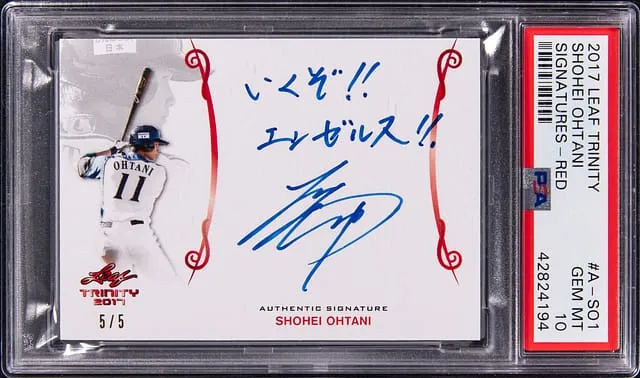
2017 Leaf Trinity Shohei Ohtani Red /5 PSA 10 Sale
Breaking down Goldin’s $67,100 sale of the 2017 Leaf Trinity Shohei Ohtani Red /5 PSA 10, signed and inscribed in Japanese, pop 2.
Sold Card
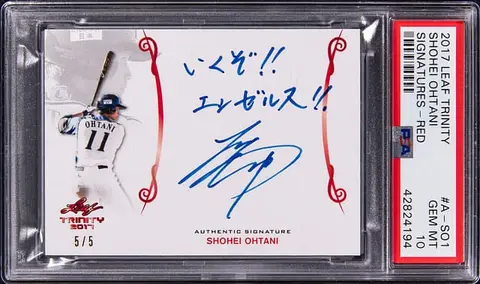
2017 Leaf Trinity Signatures Red #A-SO1 Shohei Ohtani Signed, Inscribed in Japanese Rookie Card (#5/5) - PSA GEM MT 10 - Pop 2
Sale Price
Platform
GoldinShohei Ohtani’s earliest fully licensed cards have been on collectors’ radars for years, but a recent sale at Goldin put one of his scarcest pieces back in the spotlight.
On March 15, 2026, Goldin sold a 2017 Leaf Trinity Signatures Red #A-SO1 Shohei Ohtani Signed, Inscribed in Japanese Rookie Card, serial numbered 5/5, graded PSA GEM MT 10 (population 2), for $67,100.
In this post, we’ll break down what this card is, why it matters, and how this sale fits into the broader Ohtani market.
The card at a glance
Card: 2017 Leaf Trinity Signatures Red #A-SO1
Player: Shohei Ohtani
Year / Era: 2017 (ultra-modern, pre-MLB debut in the U.S.)
Brand / Set: Leaf Trinity Signatures
Parallel: Red, serial numbered /5
Autograph: On-card, signed and inscribed in Japanese
Rookie card status: Considered an early, pre-MLB rookie issue (2017 prospect/rookie era)
Grading company: PSA
Grade: GEM MT 10 (Gem Mint)
Population: Pop 2 in PSA 10 for this specific Red parallel and autograph/inscription combo
Leaf Trinity is known in the hobby as a premium, prospect-focused product. The Signatures subset highlights on-card autographs—where the player signs directly on the card instead of a sticker—and low serial numbering.
The Red parallel is limited to just five copies. This particular card is hand-numbered 5/5, and the autograph includes a Japanese inscription, which adds another layer of appeal for collectors who focus on Ohtani’s Japan-era and early-career cards.
Why this 2017 Leaf Trinity Ohtani matters
Early, pre-MLB Ohtani
By 2017, Shohei Ohtani had already become a star in Nippon Professional Baseball (NPB). Cards from this period capture him just before his transition to Major League Baseball. For collectors who like a player’s “full story,” these pre-MLB issues act as a bridge between his NPB legacy and his MLB dominance.
While many collectors think first of Ohtani’s 2018 Topps and Bowman rookies, his 2017 Leaf issues are part of a smaller ecosystem of early cards that established his prospect-market presence.
Ultra-low serial number: Red /5
A serial number tells you how many copies of a particular version of a card exist. Here, /5 means only five copies of this Red Signatures Ohtani exist.
For modern and ultra-modern cards (roughly mid-2000s to now), autographs and parallels serial numbered to 25 or fewer are generally treated as true premium tiers. At just five copies, the Red sits in what many collectors informally treat as a “grail” level for this specific release.
On-card autograph with Japanese inscription
Two details stand out:
- On-card autograph – The signature is written directly on the card, not on a sticker that’s later applied. Collectors typically value on-card signatures more highly for visual and authenticity reasons.
- Japanese inscription – Ohtani adds additional writing in Japanese, which is much less common than a standard English-only autograph. Inscribed versions are often chased by player collectors because each inscription feels more personal and ties directly back to his time in Japan.
This combination—on-card, low-numbered, and inscribed—helps this specific card sit near the top of the 2017 Leaf Trinity Ohtani ladder.
PSA GEM MT 10, pop 2
“Pop,” short for population, refers to how many copies of a card a grading company has given a particular grade. With PSA GEM MT 10 (Gem Mint) and a population of 2, there are only two known examples of this Red /5 version in PSA’s highest grade.
When a card is already limited to five copies, seeing only two in a PSA 10 increases the perceived scarcity at the top end. For collectors focused on “best possible example” collections or high-end registries, this matters.
Market context: where this $67,100 sale sits
The sale at Goldin closed at $67,100 on March 15, 2026.
Because this card is:
- Limited to just five copies, and
- Only two of those have graded PSA 10,
clean pricing history is limited. Ultra-low serial numbered cards simply do not trade often enough to form a smooth trend line.
Nearby comps and reference points
For a card this scarce, collectors typically look to a few different reference points instead of one perfect comp:
- Other 2017 Leaf Ohtani autos – Higher-serial parallels (for example, numbered to 10, 25, or 50) and non-inscribed autos usually sell more frequently. They can provide a directional sense of how the hobby values 2017 Leaf Ohtani ink in general, though they sit in a noticeably lower tier than a Red /5 with inscription.
- Different grades of the same card – If/when BGS or PSA 9 copies of this Red parallel surface, those results help bracket the range. Typically, there’s a premium for a PSA 10 over a strong PSA 9, especially when the pop count is low.
- Comparable early Ohtani autos from other brands – Early prospect autographs from other pre-2018 products (Leaf and non-MLB-licensed issues) give some context, but the exact mix of inscription, on-card auto, and serial numbering makes this card its own case.
Because confirmed public sales of this exact card in this exact grade are rare, the $67,100 hammer at Goldin currently functions as a key marker for its value in early 2026. Rather than a “typical” price, it’s better viewed as a data point in a thinly traded segment.
How this fits into the broader Ohtani market
Shohei Ohtani sits at the center of the ultra-modern baseball card market. Several factors continue to drive collector interest:
- Two-way dominance – Elite-level production as both a pitcher and hitter, something essentially unheard of in the modern era.
- Awards and milestones – Multiple MVP-level seasons and historic stat lines keep his name at the top of hobby conversations.
- Global fanbase – Strong support from both Japanese and international collectors broadens demand for his cards, especially those that tie back to his NPB roots.
Within that landscape, Ohtani’s card market often gets grouped into tiers:
- Flagship MLB rookies (2018 Topps, Bowman Chrome, etc.)
- High-end MLB autographs and low-numbered parallels
- Pre-MLB / prospect-era issues, including 2017 Leaf
This 2017 Leaf Trinity Signatures Red fits squarely in the third category, but with attributes—extreme scarcity, on-card auto, inscription, top grade—that push it into a premium lane even within that tier.
The March 15, 2026 Goldin sale doesn’t reset Ohtani’s entire market on its own, but it does reinforce a few themes:
- Ultra-scarce, inscribed early Ohtani autos continue to command strong attention.
- High-grade examples (PSA 10, low pop) are separating from the field.
- Early, non-MLB-licensed premium cards remain relevant alongside his MLB-licensed rookies.
What collectors can take away
For newcomers, returning collectors, and small sellers, here are a few practical takeaways from this sale:
Understand the hierarchy of Ohtani cards.
Flagship MLB rookies will always be a core focus, but early prospect-era cards like 2017 Leaf Trinity continue to matter, especially when they’re low-numbered and on-card.Scarcity and grade matter more as you move up the ladder.
At the high end, differences in serial number (/5 vs. /25) and grade (PSA 10 vs. PSA 9) have an outsized impact on realized prices.Inscribed autos are a distinct subcategory.
Not every autograph is equal. Inscriptions—especially in Japanese for Ohtani—can significantly change how collectors view a card.Use sales like this as context, not a guarantee.
With a pop-2, /5 card, each sale is its own event. The $67,100 Goldin result is an important benchmark, but not a promise of future outcomes.
Final thoughts
The 2017 Leaf Trinity Signatures Red #A-SO1 Shohei Ohtani, Signed and Inscribed in Japanese, serial numbered 5/5 and graded PSA GEM MT 10 (pop 2), is a clear example of how early, non-flagship issues can develop serious standing in the modern hobby.
The March 15, 2026 Goldin sale at $67,100 underlines the ongoing strength of Ohtani’s premium market and highlights the continued collector interest in his pre-MLB story—especially when captured on an ultra-scarce, inscribed, gem-mint card.
As always, the most important part of collecting is aligning your purchases with what you personally enjoy: whether that’s flagship rookies, early prospect autos like this Leaf Trinity, or a mix of both, understanding the context behind each card will help you appreciate it more fully in your collection.