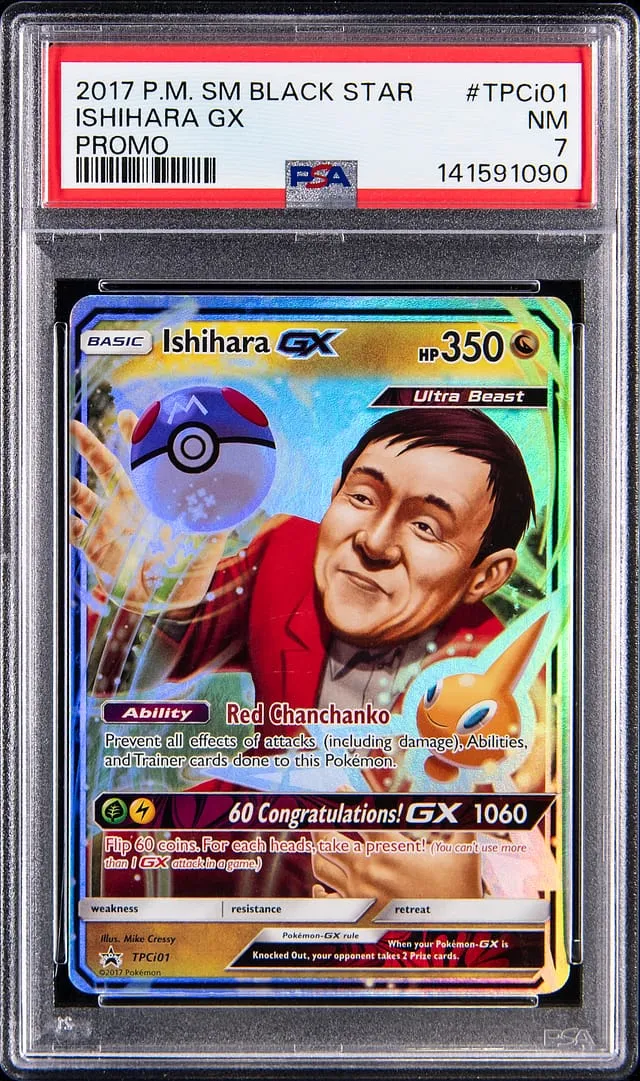
2017 Ishihara GX PSA 7 sells for $54,900 at Goldin
Deep dive on the 2017 Pokémon Ishihara GX Black Star Promo #TPCi01 in PSA 7 that sold for $54,900 at Goldin on May 18, 2026.
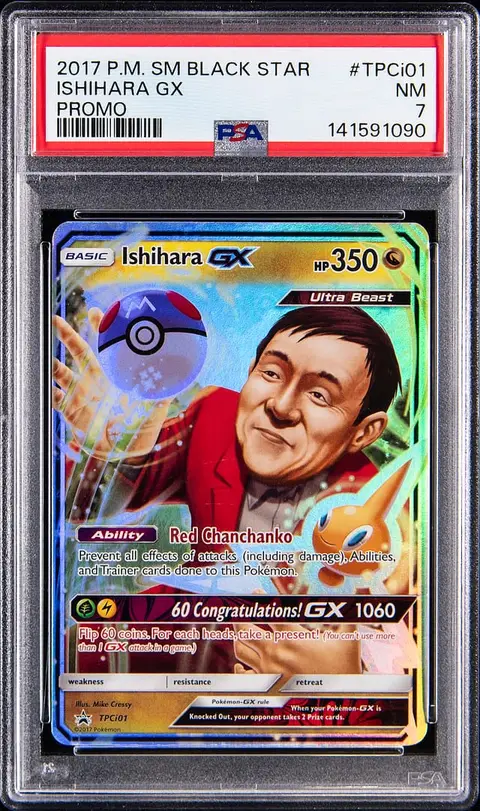
Sold Card
2017 Pokemon Sun & Moon Black Star Promo #TPCi01 Ishihara GX - PSA NM 7
Sale Price
Platform
Goldin2017 Pokémon Sun & Moon Black Star Promo #TPCi01 Ishihara GX in PSA 7 Sells for $54,900
On May 18, 2026, Goldin auctioned a 2017 Pokémon Sun & Moon Black Star Promo #TPCi01 Ishihara GX, graded PSA NM 7, for $54,900. For a niche promo card with no in-game play value, that’s a notable result—and an interesting data point for anyone watching high-end Pokémon memorabilia.
Below is a breakdown of what this card is, why collectors care, and how this sale fits into the broader market picture as of mid‑2026.
Card basics: what exactly sold?
Card: 2017 Pokémon Sun & Moon Black Star Promo #TPCi01 Ishihara GX
Character / Subject: Tsunekazu Ishihara (President & CEO of The Pokémon Company)
Set: Sun & Moon Black Star Promo (SM Black Star Promos)
Card number: #TPCi01
Issue type: Limited promotional card, not a pack-pull, not a traditional gameplay staple
Era: Ultra modern Pokémon (Sun & Moon era, 2017)
Grading details
- Grading company: PSA (Professional Sports Authenticator)
- Grade: PSA 7 (NM – Near Mint)
- Attributes: Standard version of the Ishihara GX promo (no public pack release; distributed privately)
- Autograph: Some known copies exist with on-card Ishihara autograph and separate PSA/DNA or dual authentication; this specific card is described only as “PSA NM 7,” so it’s treated as the non-autographed example.
This isn’t a rookie card in the sports sense, but it is a key issue because it captures a central figure in Pokémon’s history—Tsunekazu Ishihara—on an officially produced Pokémon TCG card.
Origin and distribution: why this promo is unusual
The #TPCi01 Ishihara GX card occupies an unusual space in the Pokémon TCG:
- Internal promo: The card is widely understood to have been distributed internally to staff of The Pokémon Company (TPCi) rather than sold at retail or pulled from packs.
- Anniversary context: It’s associated with celebrations around Ishihara’s 60th birthday, which gives it more of a commemorative feel than a normal promo or set card.
- Non-play aura: While the card has game text and can technically be read like a normal GX card, it functions in the hobby more as a company artifact—part trading card, part executive memorabilia.
In other words, this is closer to a corporate keepsake than a standard promo, which helps explain both the limited population and the strong interest from deep Pokémon collectors.
Population and rarity context
When collectors talk about pop reports (population reports), they mean the number of copies of a card that a grading company has certified at each grade. For a card like Ishihara GX, the pop is meaningfully lower than mass‑produced chase cards from the same era.
Key points about scarcity and grading, based on available public data and typical patterns for this card:
- Low total submissions: Compared with headline chase cards (like Charizard GX or alt arts from later sets), relatively few Ishihara GX promos have been graded. The card wasn’t readily available to the public, so there simply aren’t thousands of raw copies floating around.
- Condition challenges: Many copies were likely handled casually as internal gifts rather than immediately sleeved and top‑loaded. That makes high grades harder to achieve and elevates premiums for PSA 9s and PSA 10s.
- Grade distribution: Public auction records historically show stronger prices scaling up meaningfully by grade, especially for PSA 9 and PSA 10, and even more so for verified Ishihara autographs.
For PSA 7 specifically, we’re in the middle of the pack: a respectable Near Mint copy, but not competing with the top of the census.
Market context: how does $54,900 compare?
To understand this Goldin sale, it helps to look at comps—recent comparable sales of the same card or closely related versions.
Publicly documented highlights for Ishihara GX over the last several years (prior to this 2026 sale) include:
- High-grade and signed copies: Historically, the strongest results have come from PSA 9 or PSA 10 copies, especially those authenticated with Ishihara’s autograph. These have achieved six‑figure sales in the past, reflecting the combination of rarity, subject matter, and signature.
- Mid-grade unsigned copies: PSA 6–8 unsigned examples have generally sold at a significant discount to those signed or in top grades, but still at levels well above typical promo cards. They sit in a narrow niche: limited supply, but also a limited buyer pool that understands what the card represents.
Because auction data can move quickly and not every transaction is public or easily verified, it’s helpful to frame this Goldin result in ranges rather than exact comparisons:
- This sale: $54,900 for a PSA 7 unsigned copy at Goldin on May 18, 2026.
- Relative positioning: It lands below the known six‑figure peaks realized by top‑grade or signed examples, but solidly at the high end for a mid‑grade unsigned promo.
In other words, the price level is consistent with what you’d expect: a meaningful premium to more common promos, a discount to autographed or gem‑mint examples, and right in the range where advanced collectors of Pokémon history tend to compete.
Why collectors care about Ishihara GX
This card attracts a different kind of demand than a standard chase card.
1. A card of the Pokémon CEO
For many collectors, the idea that the president of The Pokémon Company has his own official GX card is inherently interesting. It’s not a Pikachu, Charizard, or Umbreon chase; it’s a snapshot of the person steering the franchise.
That gives the card:
- Historical appeal: It marks a point in Pokémon’s corporate and cultural history.
- Conversation-piece value: It’s instantly recognizable, but also confusing in a fun way to casual observers who have never seen a human character on a Pokémon-GX style card.
2. Corporate and internal card mystique
Cards that originate inside companies—employee gifts, internal promos, or celebration cards—tend to:
- Have smaller print runs than public promos.
- Circulate in a tight circle of insiders before slowly entering the larger hobby.
That dynamic adds to the card’s mystique: it feels more like a trophy from inside The Pokémon Company than just another numbered promo.
3. Ultra modern, but not mass-produced
Although this is an ultra modern card (2017), it doesn’t behave like other 2017 Sun & Moon promos:
- There’s no booster box or blister product you can crack to hunt Ishihara GX.
- The pop is low, and new supply isn’t flowing in at the same rate as pack-pulled cards.
So the market is less about “how many more can we pull?” and more about “how many employee copies will ever surface—and in what condition?”
Interpreting the Goldin sale as a collector
For collectors, sales like this are less about chasing the exact number and more about understanding where the card sits in the hierarchy of Pokémon TCG history.
What this $54,900 result suggests:
- Confirmed demand: There is still a strong collector base willing to pay five figures for mid‑grade, unsigned copies of Ishihara GX. Demand hasn’t evaporated, even as the broader market has gone through cooling and correction phases since the early‑2020s boom.
- Clear grade ladder: The spread between PSA 7 and the known high‑grade and signed copies underlines how sensitive this card is to condition and autograph status. For serious collectors, small steps up the grading ladder correspond to meaningful jumps in price.
- Niche, not speculative: The buyer pool is relatively narrow—primarily collectors who value Pokémon corporate history, unique promos, and long‑term significance more than quick flips.
None of this should be read as financial advice or as a prediction of future prices. It’s a snapshot of how the market valued this specific copy on a specific date at Goldin.
Takeaways for different types of collectors
If you’re new or returning to Pokémon
- Use cards like Ishihara GX as a reference point for how far beyond standard chase cards the Pokémon hobby can stretch.
- You don’t need to chase a five‑figure promo, but understanding why it exists helps you appreciate the ecosystem of promos, staff cards, and niche releases.
If you collect promos and staff/employee cards
- The Ishihara GX remains a cornerstone example of a high‑end, internal-style promo.
- Watching PSA 6–8 results over time can give you context for how the market values condition versus sheer ownership of the card.
If you’re a small seller
- Use this sale not as a benchmark to chase, but as an illustration of how story and origin matter: who issued the card, why it exists, and how many are realistically out there.
- When you list promos or staff cards, clearly explain their origin in plain language; buyers respond to transparent, well‑documented history.
Final thoughts
The 2017 Pokémon Sun & Moon Black Star Promo #TPCi01 Ishihara GX in PSA NM 7 closing at $54,900 at Goldin on May 18, 2026, reinforces the card’s status as one of the most distinctive modern-era Pokémon promos.
It isn’t a traditional chase, and it doesn’t fit neatly into set-building checklists. Instead, it occupies that small category of cards that document the people who shaped the franchise. For collectors focused on Pokémon’s deeper history—not just its monsters—this sale is another data point confirming that Ishihara GX remains a serious, if very specialized, cornerstone of the high‑end promo market.